SDS, TDS & COA for Aerosol Products: A Startup Guide

Guide Contents
- 1. Introduction: Why Technical Documentation is the Backbone of Aerosol Success
- 2. Safety Data Sheet (SDS): Ensuring Operational and Consumer Safety
- 3. Technical Data Sheet (TDS): The Performance Blueprint of Your Aerosol Product
- 4. Certificate of Analysis (COA): The Seal of Quality for Every Batch
- 5. Navigating Indian and Global Standards: Compliance for Startups
- 6. SDS, TDS & COA FAQs for Aerosol Products
Introduction: Why Technical Documentation is the Backbone of Aerosol Success
For any startup or entrepreneur entering the aerosol industry, the complexity of chemical formulation and high-pressure packaging can be daunting. Success in this field is not just about a great fragrance or a powerful lubricant. It is built upon a foundation of rigorous technical documentation that ensures safety, performance, and legal compliance. Without the correct paperwork, a product cannot be legally sold, transported, or even manufactured in a professional facility. Three documents carry that weight for every aerosol product: the Safety Data Sheet (SDS), the Technical Data Sheet (TDS), and the Certificate of Analysis (COA).
Technical documentation serves as the universal language between formulators, manufacturers, regulators, and consumers. It bridges the gap between a lab-scale prototype and a commercially viable product. In the aerosol world, where products contain pressurized gases and flammable solvents, these documents are not just bureaucratic requirements—they are critical safety tools that protect lives and property. They also support the wider framework described in our guide to aerosol can safety.
- Ensures legal compliance with global and local regulatory bodies.
- Provides clear safety protocols for handling, storage, and transport.
- Establishes a baseline for quality control and batch consistency.
- Builds trust with distributors, retailers, and end-users.
- Facilitates seamless international trade by adhering to GHS standards.
The three documents divide the work between hazard communication, product performance, and batch quality, as the comparison below shows.
| Attribute | SDS | TDS | COA |
|---|---|---|---|
| Purpose | Hazard communication and safe handling | Performance, properties, and application guidance | Verification that one batch meets specification |
| Scope | One product formulation | One product line | One production batch |
| Format | 16 sections in a fixed order | No prescribed layout | Batch number, test methods, results, and authorized signature |
| Primary readers | Logistics teams, emergency responders, regulators | Engineers, procurement officers, end users | Quality teams, customers, auditors |
| Basis | Required for hazardous products under GHS-aligned rules such as OSHA HazCom | Set by the manufacturer | Set by customer agreements and quality systems such as ISO 9001 |
The sections below take each document in turn, beginning with the SDS because its format and update rules are the most tightly regulated.
Safety Data Sheet (SDS): Ensuring Operational and Consumer Safety
The Safety Data Sheet (SDS), formerly known as MSDS, is the core hazard communication document for an aerosol product. It provides comprehensive information about a chemical product's properties, physical and environmental hazards, protective measures, and safety precautions for handling, storing, and transporting the product. For aerosols, the SDS must specifically address the risks associated with propellants: hydrocarbon propellants such as propane and butane are flammable, and every propellant is stored under pressure.
A well-drafted SDS follows the Globally Harmonized System (GHS) of Classification and Labelling of Chemicals. This international standard ensures that hazard communication is consistent across borders, which is vital for any startup looking to scale globally. An SDS is divided into 16 sections, each covering specific aspects of the product's profile, from emergency first-aid measures to ecological impact. In the United States, the OSHA Hazard Communication Standard prescribes the same 16 sections in a fixed order.
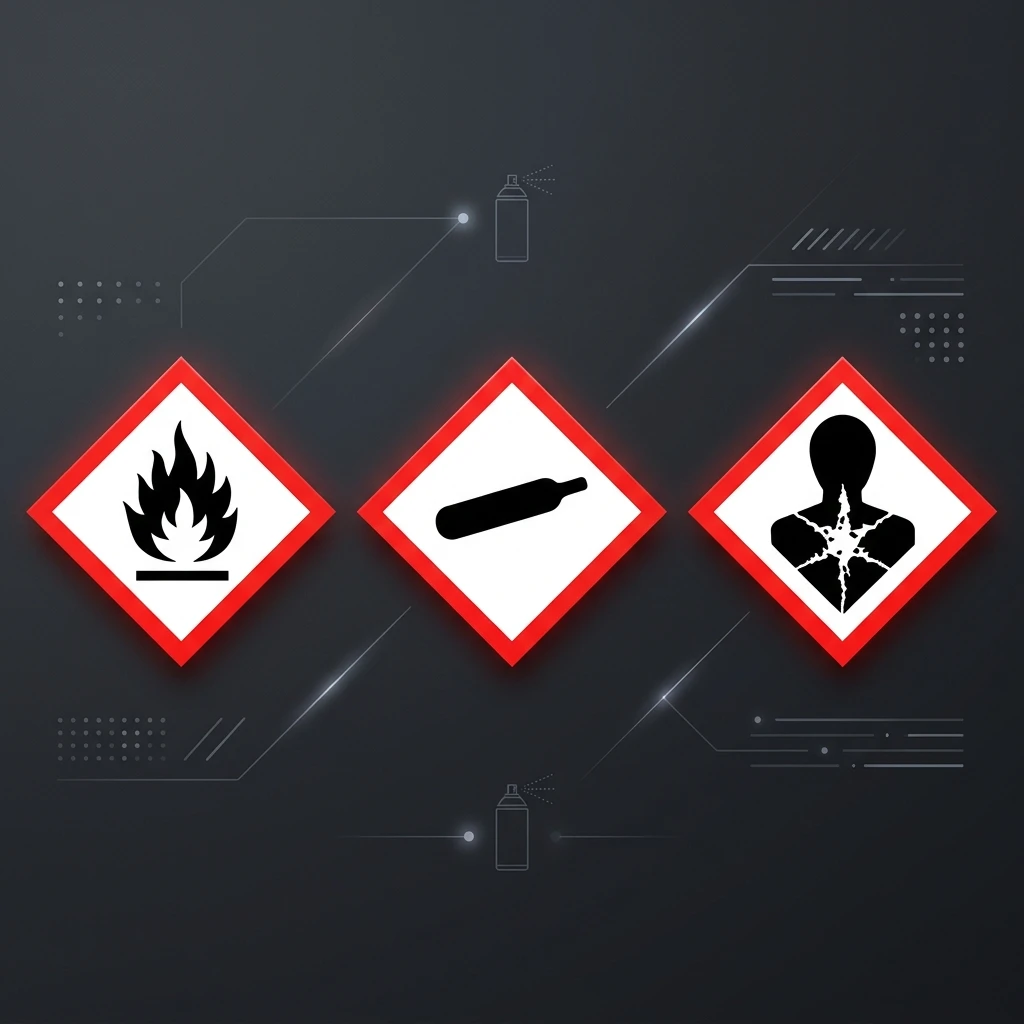
Key Sections of an Aerosol SDS You Must Understand
While all 16 sections are important, Section 2 (Hazard Identification), Section 9 (Physical and Chemical Properties), and Section 14 (Transport Information) carry the most weight for aerosol products. Section 2 states the hazard classification, signal word, hazard statements, and pictograms. Flammable aerosols fall into GHS Category 1 (H222, extremely flammable aerosol) or Category 2 (H223, flammable aerosol), and every aerosol category adds H229, the pressurized-container statement.
Section 9 reports properties such as flash point and vapor pressure, which our guide to flash point explains in depth. Section 14 outlines the UN number (UN 1950 for aerosols) and the shipping classification, following the rules in our guide to DOT and UN aerosol transport regulations. Startups must ensure these sections accurately reflect the specific propellant mix and solvent system used in their formulation.
- Hazard Identification: Lists the pictograms, the signal word ("Danger" or "Warning"), and the hazard statements for the aerosol's GHS category.
- First-Aid Measures: Critical for responding to accidental inhalation or skin contact.
- Handling and Storage: Specifies storage precautions, including the 50 °C maximum temperature that aerosol labels also state; warehouse layouts follow rules such as NFPA 30B storage classification.
- Transport Information: Essential for logistics partners to handle "Limited Quantity" or "Dangerous Goods" shipments.
With the hazard sections in place, the next task is keeping the SDS current as the formulation and the regulations change.
Regulatory Compliance (GHS) and SDS Management
Proper hazard communication is governed globally by the United Nations GHS (Globally Harmonized System). Managing SDS is an ongoing responsibility; these documents must be updated whenever the formulation changes or new toxicological data becomes available. Under OSHA's Hazard Communication Standard, new significant hazard information must be added to the SDS within three months. For entrepreneurs in India, adhering to the GHS framework is increasingly important as Indian regulations align closer with international standards like REACH (EU) and OSHA (USA). Proper SDS management protects the startup from liability and ensures that every stakeholder in the supply chain is aware of the risks.
Technical Data Sheet (TDS): The Performance Blueprint of Your Aerosol Product
While the SDS focuses on safety, the Technical Data Sheet (TDS) is all about performance and application. Think of the TDS as the "product manual" that describes the technical characteristics, benefits, and recommended usage of the aerosol. It is used by procurement officers, engineers, and end-users to determine if the product meets their specific technical requirements for a given task. No GHS or HazCom rule prescribes a TDS layout, so each manufacturer chooses which properties and test results to publish.
A professional TDS highlights the "Engineering" behind the product. For a spray paint, the TDS details drying time and gloss level; for an industrial lubricant, it focuses on load-carrying capacity and temperature range. For startups, a high-quality TDS is a powerful marketing tool that demonstrates technical authority and provides the "reason to believe" for potential high-value clients.

What Goes Into an Aerosol TDS? (Formulation to Finish)
A comprehensive TDS should include physical constants such as density, viscosity of the base liquid, and the type of propellant used. It also specifies the spray pattern (cone, fan, or stream), which the actuator's internal geometry sets as described in aerosol actuators 101, and the delivery rate (grams per second). These metrics are vital for ensuring that the product performs as expected in the hands of the consumer, providing a consistent experience from the first spray to the last.
- Product Description: A clear summary of the product's primary function and target applications.
- Physical Properties: Specific gravity, flash point, pH value, and non-volatile content.
- Application Instructions: Best practices for surface preparation and application distance.
- Performance Metrics: Corrosion resistance, dielectric strength, or antimicrobial efficacy (depending on product type).
A TDS built this way answers a buyer's technical questions before the first sample ships, and the COA then confirms each batch against the same figures.
Certificate of Analysis (COA): The Seal of Quality for Every Batch
The Certificate of Analysis (COA) is a document issued by the Quality Control (QC) department that confirms a specific batch of product meets its technical specifications. Unlike the TDS, which provides general characteristics for the product line, the COA is batch-specific. It contains the actual test results from the laboratory for that particular manufacturing run, providing a paper trail for quality assurance.
For startups, providing a COA with every shipment is a sign of industrial maturity. It proves that the manufacturer is testing every batch for critical parameters like internal pressure, net weight, and active ingredient concentration. Net-weight checks follow the methods in our guide to aerosol fill weight and headspace optimization. Quality systems such as ISO 9001 require documented evidence that each batch conforms before release. In sectors like pharmaceuticals or food-grade aerosols, a COA is non-negotiable and must be archived for several years to satisfy regulatory audits and potential product recalls.
COA vs. TDS: Understanding the Critical Difference
The most common mistake made by new entrepreneurs is confusing the TDS with the COA. While the TDS states what the product should be, the COA states what the product is for a specific batch number. The COA lists the specification range (the acceptable limits) alongside the actual value recorded during testing. It also identifies the batch number, the test method behind each result, and an authorized signature, as summarized in this certificate of analysis overview. This transparency is crucial for troubleshooting if a customer reports a performance failure in the field.
| Parameter | TDS Specification | COA Actual (Batch #102) | Result |
|---|---|---|---|
| Internal Pressure @ 25°C | 4.5 - 5.5 bar | 5.1 bar | Pass |
| Net Content | 400ml ± 5ml | 402ml | Pass |
| Active Ingredient Assay | Approved specification range | Result within range | Pass |
Each row pairs a specification limit with a measured result, so a failed batch traces back to a single parameter.
SDS, TDS & COA FAQs for Aerosol Products
What is the difference between an SDS, a TDS, and a COA for an aerosol product?
The SDS communicates hazards and safe handling in the 16-section GHS format and is required for hazardous chemical products under GHS-aligned rules. The TDS describes performance, physical properties, and application instructions for a product line, and no rule prescribes its layout. Each COA reports the measured test results of one specific batch against the specification limits. Together they cover safety, performance, and quality.
Which SDS sections matter most for an aerosol product?
Section 2 carries the hazard classification, signal word, and hazard statements, including H222 or H223 for flammable aerosols and H229 for the pressurized container. Section 3 declares the propellant and solvent ingredients, and Section 9 reports properties such as flash point and vapor pressure. Transport data appears in Section 14 as the UN 1950 classification, and Section 7 covers storage precautions such as the 50 °C temperature limit.
What is the UN number for aerosols, and why does it appear on the SDS?
Aerosols ship under UN 1950, with the proper shipping name "Aerosols", in Class 2 of the UN Model Regulations for the Transport of Dangerous Goods. Section 14 of the SDS records this classification so carriers and freight forwarders can document the shipment correctly. The Class 2 division depends on the flammability of the aerosol: Division 2.1 covers flammable aerosols and Division 2.2 covers non-flammable, non-toxic ones.
Is a COA required for every batch of aerosol product?
No GHS or HazCom rule requires a COA for general consumer or industrial aerosols, so its use is set by customer agreements and quality systems. Quality systems such as ISO 9001 require documented evidence that each batch conforms before release, and the COA is the standard form of that evidence. For pharmaceutical products, batch release testing under GMP is mandatory, and the COA documents its results.
How often must an SDS be updated?
OSHA's Hazard Communication Standard sets no fixed renewal date, but new significant information about a chemical's hazards or protective measures must be added to the SDS within three months. A formulation change alters the hazard classification data, so it triggers a revision as well. The revised SDS then goes to customers and distributors in the supply chain.
What information appears on an aerosol COA?
An aerosol COA reports batch-specific results for parameters such as internal pressure at a stated temperature, net content, and the assay of the active ingredient. Each result sits beside its specification limit from the TDS. The COA also carries the batch number, the test method behind each result, and an authorized signature. Together these details let a customer trace any result back to one production run.
Need Technical Support for Aerosol Formulations?
Partner with Global Aerosols to audit, scale up, and troubleshoot your aerosol chemistry, canister pressure calculations, filling lines, and safety systems.
Email: consulting@globalaerosols.com
Website: https://www.globalaerosols.com
Phone: +91 9819548320 +91 8169102990
About the Specialist
Absar Khan is the principal consultant and chemical formulation architect at Global Formulation. He possesses cross-disciplinary engineering expertise spanning aerosol gassing systems, pharmaceutical manufacturing, sterile injectables, cosmetics, and green chemical plant setups. Absar leads scientific and engineering advisory teams supporting manufacturers globally in technology selection, GMP layouts, validation frameworks, and regulatory strategies.
LinkedIn Portfolio: Connect with Absar Khan on LinkedIn