Aerosol Filling Line: Crimping, Gassing & Leak Detection

Guide Contents
The production of aerosol products represents a sophisticated intersection of mechanical engineering, fluid dynamics, and stringent safety protocols. Unlike traditional atmospheric liquid filling, an aerosol line must manage pressurized systems where the container itself is a functional part of the delivery mechanism. For startups, students, and entrepreneurs, mastering the technical nuances of the filling line is the difference between a high-performing product and a costly, or even hazardous, manufacturing failure.
As global demand for convenience-driven products rises—from pharmaceutical inhalers to industrial lubricants—the barrier to entry is no longer just the formulation, but the ability to execute a precise, repeatable manufacturing process. This guide provides a deep dive into the four critical pillars of the aerosol filling line, detailing the physics and the engineering standards required for commercial success. By understanding these stages, manufacturers can optimize ROI while ensuring their facility meets rigorous global safety standards.
The filling line is only one part of a wider production system. If you are still evaluating the fundamentals, our overview of how aerosol cans work explains the pressure and valve mechanics assumed here, while Aerosol Manufacturing 101 covers the surrounding plant, compliance and formulation requirements.
Overview of a fully automatic high-speed aerosol filling line
1. Precision Crimping: The Foundation of Pressure Retention
The crimping process is the primary mechanical operation that transforms a metal container into a pressurized delivery system. This stage involves the insertion of the valve into the can's 1-inch (25.4mm) opening, followed by the radial expansion of the valve cup. This expansion creates a permanent, airtight seal against the can’s "curling" or rim. Because the internal pressure of an aerosol can often exceed 5–8 bar at ambient temperature, the integrity of this seal is non-negotiable for shelf-life and consumer safety.
What the crimp actually seals against is the valve gasket, so crimp settings can only be validated alongside the gasket material in use. A gasket that swells in contact with the formulation behaves differently under the same crimp dimensions than one that shrinks, which is why gasket material selection and chemical compatibility is treated as part of the crimp specification rather than a separate decision. Where crimping is set up incorrectly, the resulting defects are the leading contributors to the failure modes described in our guide to why aerosol cans leak.
| Crimp Parameter | Technical Description | Impact of Failure |
|---|---|---|
| Crimp Diameter | The final external measurement of the expanded valve cup within the can opening. | Insufficient diameter leads to "valve blow-out" under high temperatures. |
| Crimp Depth | The vertical distance from the top of the can rim to the engagement point of the crimp. | Incorrect depth causes improper actuator seating or failure to dispense. |
| Gasket Compression | The percentage of deformation (target 15-25%) applied to the valve seal. | Inadequate compression allows micro-leakage of propellant over time. |
These three parameters are interdependent, so they are qualified together rather than one at a time. A crimp that measures correctly on a sectioned sample can still fail in service if tooling wears during the run, which is why dimensional checks are repeated at set intervals rather than only at set-up.
2. Propellant Gassing: The Energetic Component
Once the container is sealed, the propellant—the "engine" of the aerosol—must be introduced. This is achieved through high-pressure injection systems that force the propellant into the can. In modern manufacturing, this is typically done using "Through-the-Valve" (TTV) technology, where the gassing head depresses the valve stem and injects the propellant at pressures higher than the can's internal resistance. For high-volume production, "Under-the-Cup" (UTC) gassing is used, where the propellant is injected just before the crimping head seals the valve.
The practical difference between the two methods is throughput. TTV must push the entire propellant charge through the narrow flow path of the valve stem and dip tube, which sets a hard ceiling on cycle time. UTC bypasses that restriction by dosing propellant into the open can in the fraction of a second before the cup is seated, so it supports far higher line speeds at the cost of more complex tooling and tighter timing tolerances.
Propellant selection governs far more than spray force. It determines the flammability classification of the finished goods, the pressure the crimp must contain across the temperature range, and the solvency environment the gasket will live in. Liquefied hydrocarbon propellants are flammable, and facilities handling them fall under fire and explosion controls such as those published by the National Fire Protection Association. Where propellants are being switched for environmental reasons, the EPA Significant New Alternatives Policy programme lists which substitutes are acceptable for aerosol use. Our comparison of LPG, DME, HFC, nitrogen and CO₂ sets out the trade-offs in detail.
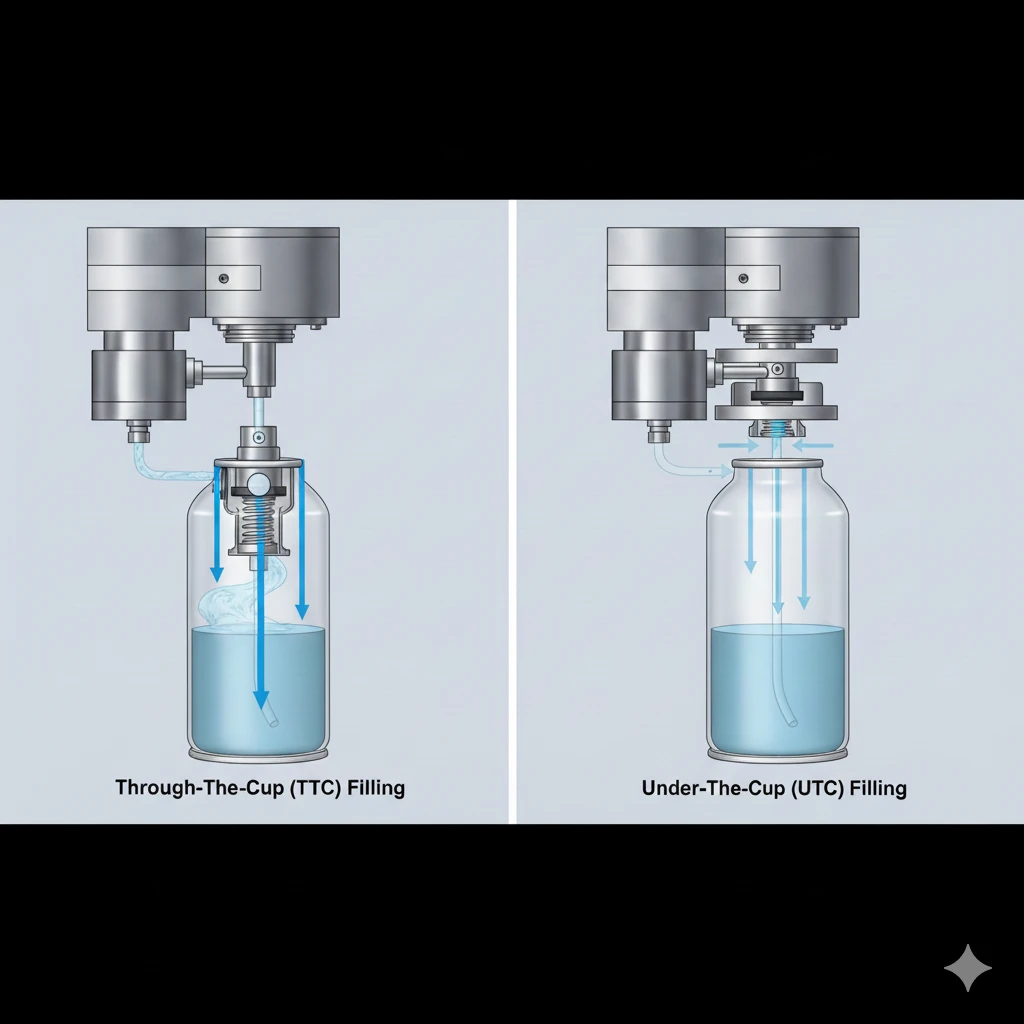
Technical diagram showing the difference between TTV (Through-the-Valve) and UTC (Under-the-Cup) gassing methods
3. Automatic Weight Checking: The Quality Auditor
In an automated aerosol line, the weight check station serves as the final arbiter of success. Because the propellant is injected at high speeds, even a momentary drop in line pressure can result in an under-filled can. Conversely, an over-filled can is a safety hazard, as it may lack the "headspace" required for the propellant to expand if the can is exposed to heat. Modern check-weighers use electromagnetic force restoration to monitor every unit without stopping the production line.
Headspace deserves particular attention because the physics are unforgiving. Liquids are effectively incompressible, so once a can is filled beyond its design level there is no vapour volume left to absorb thermal expansion. Internal pressure then climbs steeply with temperature rather than following the propellant's normal vapour pressure curve. This is why fill level is treated as a safety-critical parameter subject to continuous monitoring, not simply a commercial one.
Because it inspects every unit rather than a statistical sample, the check weigher also doubles as a live process monitor. A slow downward drift in average fill weight points to a gassing pump losing pressure or an injector beginning to block, often long before any can falls outside the reject limit. Treating that trend data as an early warning signal is more valuable than using the station purely as a pass/fail gate.
4. Leak Detection: The Safety Firewall
Aerosol cans are essentially pressure vessels. International transport regulations (such as ADR or DOT) and safety standards (like PESO in India) require that every single can produced be tested for leaks. This "safety firewall" prevents defective units from entering the supply chain, protecting both the consumer and the brand's reputation.
The reference method is the hot water bath. Filled cans travel on a conveyor through heated water while operators or vision systems watch for escaping bubbles, and the same immersion simultaneously proves the can withstands elevated temperature without bursting. The EU Aerosol Dispensers Directive 75/324/EEC requires that the contents reach 50 °C during this test. Aerosols also travel as dangerous goods under UN 1950, and the packaging and pressure requirements for that classification are set out in the UN Model Regulations; our guide to DOT and UN aerosol transport rules explains how these obligations apply to a finished batch.
A bath test only catches leaks large enough to bubble within the residence time of the conveyor. Slower micro-leaks that develop over weeks are found instead through statistical weight-loss studies on retained samples, where cans are weighed repeatedly over a storage period. Running both controls together is what separates a line that ships reliably from one that passes end-of-line testing and still generates field complaints months later.

A high-speed electronic leak detection tunnel with digital monitoring screens
Frequently Asked Questions
What is the most common cause of aerosol leaks?
How do I choose between LPG and nitrogen as a propellant?
What is the difference between TTV and UTC gassing?
Why does an aerosol can need headspace?
How is every aerosol can tested for leaks in production?
What does a check weigher detect on an aerosol line?
Need Technical Support for Aerosol Formulations?
Partner with Global Aerosols to audit, scale up, and troubleshoot your aerosol chemistry, canister pressure calculations, filling lines, and safety systems.
Email: consulting@globalaerosols.com
Website: https://www.globalaerosols.com
Phone: +91 9819548320 +91 8169102990
About the Specialist
Absar Khan is the founder and lead aerosol consultant at Global Aerosols. He possesses cross-disciplinary engineering expertise spanning aerosol gassing systems, crimping and filling line design, propellant handling, GMP facility layout, and regulatory compliance. Absar leads scientific and engineering advisory teams supporting manufacturers globally in technology selection, GMP layouts, validation frameworks, and regulatory strategies.
LinkedIn Portfolio: Connect with Absar Khan on LinkedIn