Aerosol Actuators 101: Design, Spray Patterns, and Industrial Applications
Guide Contents
- 1. What Is an Aerosol Actuator?
- 2. Why Aerosol Actuators Are Critical to Product Performance
- 3. How Aerosol Actuators Work
- 4. Types of Aerosol Actuators
- 5. Spray Patterns and Atomization Behavior
- 6. Key Design Parameters in Aerosol Actuators
- 7. Common Problems Caused by Incorrect Actuator Selection
- 8. Industrial Applications of Aerosol Actuators
- 9. How to Choose the Right Aerosol Actuator
- 10. Manufacturing and Customization of Aerosol Actuators
- 11. Regulatory and Quality Considerations
- 12. Frequently Asked Questions
- 13. External Technical References
- 14. Explore the Aerosol Ecosystem Further
Aerosol actuators are one of the most underestimated components in an aerosol system, yet they play a decisive role in how a product performs in real-world use. While cans, valves, propellants, and formulations receive significant attention, the actuator is the final interface between the internal aerosol system and the user. Its design directly controls spray pattern, discharge rate, droplet size, and directional accuracy.
From industrial spray paints and automotive cleaners to pharmaceuticals and personal care aerosols, actuator engineering determines whether a product feels precise, wasteful, safe, or unreliable. This article provides a technically accurate explanation of aerosol actuators, focusing on their design, working principles, spray behavior, and industrial relevance.
What Is an Aerosol Actuator?
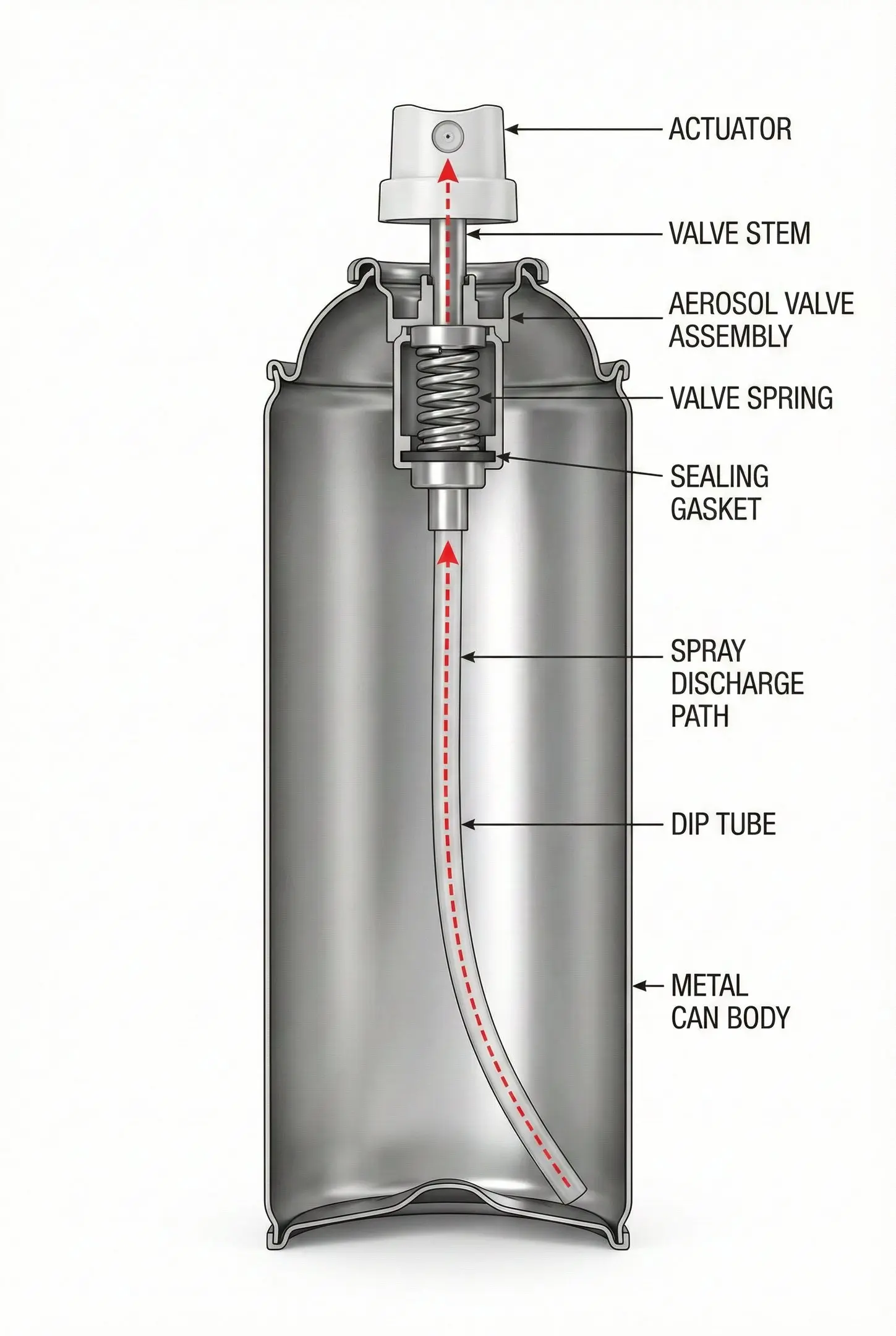
An aerosol actuator is the molded plastic component mounted on the valve stem that a user presses to release product from an aerosol container. Its primary function is to mechanically open the valve while simultaneously shaping and directing the discharge of the pressurized formulation. Without an actuator, controlled dispensing of aerosol contents is not possible.
Although often perceived as a simple external button, the actuator is a precision-engineered fluid-handling device. Its internal geometry determines how liquid and propellant interact at the point of discharge, converting stored pressure energy into a controlled spray, stream, or foam. The actuator only makes sense in the context of the complete pressurized delivery system — see our guide to how aerosol cans work for how propellant pressure and valve mechanics combine with the actuator to produce a spray.
- Interfaces directly with the aerosol valve stem
- Controls spray direction, flow rate, and atomization
- Acts as the final delivery component in the aerosol system
Why Aerosol Actuators Are Critical to Product Performance
The actuator governs real-world product behavior regardless of formulation quality or propellant selection. Two aerosol products with identical cans, valves, propellants, and formulations can perform very differently solely due to actuator design. This makes the actuator a performance-critical component rather than a cosmetic accessory.
From a commercial and regulatory standpoint, actuator performance influences user satisfaction, material efficiency, safety, and compliance. Inadequate actuator selection commonly results in customer complaints, product returns, or regulatory scrutiny. Actuator selection is one part of the broader discipline covered in our aerosol technology and formulations resource, which addresses how delivery components interact with formulation chemistry across the full product system.
- Uniformity and consistency of spray
- Material utilization and overspray control
- User safety and directional accuracy
How Aerosol Actuators Work
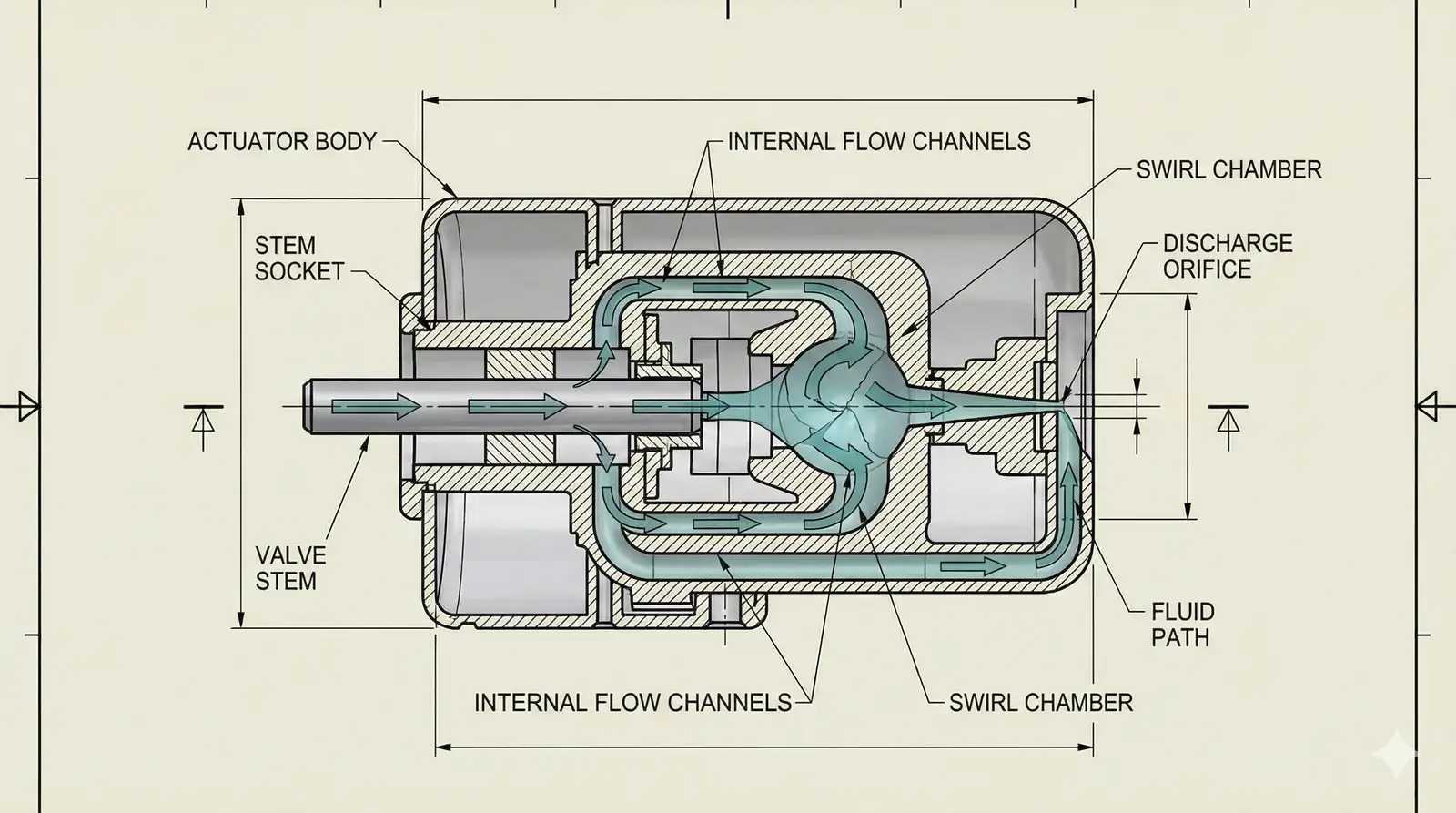
Aerosol actuators operate by transmitting mechanical force from the user’s finger to the valve stem, opening the valve and allowing pressurized contents to flow upward. Once inside the actuator, the formulation passes through internal channels, expansion regions, and orifices that control velocity and atomization.
The interaction between actuator geometry, propellant pressure, formulation viscosity, and valve flow rate determines whether the discharge appears as a fine mist, coarse spray, foam, or solid stream. The stem socket seal is equally dependent on the valve's own gasket and sealing components — see our guide to aerosol valve gasket materials for how elastomer selection affects the seal the actuator engages with.
- Stem socket that engages the valve stem
- Internal flow channels and swirl chambers
- Discharge orifice controlling exit velocity
Types of Aerosol Actuators
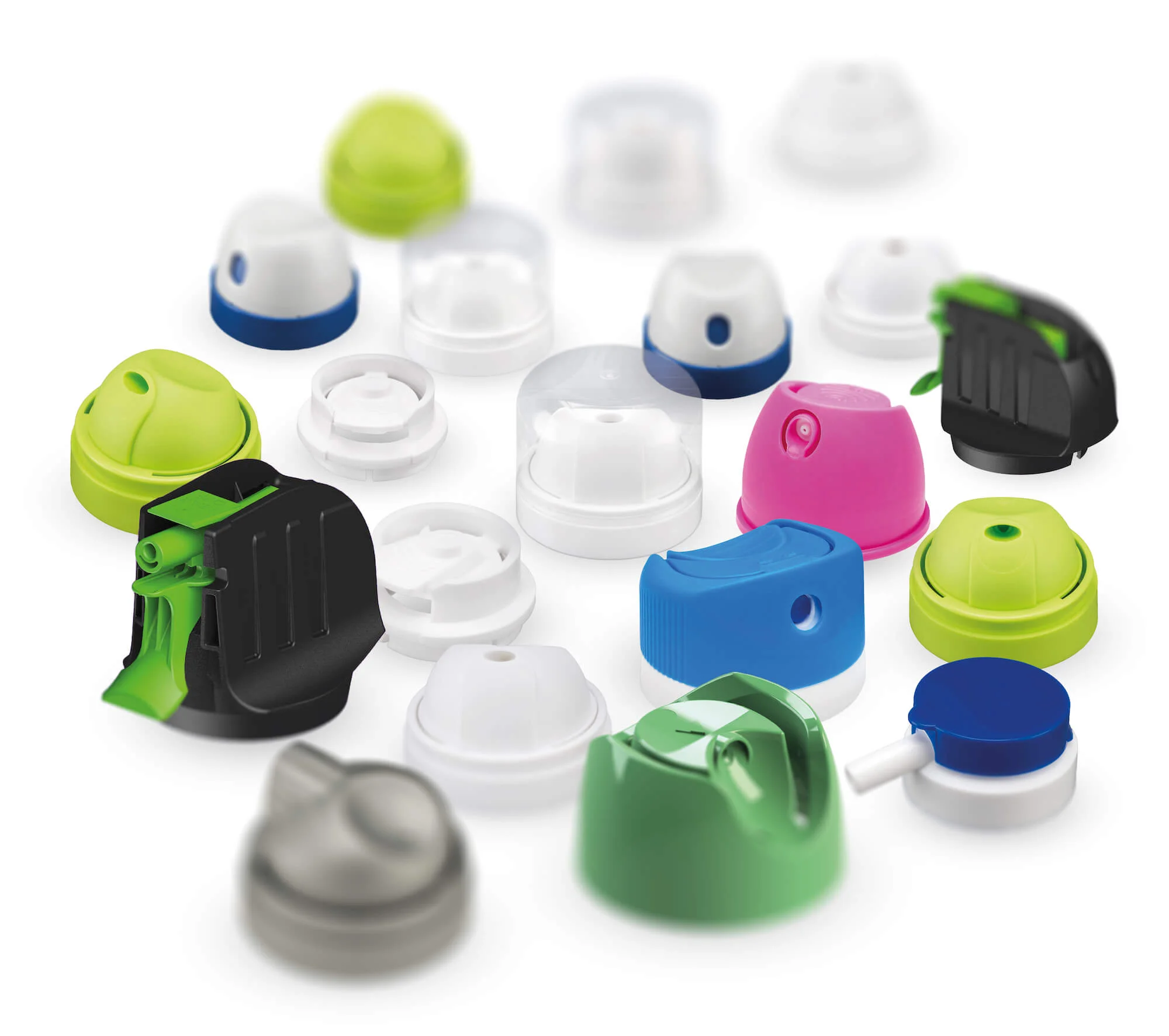
Aerosol actuators are classified according to the type of discharge they produce and the application they are designed to serve. Each actuator type incorporates specific internal geometries to match formulation properties and end-use requirements. Selection must always consider the entire aerosol system rather than the actuator in isolation.
Different industries rely on different actuator categories to achieve required spray characteristics, safety features, and regulatory compliance. Actuator type selection follows the same system-level logic used to classify the aerosol product itself — see our guide to types of aerosol systems for how solution, emulsion, and bag-on-valve systems each place different demands on actuator design.
| Actuator Type | Spray Characteristic | Typical Application |
|---|---|---|
| Standard spray | Cone spray, moderate droplet size | General-purpose sprays, cleaners, coatings |
| Foam / mousse | Structured foam discharge | Shaving foams, hair mousse, cleaning foams |
| Stream / jet | Solid stream, minimal atomization | Precision cleaning, penetrating lubricants |
| Metered-dose | Fixed, repeatable dose volume | Pharmaceutical and other regulated dosing products |
| Specialty (inverted / locking) | Application-specific geometry | Child-resistant or inverted-use products |
Spray Patterns and Atomization Behavior
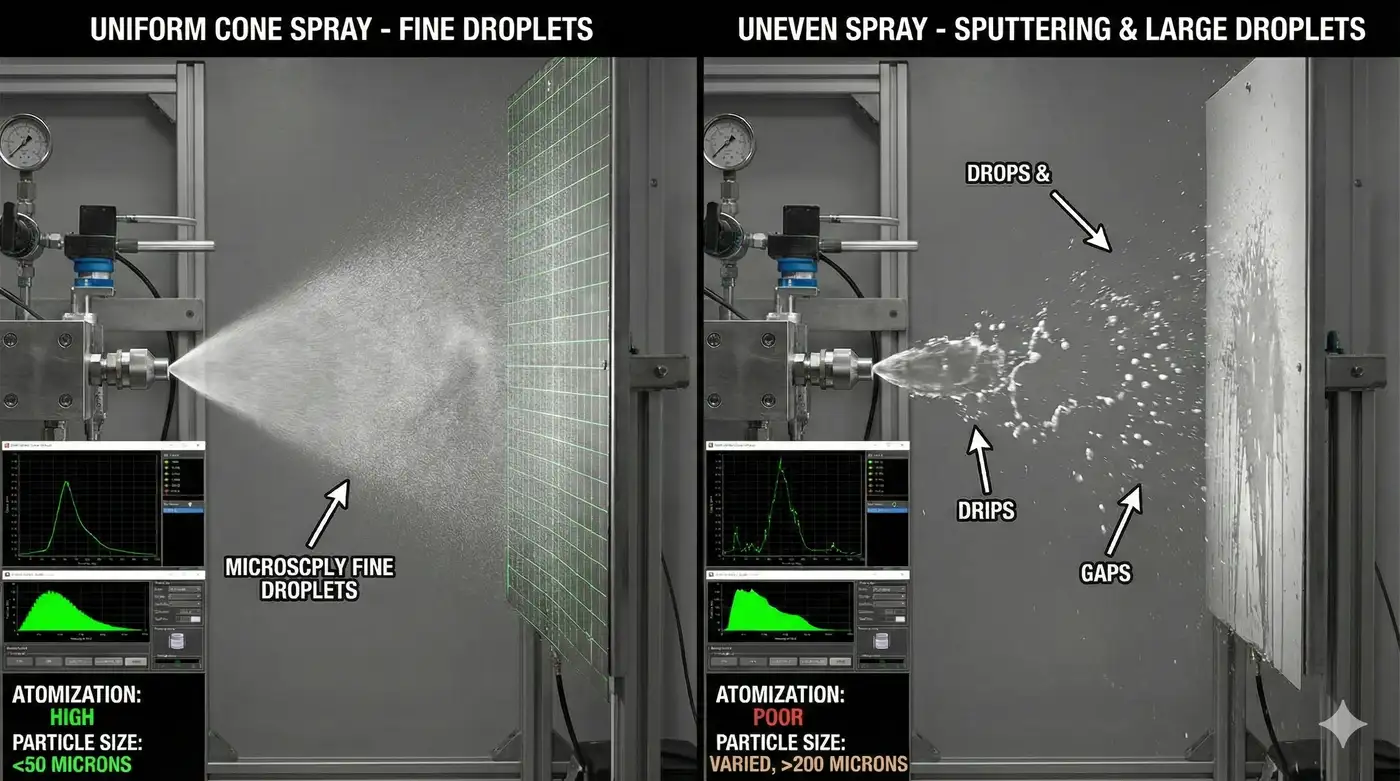
Spray pattern formation is governed primarily by actuator orifice size, swirl chamber geometry, and discharge velocity. The actuator converts pressurized liquid into droplets by forcing it through narrow passages where velocity increases and pressure drops. This controlled disruption results in atomization.
Spray patterns directly affect coverage efficiency, material consumption, and safety. Wide fan sprays are typically used for coatings, while narrow streams are preferred for precision cleaning. Propellant vapor pressure is the other half of the atomization equation — see our comparison of aerosol propellants for how LPG, DME, HFC, N₂, and CO₂ each drive different discharge energy at the actuator. Spray pattern and delivery rate are quantified using standardized test methods maintained by ASTM International, which allow formulators to compare actuator performance objectively rather than by subjective visual inspection.
- Cone spray (wide or narrow)
- Hollow cone spray
- Solid stream or jet
- Structured foam discharge
Key Design Parameters in Aerosol Actuators
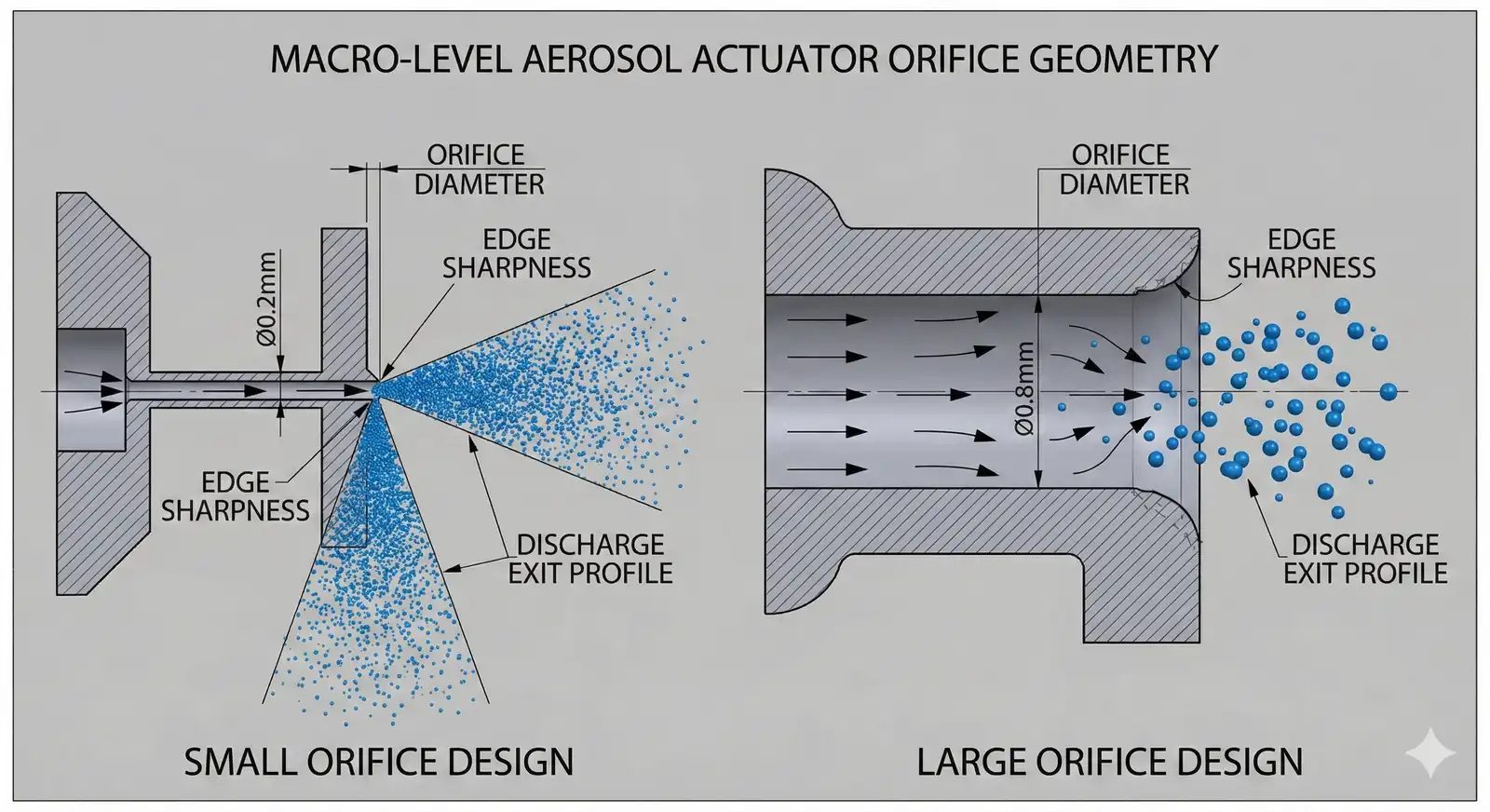
The actuator orifice is the most critical flow‑controlling feature within an aerosol actuator and directly determines discharge rate, spray pattern, droplet size distribution, and atomization efficiency. The orifice is the final restriction point through which the pressurized formulation exits the actuator, and its diameter, length, edge sharpness, and surface finish govern fluid velocity and pressure drop at the point of release. Smaller orifices increase exit velocity and promote finer atomization but raise the risk of clogging, pressure sensitivity, and flow instability, especially with high‑viscosity or particulate‑containing formulations. Larger orifices reduce shear forces, producing coarser sprays or streams with higher mass flow rates, commonly used for cleaners, lubricants, and jet applications. Orifice geometry must always be engineered in conjunction with valve flow rate, propellant vapor pressure, and formulation rheology to achieve stable, repeatable spray performance across the full life of the can.
Actuator performance is defined by precise dimensional and material choices made during design and tooling. Even small changes in orifice diameter or chamber depth can significantly alter flow rate and spray quality. This is why actuator tooling is treated as a critical engineering asset rather than a generic mold. Because propellant type also governs the pressure and vapor energy available at the orifice, actuator geometry cannot be finalized in isolation — see our analysis of propellant influence on aerosol performance for how vapor pressure and atomization physics interact with actuator design.
Material selection is equally important, as actuators must resist chemical attack, stress cracking, and dimensional deformation over time.
- Orifice diameter and shape
- Swirl chamber depth and angle
- Polymer type (typically polypropylene or polyethylene)
Common Problems Caused by Incorrect Actuator Selection
Incorrect actuator selection is a frequent root cause of aerosol product failures, especially in startups and first-time manufacturers. These failures are often misattributed to formulation or propellant issues when the actuator is actually responsible.
Most actuator-related issues only become visible during real-use testing, making early pilot trials essential. Spray paint aerosols are especially sensitive to actuator-formulation mismatch — see our breakdown of failures in aerosol spray paints for real-world examples of how orifice selection and formulation viscosity interact to cause spatter, clogging, or uneven coverage.
- Clogging due to incompatible orifice size
- Excessive overspray or misting
- Dripping or post-spray leakage
- Inconsistent discharge over can life
Industrial Applications of Aerosol Actuators
Aerosol actuators are application-specific components tailored to industrial, consumer, and regulated markets. Each sector demands different performance characteristics, safety features, and compliance standards. As a result, actuator design varies significantly across industries.
Understanding these application differences is essential when developing products for multiple markets.
- Spray paints and coatings: wide fan or controlled cone sprays
- Automotive and industrial cleaners: directional streams or aggressive sprays
- Pharmaceuticals: metered-dose and regulatory-compliant actuators
- Personal care: fine mist or foam actuators
How to Choose the Right Aerosol Actuator
Choosing the correct actuator requires a system-level approach that considers formulation rheology, propellant type, valve flow rate, and intended use conditions. There is no universal actuator that works across all products, and copying actuator designs without testing often leads to failure.
Pilot testing under realistic conditions is the only reliable way to validate actuator suitability before commercial launch.
- Formulation viscosity and solids content
- Propellant pressure and type
- Required spray pattern and discharge rate
- User ergonomics and safety requirements
Manufacturing and Customization of Aerosol Actuators
Aerosol actuators are typically manufactured by injection molding using high-precision tooling. Tool design directly affects dimensional consistency, surface finish, and long-term performance. For high-volume products, even minor tooling defects can lead to large-scale quality failures.
Custom actuators are justified when standard designs cannot meet performance, branding, or regulatory requirements.
- Multi-cavity injection molding
- Tight dimensional tolerances
- Tool maintenance and validation
- Custom branding or geometry where required
Regulatory and Quality Considerations
While actuators themselves are often considered secondary components, they are subject to quality and safety expectations, especially in regulated markets such as pharmaceuticals and medical devices. Dimensional stability, material traceability, and batch consistency are essential.
Inconsistent actuator quality can compromise dosing accuracy, spray reproducibility, and product safety.
- Incoming inspection and dimensional checks
- Material compliance and traceability
- Functional testing with valves and formulations
Frequently Asked Questions
What is the function of an aerosol actuator?
An aerosol actuator is the molded component mounted on the valve stem that a user presses to open the valve and dispense the pressurized formulation. It shapes and directs the spray by forcing the fluid through internal channels and a discharge orifice, converting stored propellant pressure into a controlled mist, stream, or foam.
How does orifice size affect aerosol spray performance?
The actuator orifice is the final restriction the formulation passes through before release, and its diameter governs exit velocity and atomization. Smaller orifices raise fluid velocity and produce finer droplets but increase susceptibility to clogging and pressure sensitivity, while larger orifices lower velocity and shear, producing coarser sprays or streams with higher mass flow rates.
What materials are aerosol actuators made from?
Aerosol actuators are almost universally injection-molded from polypropylene or polyethylene because both polymers resist chemical attack from common propellants and solvents, maintain dimensional stability under repeated valve-stem loading, and tolerate the stress-cracking risk posed by hydrocarbon propellants such as LPG and DME.
What causes an aerosol actuator to clog?
Clogging commonly results from an orifice diameter too small for the formulation's viscosity or particulate content, from dried residue accumulating in the discharge channel between uses, or from an actuator-formulation pairing that was not validated during pilot testing. Incoming inspection and functional testing with the actual formulation catch this risk before commercial launch.
Why do different aerosol products use different actuator types?
Actuator geometry must match both the formulation's physical properties and the application's performance requirements. A wide fan spray suits coatings that need broad, even coverage, a narrow stream suits precision cleaning or lubrication, and a metered-dose actuator suits pharmaceutical products where a fixed, repeatable dose volume is a regulatory requirement.
Can an aerosol actuator be used with any valve or can?
No. Actuator selection must account for the valve's stem diameter and flow rate, the propellant's vapor pressure, and the formulation's viscosity, since these factors jointly determine spray pattern and discharge rate. Copying an actuator design from another product without validating it against the specific valve and formulation combination is a common cause of aerosol product failures.
External Technical References
- European Aerosol Federation (FEA)
- Packaging Europe – Aerosol Technology
- U.S. Consumer Product Safety Commission
Explore the Aerosol Ecosystem Further
Aerosol actuators are only one part of a complex, interdependent system that includes cans, valves, propellants, formulations, and manufacturing processes. A clear understanding of the complete aerosol ecosystem is essential for developing safe, compliant, and commercially successful products.
- How Aerosol Cans Are Manufactured
- Aerosol Can Safety: Pressure, Burst Tests & DOT Rules
- Aerosol Manufacturing 101
- How Aerosol Cans Work
- Aerosol Propellants Explained
- Aerosol Chemistry 101
- From Lab to Commercial Launch
- Choosing the Right Aerosol Product Consultant
Need Technical Support for Aerosol Formulations?
Partner with Global Aerosols to audit, scale up, and troubleshoot your aerosol chemistry, canister pressure calculations, filling lines, and safety systems.
Email: consulting@globalaerosols.com
Website: https://www.globalaerosols.com
Phone: +91 9819548320 +91 8169102990
About the Specialist
Absar Khan is the principal consultant and chemical formulation architect at Global Formulation. He possesses cross-disciplinary engineering expertise spanning aerosol gassing systems, pharmaceutical manufacturing, sterile injectables, cosmetics, and green chemical plant setups. Absar leads scientific and engineering advisory teams supporting manufacturers globally in technology selection, GMP layouts, validation frameworks, and regulatory strategies.
LinkedIn Portfolio: Connect with Absar Khan on LinkedIn