CARB Aerosol VOC Regulations: Limits by Category & Reformulation Strategies
CARB aerosol VOC regulations are limits set by the California Air Resources Board on the volatile organic compound content of aerosol consumer products sold in California, expressed as a maximum weight percent by product category. They work by capping the share of a formulation — including propellant — that can consist of reactive VOCs, forcing manufacturers to select lower-reactivity solvents, alternative propellants, or reformulated actives. This matters for aerosol manufacturers because California's limits are frequently the strictest in the US market and are widely adopted by other states, meaning CARB compliance often functions as the de facto national reformulation target.
What Is the CARB Consumer Products Regulation?
The California Air Resources Board regulates VOC emissions from consumer products, including aerosols, under its Consumer Products Regulation, a framework built to reduce ground-level ozone precursor emissions across California's air basins. VOCs react with nitrogen oxides in the presence of sunlight to form ozone, and consumer products — cleaners, personal care aerosols, automotive products, and coatings among them — have been documented as a meaningful, non-mobile source of VOC emissions in state air quality inventories. CARB's authority to regulate stricter than federal standards flows from a specific waiver under the federal Clean Air Act, a legal basis distinct from EPA's own national aerosol coatings VOC program.
- Regulating body: California Air Resources Board (CARB)
- Legal basis: Clean Air Act waiver permitting California-specific standards
- Scope: Consumer products sold, supplied, offered for sale, or manufactured for use in California
- Mechanism: Category-specific maximum VOC content limits, expressed as weight percent
Because California represents one of the largest single consumer product markets in the country, and because a number of other states adopt CARB limits through Ozone Transport Commission model rules, the practical reach of the regulation extends well beyond California's borders. Any manufacturer distributing nationally needs a working understanding of the regulatory and safety landscape that CARB sits within before finalizing a formulation intended for broad US distribution.

Comparison of reformulated aerosol product samples during VOC content evaluation, illustrating how propellant and solvent choice change measured VOC weight percent.
VOC Limits by Aerosol Product Category
CARB's Consumer Products Regulation does not apply a single VOC limit across all aerosol products — it defines dozens of individual product categories, each with its own limit and formal category definition, reflecting differences in typical formulation chemistry, function, and usage volume. Correctly classifying a product into its CARB-defined category is the essential first step in any compliance assessment, since an air freshener, a multi-purpose lubricant, and a hairspray are each measured against a different ceiling. The table below illustrates representative category types; exact current numeric limits must always be confirmed against the live CARB regulation text, since limits are periodically tightened.
| Category Type | Typical Formulation Chemistry | Regulatory Consideration |
|---|---|---|
| Aerosol air fresheners | Fragrance oils, solvent carriers, hydrocarbon or compressed gas propellant | Among the most tightly limited categories due to high sales volume |
| Personal care aerosols (hairspray, deodorant) | Polymers, actives, alcohol or hydrocarbon carrier systems | Distinct sub-limits for hairspray vs. general personal care |
| Multi-purpose lubricants | Base oils, penetrants, hydrocarbon propellant | Higher typical limit reflecting functional solvent requirements |
| Aerosol coatings / spray paints | Resins, pigments, solvent blends | Regulated under a related but separate Aerosol Coatings Regulation |
| Disinfectants and cleaners | Actives, surfactants, aqueous or solvent carriers | Often subject to dual EPA/CARB oversight where pesticidal claims apply |
Formulators entering a new aerosol product category should treat category definition as a compliance question in its own right, not an assumption — CARB's category definitions are based on labeled use and marketed function, and misclassifying a product does not exempt it from the correct limit. For manufacturers building a new product line, our Aerosol Manufacturing 101 guide covers how formulation and regulatory classification decisions interact from the earliest development stage.
How VOC Content Is Calculated
VOC content under the CARB regulation is generally calculated as the weight percent of the total finished product — concentrate plus propellant — that consists of compounds meeting the regulatory definition of a volatile organic compound. This is a critical distinction for aerosols specifically: unlike a pump-spray or trigger-spray liquid product, an aerosol's propellant is part of the calculation, and hydrocarbon propellants such as isobutane, propane, and butane are themselves classified as VOCs. A formulation that would pass as a non-aerosol liquid product can therefore require different treatment once packaged as an aerosol, because propellant weight is often a substantial fraction of total fill weight.
CARB-Exempt Compounds
CARB maintains a specific list of compounds exempted from the VOC definition on the basis that they have negligible photochemical reactivity in ozone formation, even though they may be organic and volatile in a general chemical sense. Formulators sometimes substitute a portion of a reactive solvent with a CARB-exempt compound to lower the calculated VOC percentage without removing solvent function entirely, but this exemption list is a living regulatory document, not a fixed reference, and must be checked against the current version before being relied upon in a compliance calculation.
Reformulation Strategies for CARB Compliance
Bringing an aerosol formulation under its CARB category limit typically requires working across three variables together — propellant system, solvent chemistry, and exempt-compound substitution — rather than adjusting a single ingredient in isolation. Propellant substitution toward compressed gases such as nitrogen or carbon dioxide removes a hydrocarbon VOC contributor entirely, though it changes spray characteristics and can require valve and actuator redesign, a trade-off covered in depth in our guide to compressed gas vs liquefied gas aerosol systems. Partial hydrocarbon-to-compressed-gas hybrid systems are also used where full replacement is not functionally viable.
- Propellant substitution: Replacing or partially replacing hydrocarbon propellant with compressed gas (N₂, CO₂)
- Solvent substitution: Replacing reactive solvents with CARB-exempt low-reactivity compounds where chemically compatible
- Active loading reduction: Reformulating actives or carrier ratios to reduce total solvent demand per unit performance
- Water-based reformulation: Shifting a portion of the formulation to an aqueous base where product performance allows
Reformulation decisions also interact directly with a product's flammability classification, since reducing hydrocarbon propellant content can shift a product's flash point and DOT/CARB flammability category. Our flash point guide explains how these thresholds are determined and why they should be reassessed after any propellant-driven VOC reformulation, not assumed unchanged.

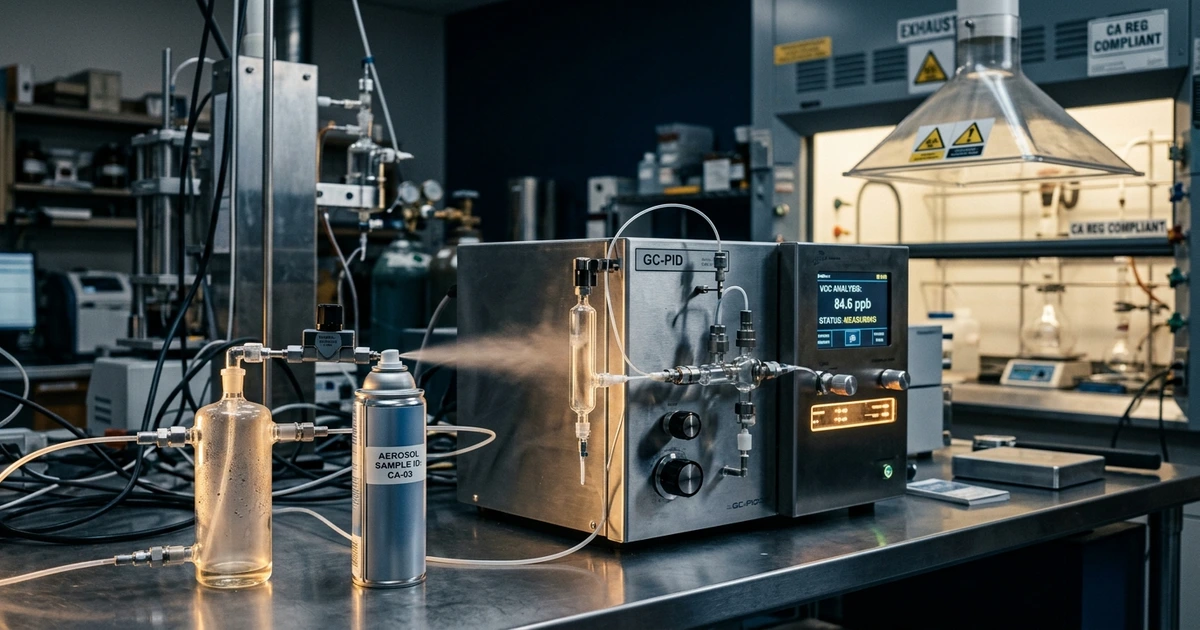
VOC content testing apparatus used to verify aerosol formulation compliance against CARB category-specific limits before market release.
CARB vs Federal EPA and Other State VOC Rules
CARB regulations operate alongside, not in place of, federal VOC oversight, and the two frameworks are not interchangeable for compliance purposes. The US EPA's national Aerosol Coatings VOC program establishes a federal floor for spray paint and coating products specifically, while CARB's broader Consumer Products Regulation covers a much wider range of aerosol categories and, for most of them, sets a stricter limit than any federal equivalent. A product that satisfies the EPA national standard is not automatically compliant in California.
- Federal EPA: Sets national VOC limits primarily for aerosol coatings under 40 CFR Part 59
- CARB: Sets California-specific limits across a far broader range of consumer product categories, generally stricter
- OTC states: Multiple Northeastern and other US states adopt CARB limits directly via Ozone Transport Commission model rules
Because a growing number of states outside California apply CARB's own limits through OTC adoption, many manufacturers treat CARB compliance as the practical national reformulation baseline rather than a California-only requirement. Consult the CARB Aerosol Coatings Regulation program page directly for the current text governing spray paint and coating VOC limits, since this sits as a related but separate rule from the general Consumer Products Regulation.
Compliance Documentation & Enforcement
Demonstrating CARB compliance requires more than a passing formulation — manufacturers must be able to produce calculation records showing how the declared VOC content was determined, including raw material VOC data for every component and the finished product's propellant fraction. This documentation typically lives alongside a product's safety data sheet and technical data sheet, and should be retained and kept current whenever a formulation changes, since even a supplier-side raw material change can shift calculated VOC content without any deliberate reformulation decision on the manufacturer's part.
Selling a noncompliant aerosol product in California carries real enforcement exposure — civil penalties, mandatory reformulation, distribution restriction, or recall are all within CARB's enforcement toolkit, and because OTC states mirror CARB limits, a single noncompliant SKU can create liability across a multi-state footprint rather than California alone. Teams moving a formulation from lab-scale development into commercial production should build VOC compliance verification into the standard release checklist described in our lab-to-commercial launch guide, rather than treating it as a late-stage check performed only before the first California shipment. For a wider view of how VOC rules compare across regions beyond the US, see our companion guide on global aerosol VOC regulations.
Frequently Asked Questions
What is CARB and why does it regulate aerosol VOC content?
Are CARB aerosol VOC limits the same as federal EPA limits?
How is VOC content calculated for an aerosol product under CARB rules?
Which propellants help reduce VOC content in a CARB-compliant aerosol?
Do exempt solvents count toward the VOC limit?
What happens if an aerosol product exceeds its CARB VOC limit?
Does CARB regulate all aerosol product categories the same way?
How often do CARB VOC limits change?
Is reformulating for CARB compliance the same as reformulating for EU VOC rules?
Need Expert Aerosol Consulting?
Our team provides end-to-end aerosol technical consultancy — from formulation development and propellant selection to filling line setup, regulatory compliance, and market launch strategy.
Get a Free Consultation