EU Aerosol Dispensers Directive 75/324/EEC: Testing, Labeling & CE Marking
Guide Contents
- 1. Scope of the EU Aerosol Dispensers Directive
- 2. EU Aerosol Pressure Testing Requirements
- 3. Aerosol Labeling Under EU Regulation
- 4. CE Marking and the Reversed Epsilon Symbol
- 5. Flammability Classification & CLP Alignment
- 6. Compliance Documentation & Market Surveillance
- 7. Frequently Asked Questions
The EU aerosol dispensers directive, formally Directive 75/324/EEC, is the harmonized European law governing the design, pressure testing, filling, and labeling of aerosol dispensers placed on the EU market. It works by setting mandatory technical construction standards and conformity marking requirements that every aerosol manufacturer or importer must satisfy before a product can be legally sold in EU member states. This matters for aerosol manufacturers because non-compliance blocks market access entirely and exposes companies to regulatory enforcement, making early compliance planning essential for any product destined for Europe.
Scope of the EU Aerosol Dispensers Directive
Directive 75/324/EEC applies to any non-reusable container made of metal, glass, or plastic that is filled with compressed, liquefied, or dissolved gas, and fitted with a release device that discharges its contents as a spray, foam, paste, or powder. This broad definition captures cosmetic aerosols, household cleaning sprays, industrial lubricants, paints, and technical products alike, spanning nearly every category of aerosol manufactured for the EU market.
Certain product categories fall outside the directive's direct scope and are instead governed by separate, more specific EU frameworks. Medicinal aerosols, such as metered dose inhalers, are regulated under pharmaceutical legislation, while cosmetic-specific ingredient safety and claims are governed by the EU Cosmetics Regulation. Manufacturers producing multi-category products, such as a cosmetic aerosol, must therefore satisfy both the aerosol dispensers directive for container and pressure compliance and the relevant product-category regulation for formulation and labeling claims. For a broader view of how EU rules interact with cosmetic aerosol formulation, see our cosmetics and personal care aerosols guide.
Understanding this scope early in product development prevents costly redesign later. Manufacturers exporting into the EU from outside markets should map their product portfolio against the directive's definitions before finalizing container specifications, as detailed further in our aerosol manufacturing 101 guide.
EU Aerosol Pressure Testing Requirements
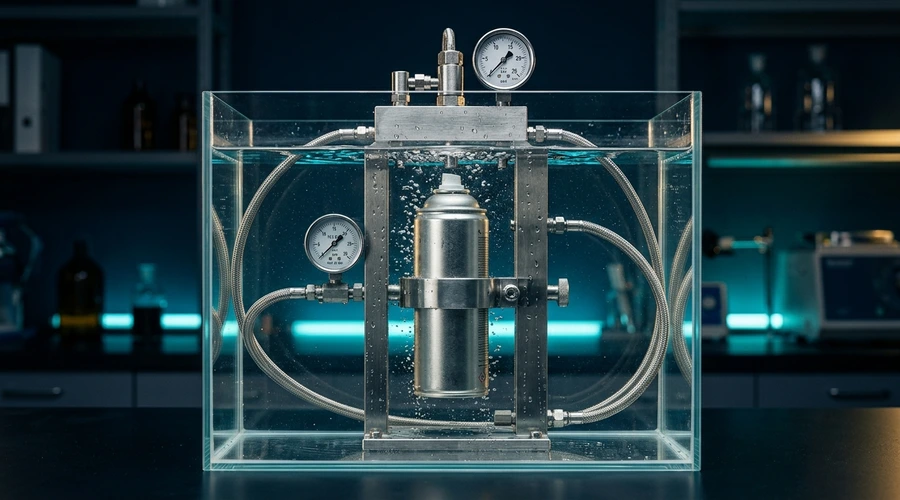
EU aerosol pressure testing is central to demonstrating compliance with Directive 75/324/EEC, since container integrity under thermal stress is the primary safety concern for pressurized dispensers. The directive requires filled containers to be immersed in a hot water bath maintained at 50°C for a specified duration, verifying that the container does not leak, distort, or burst under the elevated internal pressure this temperature produces. This test simulates realistic worst-case storage and transport conditions, such as a vehicle interior or warehouse exposed to summer heat.
Alongside the hot water bath test, manufacturers must verify that the internal pressure of the filled container at 50°C remains within defined limits relative to the container's rated burst pressure, ensuring an adequate safety margin. These limits vary based on container material and construction, with metal aerosol cans, glass containers, and plastic dispensers each subject to specific design and pressure thresholds under the directive's technical annexes.
| Test Parameter | Requirement Under 75/324/EEC | Purpose |
|---|---|---|
| Hot Water Bath Test | Immersion at 50°C for defined hold period | Verifies no leakage, distortion, or bursting under thermal stress |
| Internal Pressure at 50°C | Must remain within container-rated safety margin | Confirms adequate margin below burst pressure |
| Fill Ratio Verification | Liquid phase must not fully occupy container at 50°C | Prevents hydraulic overpressure from thermal expansion |
Manufacturers seeking the underlying pressure test methodologies referenced across international aerosol standards can consult ASTM International, whose test methods for aerosol fill and pressure characteristics are frequently cross-referenced during EU compliance testing. For a detailed breakdown of how burst pressure testing protocols compare across jurisdictions, see our guide on aerosol burst pressure testing.
Aerosol Labeling Under EU Regulation
Aerosol labeling EU regulation requirements under Directive 75/324/EEC work alongside the CLP Regulation (Classification, Labelling and Packaging), which implements the Global Harmonized System within the EU. Every compliant aerosol label must display the reversed epsilon conformity symbol, the net content by volume, and precautionary statements specific to pressurized containers, including warnings against exposure to heat above 50°C, puncturing, and incineration even when empty.
Beyond the directive-specific pressure warnings, labels must carry GHS hazard pictograms and signal words corresponding to the product's classification under CLP, covering flammability, health hazards, and environmental hazards where applicable. Precautionary (P-statement) and hazard (H-statement) codes must be printed in the official language(s) of each EU member state where the product is sold, which often requires multi-language label variants for pan-European distribution. To understand the full pictogram and statement system referenced here, see our guide on GHS and HazCom labeling for aerosol products.

CE Marking and the Reversed Epsilon Symbol
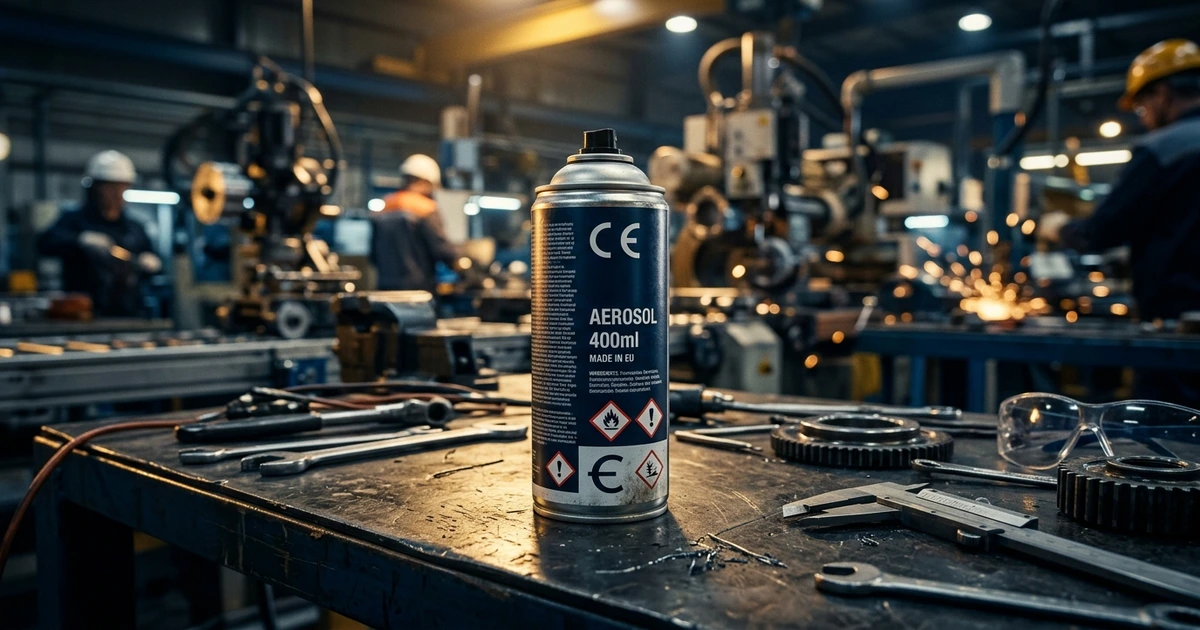
A common point of confusion for manufacturers new to the EU market is CE marking aerosol product expectations. Unlike most consumer product categories that carry the standard CE mark under general EU product safety law, aerosol dispensers compliant with Directive 75/324/EEC instead display the reversed epsilon symbol — a stylized "3" or reversed "E" mark — as their conformity indicator. This symbol certifies that the container's design, filling process, and pressure testing satisfy the directive's technical requirements.
The reversed epsilon mark is a legal declaration by the manufacturer or importer that the aerosol dispenser has undergone the required design verification and testing procedures. It must appear clearly and permanently on the container, typically alongside the net content declaration, and cannot be substituted with a general CE mark, since the aerosol dispensers directive operates as a distinct, self-contained conformity system within EU product law.
Flammability Classification & CLP Alignment
Flammability classification under the EU aerosol framework is determined through standardized ignition testing that measures flame projection distance, flashback distance, and the presence of flammable components above defined concentration thresholds. Based on these results, products are classified as non-flammable, flammable, or extremely flammable, a tiering system that determines which hazard pictograms and precautionary statements must appear on the finished label under the CLP Regulation.
This classification also has downstream implications beyond labeling, directly influencing warehouse storage segregation and transport documentation. Products classified as extremely flammable under the EU framework typically align with the highest hazard tiers used in warehouse fire protection standards, meaning formulation choices made for EU flammability classification often echo requirements seen in storage codes elsewhere. For a comparison of flammability-driven storage classification, see our guide on NFPA 30B warehouse storage classification. Formulators evaluating solvent and propellant flash point data during EU classification testing can reference the ECHA CLP Regulation portal directly.
Compliance Documentation & Market Surveillance
European aerosol directive compliance requires manufacturers or the entity placing the product on the EU market to maintain comprehensive technical documentation, including pressure test results, formulation flammability data, container specification sheets, and quality control records from the filling process. This documentation must be retained and made available to national market surveillance authorities upon request, forming the evidentiary basis for the reversed epsilon conformity declaration.
Market surveillance authorities across EU member states can conduct spot checks on aerosol products already in circulation, and non-compliant products can be subject to recall or sales prohibition. Given the cross-border nature of EU distribution, a single compliance failure can trigger enforcement action across multiple member states simultaneously, making thorough documentation practices a critical part of any European market entry strategy. For guidance on the full documentation package expected during regulatory review, see our resource on understanding SDS, TDS, and COA for aerosol products. The full legal text of the directive itself is published on EUR-Lex.
Frequently Asked Questions
What products does the EU Aerosol Dispensers Directive 75/324/EEC cover?
Directive 75/324/EEC covers all aerosol dispensers placed on the EU market, meaning any non-reusable container made of metal, glass, or plastic, filled with compressed, liquefied, or dissolved gas, fitted with a release device that discharges its contents as a spray, foam, paste, or powder. This includes cosmetic, household, industrial, and technical aerosol products, though certain categories such as medicinal aerosols are regulated under separate pharmaceutical directives.
What pressure testing is required under the EU aerosol dispensers directive?
The directive requires that aerosol dispensers withstand a hot water bath test at 50°C for a minimum period without leaking, distorting, or bursting, verifying that internal pressure at that elevated temperature stays within the container's design limits. Manufacturers must also verify that the filled container's internal pressure at 50°C does not exceed 12 bar for most metal containers, with specific limits varying by container material and construction.
Does an aerosol product need CE marking under 75/324/EEC?
Aerosol dispensers that comply with Directive 75/324/EEC carry the reversed epsilon symbol on the label rather than the CE mark used for most other product categories under EU law. This symbol certifies that the dispenser meets the directive's design, filling, and testing requirements, and it is a mandatory conformity marking for aerosol products legally placed on the EU market.
What labeling information is mandatory on an EU-compliant aerosol can?
Mandatory labeling includes the reversed epsilon conformity symbol, flammability classification symbols where applicable, precautionary statements regarding pressurized containers (such as warnings against puncturing, heat exposure, and disposal), the net content by volume, and GHS hazard pictograms and signal words corresponding to the product's classification under the CLP Regulation.
How does the EU aerosol directive classify flammability for labeling purposes?
Flammability classification under the directive follows criteria based on flame projection distance during ignition testing, flashback distance, and the presence of flammable components exceeding defined thresholds. Products are classified as non-flammable, flammable, or extremely flammable, with each tier requiring corresponding GHS pictograms and precautionary statements under the CLP Regulation, which implements GHS within the EU.
Who is responsible for demonstrating compliance with 75/324/EEC before market placement?
The manufacturer or, for imported products, the entity placing the aerosol dispenser on the EU market bears responsibility for demonstrating compliance. This includes maintaining technical documentation covering pressure test results, formulation flammability data, and quality control records, which must be available for inspection by EU market surveillance authorities.
Need Expert Aerosol Consulting?
Our team provides end-to-end aerosol technical consultancy — from formulation development and propellant selection to filling line setup, regulatory compliance, and market launch strategy.
Related Articles
- Aerosol Burst Pressure Testing ISO and DOT proof pressure protocols explained.
- SDS, TDS & COA Documentation The startup's guide to aerosol documentation.
- Aerosol Manufacturing 101 The ultimate guide to commercial aerosol manufacturing.
- How Aerosol Cans Work Explore valve, pressure, and actuator physics.
- Aerosol Propellants Explained LPG vs DME vs HFC vs N₂ vs CO₂ propellants compared.
- Aerosol Chemistry 101 Solvents, binders, surfactants, and additives.
- From Lab to Commercial Launch R&D scale-up to commercial aerosol production.
- Choosing a Product Consultant How to select the right technical expert.
Absar Khan
Founder & Lead Aerosol Consultant, Global Aerosols
Absar Khan is a senior aerosol industry consultant with deep expertise spanning aerosol formulation, propellant technology, valve engineering, filling line setup, and regulatory compliance across global markets. His work integrates aerosol chemistry, GMP manufacturing practices, safety and flammability assessment, quality systems, and regulatory strategy for markets including India, the EU, and the US. As Founder and Lead Consultant at Global Aerosols, Absar leads technical and engineering teams delivering end-to-end aerosol solutions — from initial formulation and lab trials through pilot-scale testing, commercial manufacturing setup, and full market launch.
Connect on LinkedIn →