Aerosol Air Freshener Dispersion & Odour Control Guide

Guide Contents
An in-depth technical guide to aerosol air freshener dispersion, covering the physics of atomization, molecular odour neutralization, and the manufacturing engineering required for high-performance air care products.
Introduction to Air Care Engineering
The air care sector represents a high-growth segment in both consumer FMCG and commercial facility management markets. Developing an aerosol air freshener requires balancing fast solvent evaporation with uniform fragrance droplet suspension under pressure. Manufacturers must also integrate active odour neutralizers rather than relying on masking scents alone. The sections below take these design objectives in turn.
In the modern FMCG landscape, the aerosol air freshener has evolved from a simple fragrance delivery system into a sophisticated piece of chemical engineering. For manufacturers and entrepreneurs entering the manufacturing business, success is no longer dictated solely by fragrance choice, but by the technical efficiency of the delivery mechanism. Understanding the interplay between formulation chemistry and aerosol physics is critical for creating products that stand out in a competitive global market. Our aerosol technology and formulations hub covers both subjects.
The primary goal of any air care product is to provide a consistent, long-lasting sensory experience while effectively managing environmental malodours. This requires a deep understanding of formulations that can maintain stability under pressure and achieve specific dispersion characteristics upon actuation. As the industry moves towards more specialized solutions, the technical demands on formulators continue to increase, requiring a balance of chemical stability and mechanical precision.
Furthermore, the global shift toward sustainability and safety has forced a re-evaluation of traditional aerosol components. Brands that navigate the complexities of low-VOC regulations while maintaining the high-performance "dry" spray that consumers demand hold a real technical edge. This introductory guide serves as a foundation for understanding the science that drives this global industry and how technical excellence translates into a stronger competitive position.
- The Growing Market for Aerosol Air Fresheners: Increasing urbanization and consumer awareness of indoor air quality are driving continued growth in the global air care market, particularly in emerging economies like India.
- Why Dispersion Matters for Consumer Satisfaction: A product that leaves large droplets or a "wet" fallout fails to meet premium consumer expectations; fine atomization is the hallmark of quality.
- Innovation and Positioning: Proprietary odour control technologies and advanced valve systems give formulators a basis for premium positioning.
- The Entrepreneurial Opportunity: For startups, the air freshener segment offers a high-volume entry point into the aerosol industry, provided they prioritize technical formulation and safety.
With those four drivers established, the next section turns to how the spray itself is formed.
The Mechanics of Aerosol Dispersion
Aerosolized air fresheners rely on micro-atomization physics to project fragrance molecules across an indoor space. Liquefied gas propellants break the concentrate into a fine mist that stays suspended instead of settling and wetting surfaces. Understanding these atomization mechanics is key to configuring the valve orifices and actuator style. The paragraphs and bullets below cover the variables that govern mechanical dispersion.
At the heart of every aerosol air freshener is the process of atomization—the physical breakdown of a liquid formulation into a fine mist of droplets. This process is governed by the principles of fluid dynamics. It is influenced by the internal vapor pressure of the container, the surface tension of the liquid, and the precise geometry of the actuator's orifice. For any serious manufacturing business, achieving the correct droplet size distribution (DSD) is paramount for ensuring that the fragrance remains suspended in the air for an optimal duration. This provides a consistent sensory experience. Our guide to aerosol particle size distribution measurement explains how DSD is measured.
Droplet size is measured in microns (micrometers). Under Stokes' law, settling velocity rises with the square of droplet diameter. A large droplet therefore falls quickly onto furniture and flooring and leaves visible residue, while a fine droplet stays airborne. At the fine end, the US EPA notes that particles 10 microns or smaller can enter the lungs, and some reach deep into them. This raises safety and regulatory concerns for room sprays. Mastering this balance requires careful selection of valve components and propellant types to keep the spray "dry" yet effective.
The engineering of the actuator is equally critical. Mechanical breakup actuators force the liquid through tangential channels into a swirl chamber before it exits the final orifice. Our guide to aerosol actuator design covers this geometry in detail. The resulting high-velocity vortex shatters the liquid stream more efficiently than a standard orifice alone. This level of technical precision separates premium products from budget alternatives and supports brand loyalty.

Visualization of atomization mechanics: How pressure differentials and valve geometry dictate particle dispersion patterns.
- Atomization Dynamics: The sudden drop in pressure as the formulation exits the can causes the dissolved propellant to flash-boil, which provides the energy necessary to overcome the liquid's surface tension.
- The Role of Propellants in Particle Distribution: Liquefied propellants like LPG (Liquefied Petroleum Gas) or DME (Dimethyl Ether) provide a constant internal pressure, ensuring the spray characteristics remain consistent from the first use to the final drop. Our DME propellant guide covers the second in detail.
- Valve and Actuator Design for Optimal Spray Patterns: Advanced actuators with specialized "swirl chambers" are essential for achieving the fine, misty dispersion expected in high-end air care products.
- Viscosity and Surface Tension Management: The solvent system must be carefully tuned to allow for rapid breakup without compromising the stability of the fragrance oil within the formulation.
Technical Comparison of Dispersion Systems
When planning an air freshener product line, selecting the right propellant and valve combination is a central decision for the formulator. Each system offers distinct advantages in terms of cost, performance, and environmental impact. Below is a comparison of the most common systems used in the professional air care industry today.
| System Type | Propellant Behaviour | Flammability | Primary Application |
|---|---|---|---|
| Continuous Spray (LPG) | Liquefied propellant; constant pressure from first use to last | Flammable | General Air Freshening & Household Use |
| Metered Dose (DME) | Liquefied propellant; constant pressure with polar solvency | Flammable | Automatic Timed Dispensers & Professional Care |
| Compressed Air/N2 | Compressed gas; pressure declines as the can empties | Non-flammable | Eco-friendly/Water-based Sustainable Products |
| Dual Compartment (BOV) | Product isolated from the propellant inside a bag | Depends on propellant used | High-End Pure Fragrance Applications |
Whichever system is chosen, droplet size distribution is confirmed by measurement on the finished product.
Odour Control Science: Beyond Masking
Modern commercial air fresheners rely on chemical neutralization rather than heavy perfumes to manage stubborn odours. Malodour counteractants chemically bind with organic sulfur and nitrogen compounds in the air, neutralizing their volatility. This molecular neutralization ensures clean, long-lasting freshness in restrooms, kitchens, and industrial spaces. The comparison table and bullets below set out the primary odour control technologies.
While early air fresheners relied heavily on high concentrations of fragrance to "mask" or overpower unpleasant smells, modern odour control science focuses on the molecular neutralization of malodours. This involves the use of specialized chemical agents that react with or encapsulate foul-smelling molecules at the source. Common malodours such as mercaptans, amines, and sulphides have specific chemical structures that can be targeted by advanced neutralizers, effectively removing them from the air rather than just hiding them.
Technical expertise in this area involves selecting the right neutralizers that are compatible with the overall formulations and the aerosol delivery system. Ingredients like zinc ricinoleate, which acts as a molecular "trap" for sulfur and nitrogen-based odours, or cyclodextrins, which are ring-shaped sugar molecules that encapsulate malodours, are industry standards. Each cyclodextrin ring has a hydrophobic interior and a hydrophilic exterior, so it forms complexes with hydrophobic compounds while staying soluble in water. These compounds must be integrated with precision to ensure they do not interfere with the fragrance performance or cause clogging in the valve system.
Furthermore, "pairing" techniques let formulators select fragrance notes that complement the chemical neutralizers rather than compete with them, reinforcing the sense of freshness after the malodour molecules are captured. This dual approach—combining chemical neutralization with fragrance pairing—separates a premium air care product from one that relies on masking alone.
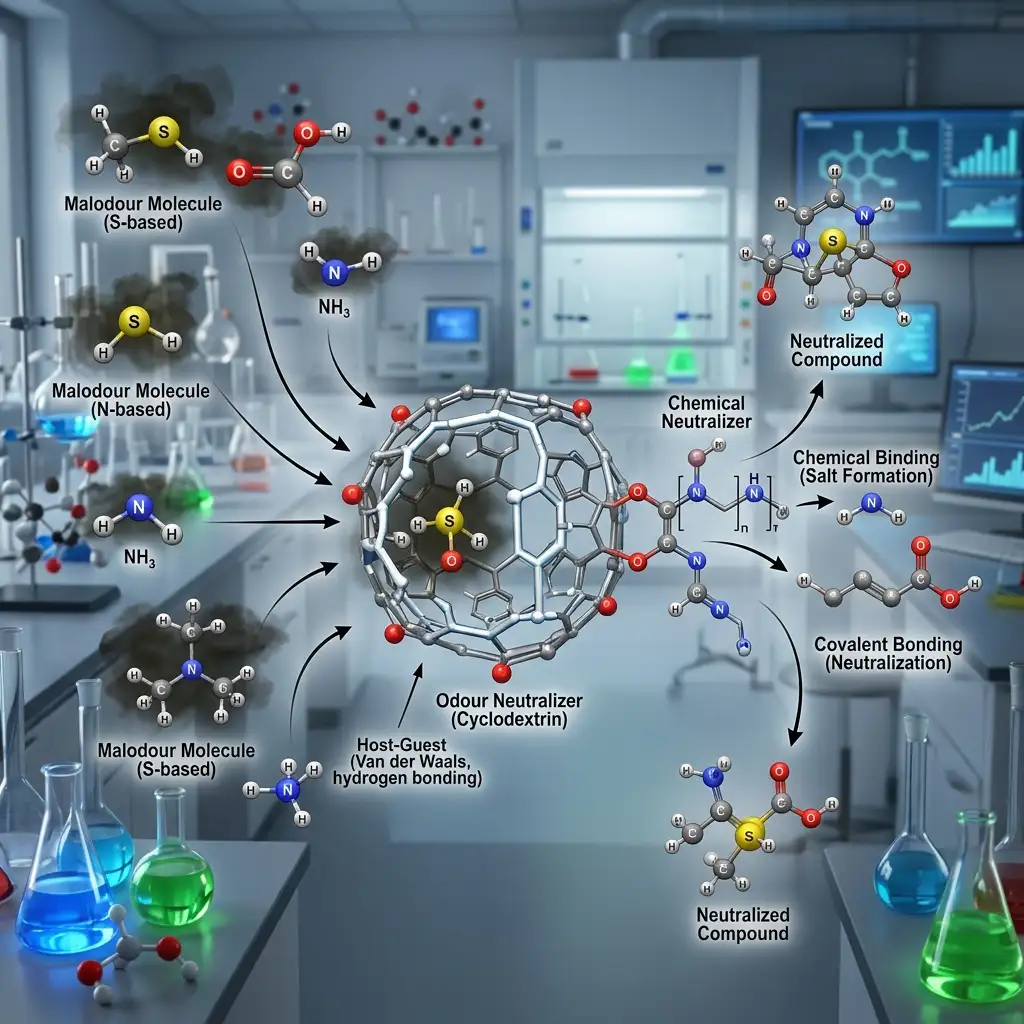
Molecular Neutralization: Specialized compounds interacting with malodour molecules to eliminate rather than mask scents.
The three approaches to a malodour act on the odour molecule in different ways, as the table shows.
| Approach | Mechanism | Target |
|---|---|---|
| Fragrance masking | Overpowers perception with a stronger scent while the malodour molecules stay in the air | Any malodour, temporarily |
| Zinc ricinoleate | Acts as a molecular trap for the malodour molecule | Sulfur- and nitrogen-based odours |
| Cyclodextrins | Ring-shaped sugar molecules encapsulate the malodour in a hydrophobic cavity | Hydrophobic malodour compounds |
- Molecular Odour Neutralization vs. Fragrance Masking: Masking is a temporary sensory trick, while neutralization captures the malodour molecule through chemical binding or encapsulation.
- The Chemistry of Odour Counteractants: Utilizing compounds with reactive functional groups allows for the efficient capture of airborne volatiles through covalent bonding or strong physical adsorption.
- Long-Lasting Fragrance Delivery Systems: Techniques such as fragrance encapsulation or the use of heavy-base solvents can extend the longevity of the desired scent post-neutralization, increasing consumer value.
- Malodour Specificity: Neutralizers are "tuned" to target specific environments, such as kitchen odours, bathroom malodours, or tobacco smoke.
With the odour chemistry defined, the next section covers building a formulation that keeps these actives stable in the can.
Formulation Considerations for Manufacturers
Formulating air care aerosols involves selecting compatible solvents, active counteractants, propellants, and packaging liners. Because water-based formulas are prone to container rust, developers must integrate specific corrosion inhibitors and choose the right metal can type. Stabilizing the fragrance oil under pressure prevents nozzle clogging and sputtering. The paragraphs and bullets below cover these formulation considerations.
Creating a high-performance aerosol air freshener requires a rigorous, multi-disciplinary approach to formulations. The development chemist must ensure that the fragrance oil remains completely miscible in the solvent and propellant blend across a wide range of temperatures. Any phase separation within the can will lead to "spitting," inconsistent fragrance delivery, or even complete valve failure. Solvents such as ethanol, Isopropyl Alcohol (IPA), or specialized glycols are used to bridge the gap between oil-based fragrances and liquefied propellants.
In the manufacturing business, the choice between solvent-based and water-based systems is a critical strategic decision. Solvent-based systems offer superior atomization and faster drying times, which are preferred for premium "dry" sprays. However, water-based systems are increasingly popular due to their lower cost, reduced flammability, and compliance with strict VOC (Volatile Organic Compound) regulations in many international markets. In California, CARB's consumer products program addresses VOC emissions from chemically formulated consumer products, and our guide to CARB aerosol VOC limits covers reformulation strategies. Managing the corrosion risks in water-based systems requires the addition of sophisticated inhibitors and the use of internal can coatings. Our two-part series on can corrosion (Part 1 and Part 2) explains the mechanisms.
Quality control during the filling process is another essential pillar of success. Each batch must be tested for pressure consistency, leakage (via water bath or electronic leak detection), and spray rate. For startups and students looking to enter this field, understanding these validation steps is just as important as the chemistry itself. Technical accuracy in every step of the process ensures that the product performs safely and effectively in the hands of the end-user.
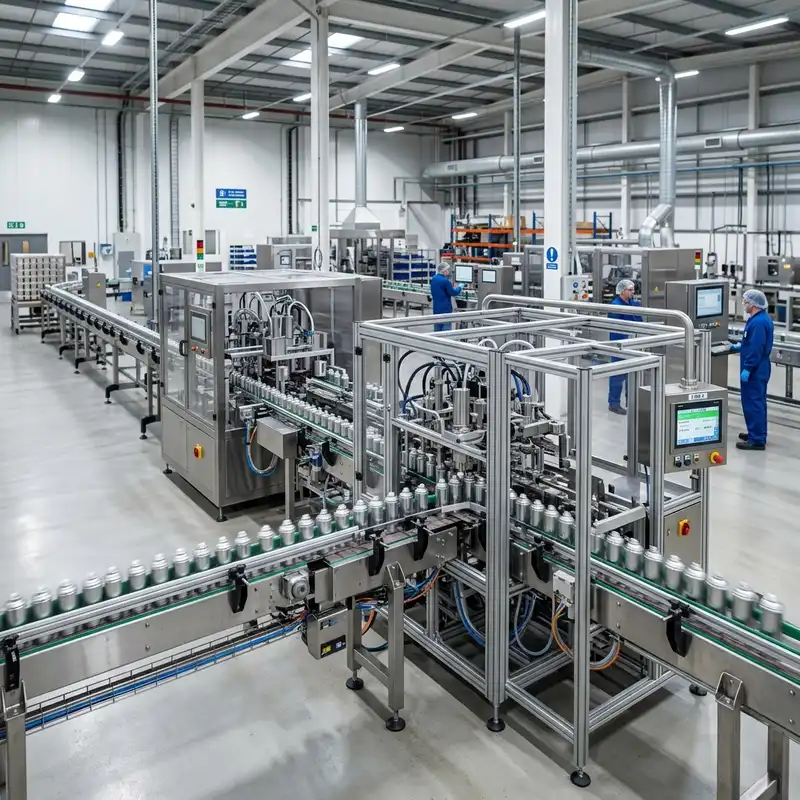
High-speed aerosol filling: Precision engineering is required to maintain formulation integrity and safety during the manufacturing process.
- Balancing Solvent Systems and Fragrance Stability: Ensuring the fragrance remains "in solution" is critical for preventing valve clogging and maintaining a consistent scent profile.
- Safety Standards and Regulatory Compliance: Manufacturers must strictly adhere to pressure testing protocols and provide comprehensive Safety Data Sheets (SDS) for all products. OSHA's Hazard Communication Standard requires the SDS in a 16-section format.
- Environmental Impact and Sustainability: The industry is rapidly shifting toward low-GWP (Global Warming Potential) propellants like HFOs and more sustainable, recyclable aluminum or tinplate packaging.
- Corrosion Inhibition: In water-containing formulations, protecting the integrity of the can is vital for ensuring a 2-year shelf life and preventing catastrophic failures.
Once the formulation holds up inside the can, the remaining question is how to scale it commercially.
Scaling Your Air Freshener Manufacturing Business
Scaling up air freshener production requires migrating from manual lab filling to high-speed automated lines. Manufacturers must validate the mixing shear rate, gassing tolerances, and line speed to ensure safety and quality. Startups can use licensed contract fillers, described in our guide to how contract aerosol filling works, to minimize initial capital expenditure while expanding market presence. The paragraphs below cover the main launch strategy steps.
For entrepreneurs and startups, scaling an aerosol manufacturing business requires a strategic focus on technical excellence and supply chain optimization. The initial investment in filling equipment and safety infrastructure can be significant, but the potential for industry profits is substantial for those who can deliver high-quality, consistent products. Partnering with experienced consultants can drastically reduce the time-to-market and avoid common formulation pitfalls.
Identifying high-growth segments—such as automatic metered sprays, luxury home fragrances, or specialized industrial deodorizers—allows smaller players to compete effectively against multinational brands. By focusing on niche applications where technical performance is the primary driver, businesses can establish themselves as authority figures in the air care sector.
Smaller players can look to adjacent segments such as hospital-grade disinfectants, pet odour removers, and premium automotive air care. Reducing waste in the filling process and lowering formulation cost through better chemistry improve the margin on every unit.
Aerosol Air Freshener FAQs
How does an aerosol air freshener turn liquid into a fine mist?
The concentrate and dissolved liquefied propellant leave the can through the valve and actuator orifice. A sudden drop in pressure makes the propellant flash-boil, and the released energy overcomes the liquid's surface tension and breaks it into droplets. Final droplet size is then set by the actuator's swirl chamber, the orifice size, and the liquid viscosity.
Why does droplet size matter for aerosol air fresheners?
Under Stokes' law, settling velocity rises with the square of droplet diameter, so large droplets fall onto furniture and floors and leave residue, while fine droplets stay airborne. At the fine end, the US EPA notes that particles 10 microns or smaller can enter the lungs, which is why formulators control the fine fraction of the spray. Droplet size distribution is therefore measured during development.
What is the difference between masking an odour and neutralizing it?
Masking overpowers the perception of a malodour with a stronger fragrance, and the malodour molecules stay in the air. Neutralization targets the molecules themselves: zinc ricinoleate traps sulfur- and nitrogen-based odours, and cyclodextrins encapsulate malodours inside a hydrophobic ring cavity. Modern air fresheners pair these neutralizers with a fragrance instead of relying on scent alone.
Why do LPG and DME give consistent spray performance in air fresheners?
LPG and DME are liquefied propellants, so the liquid phase keeps replacing vapor as product is dispensed and the internal pressure stays constant at a given temperature. The spray characteristics therefore stay consistent from the first actuation to the last. Compressed gases such as nitrogen behave differently because their pressure falls as the can empties.
Why do water-based air fresheners need corrosion inhibitors and can coatings?
Water in contact with a metal can wall drives corrosion, and water-based formulas are more prone to container rust than solvent-based ones. Corrosion inhibitors in the formulation and an internal can coating protect the wall over the shelf life, and storage testing confirms the compatibility. Corrosion that penetrates the can wall causes leaks.
Which quality checks does each aerosol air freshener batch need?
Each batch is tested for pressure consistency, for leakage by water bath or electronic leak detection, and for spray rate. Fill weight checks confirm the net content. Batch records tie every result to one production run, and a Safety Data Sheet in the 16-section GHS format accompanies the product.
Need Technical Support for Aerosol Formulations?
Partner with Global Aerosols to audit, scale up, and troubleshoot your aerosol chemistry, canister pressure calculations, filling lines, and safety systems.
Email: consulting@globalaerosols.com
Website: https://www.globalaerosols.com
Phone: +91 9819548320 +91 8169102990
About the Specialist
Absar Khan is the principal consultant and chemical formulation architect at Global Formulation. He possesses cross-disciplinary engineering expertise spanning aerosol gassing systems, pharmaceutical manufacturing, sterile injectables, cosmetics, and green chemical plant setups. Absar leads scientific and engineering advisory teams supporting manufacturers globally in technology selection, GMP layouts, validation frameworks, and regulatory strategies.
LinkedIn Portfolio: Connect with Absar Khan on LinkedIn