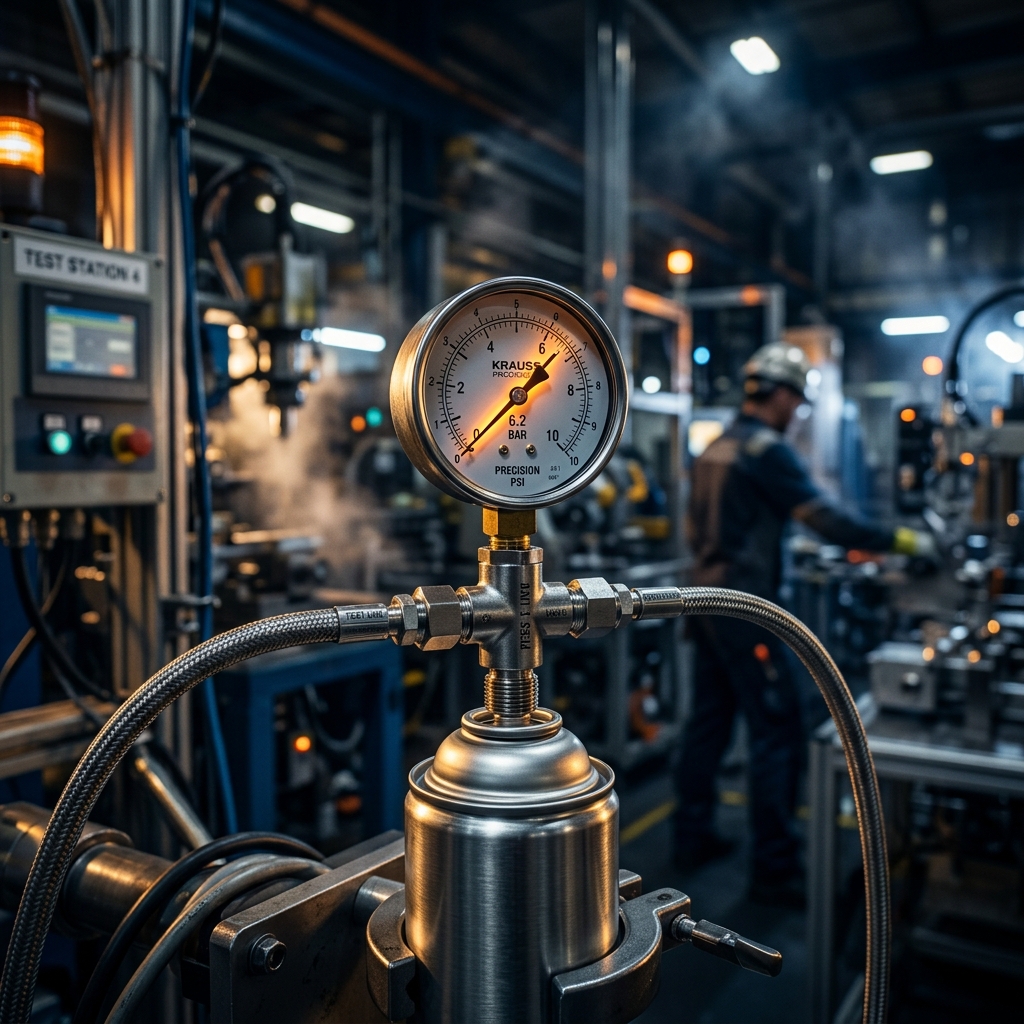
A compressed gas aerosol uses a non-condensable gas — most commonly nitrogen or carbon dioxide — stored entirely in the vapour phase at high initial pressure. Unlike systems that rely on a liquefied propellant, the pressure inside a compressed gas aerosol decreases progressively with each actuation because there is no liquid reservoir to replenish expelled gas. This fundamental distinction governs every aspect of spray performance, formulation compatibility, and storage behaviour, and it is the first engineering decision any aerosol product developer must make. Understanding how each propellant system behaves across its pressure-temperature envelope is essential for designing a product that performs consistently, complies with applicable regulations, and reaches market with predictable shelf life.
What Is a Compressed Gas Aerosol?
A compressed gas aerosol stores its propellant entirely as a gas within the can headspace, with no phase change occurring during storage or use. The gas is charged at a defined pressure at the point of filling, and this charge represents the system's entire pressure reservoir. Common compressed gas propellants include nitrogen (N₂), carbon dioxide (CO₂), and compressed air in certain specialised applications. Each is stored in its gaseous state at ambient temperatures, meaning there is no liquid propellant phase present inside the can at any point in the product's life cycle.
The operating principle is straightforward but has significant implications: as product is dispensed and the headspace volume expands, gas pressure drops according to ideal gas law behaviour. The relationship between volume and pressure means that a can at 50% fill will deliver noticeably lower spray velocity than it did when full, all else being equal. This pressure decay is not a defect — it is an intrinsic characteristic of the technology that formulators must account for in product design.
Nitrogen as a Compressed Gas Propellant
Nitrogen is the most widely used compressed gas propellant due to its chemical inertness, lack of global warming potential (GWP = 0), non-flammability, and complete absence of solvency effects on organic formulations. It is the standard choice for food-contact aerosols, pharmaceutical applications, and products where hydrocarbon solvency would compromise formulation stability. As documented by PubChem, nitrogen is a diatomic gas with near-ideal behaviour across the pressure and temperature ranges relevant to aerosol applications.
Carbon Dioxide as a Compressed Gas Propellant
Carbon dioxide occupies a unique position: at the pressures and temperatures encountered in aerosol manufacturing, CO₂ may exist at or near its critical point, exhibiting more complex phase behaviour than nitrogen. It is moderately soluble in many organic solvents and aqueous systems, which means dissolved CO₂ can influence formulation pH and contribute additional pressure as it evolves from solution. CO₂ is widely used in food aerosol applications — particularly beverage and whipped cream systems — where its interaction with the product is by design rather than a liability.
- Nitrogen: GWP = 0, non-flammable, inert, no solvency — preferred for food, pharma, and sensitive formulations
- CO₂: Moderate solubility in water and organics, can affect pH, higher initial pressure potential
- Compressed air: Limited industrial use; oxygen content creates oxidation and flammability risks in many formulations
- Filling is performed at a defined charge pressure; no liquid propellant phase is introduced to the can

Phase comparison: a compressed gas vessel (right, uniform vapour phase) versus a liquefied gas vessel (left, liquid-vapour equilibrium) illustrating the fundamental difference in propellant state during use.
How Liquefied Gas Propellants Work
Liquefied gas propellants — most commonly blends of liquefied petroleum gas (LPG: butane, isobutane, and propane) and dimethyl ether (DME) — are stored inside the aerosol can as a liquid in equilibrium with their own vapour. This liquid-vapour coexistence is the defining thermodynamic feature of these systems. As long as liquid propellant remains in the can, the vapour pressure above it is governed by the propellant's own vapour pressure curve at the prevailing temperature — not by how much propellant has been used. This is the fundamental engineering advantage of liquefied gas propellants: they provide consistent propellant pressure throughout most of the can's useful life, declining only once the liquid phase is exhausted.
The vapour pressure of LPG blends is well-characterised by Raoult's Law for ideal mixtures, where each component contributes to total vapour pressure in proportion to its mole fraction in the liquid phase. The British Aerosol Manufacturers' Association (BAMA) and the European Aerosol Federation provide guidance on blending practices, with butane, isobutane, and propane each contributing different pressure levels depending on their proportion in the blend. Formulators select the blend composition to achieve a target vapour pressure appropriate for the product and its container rating.
DME as a Co-Propellant and Solvent
Dimethyl ether occupies a dual role in aerosol formulation: it functions simultaneously as a propellant and as a powerful co-solvent. Its water miscibility and strong solvency for many organic compounds make it unique among propellant choices, particularly valuable in formulations where complete solubilisation of active ingredients into the propellant phase is required. However, its solvency also means it can cause swelling in certain elastomers and polymer materials, requiring careful material compatibility testing of all valve components.
- LPG blends: customisable vapour pressure by blend ratio; flammable; widely used in personal care, industrial, and household aerosols
- DME: dual propellant and co-solvent; water-miscible; excellent solvency; requires polymer compatibility verification
- HFCs and HFOs: non-flammable fluorinated propellants; used in pharmaceutical MDIs and specialty products
- Pressure remains nearly constant until liquid phase depletion — typically the last 5–10% of product life
Pressure Profiles Compared: The Core Technical Distinction
The most practically consequential difference between compressed gas and liquefied gas aerosols is their pressure-depletion profile. In a compressed gas system, pressure follows a declining curve closely approximated by the ideal gas law: as product is dispensed and headspace volume increases, pressure decreases proportionally. In a liquefied gas system, pressure remains stable across the depletion curve because the liquid-vapour equilibrium maintains a constant vapour pressure at constant temperature — pressure drops only when the last of the liquid propellant evaporates.
Consumer products with consistent spray requirements — hairsprays, deodorant body sprays, paint aerosols — universally favour liquefied gas propellants precisely because uniform pressure delivery translates to uniform spray output across the can's useful life. For a full breakdown of propellant options and their engineering properties, see our comprehensive guide to aerosol propellants explained.
| Property | Compressed Gas (N₂/CO₂) | Liquefied Gas (LPG/DME) |
|---|---|---|
| Pressure profile during use | Declining (follows ideal gas law) | Near-constant (liquid-vapour equilibrium) |
| Spray consistency | Decreases toward depletion | Consistent throughout most of can life |
| Flammability | Non-flammable (N₂, CO₂) | Flammable (LPG/DME); some HFCs non-flammable |
| GWP | Zero (N₂); low (CO₂) | Low (LPG, DME); varies (HFC/HFO) |
| Solvency effect | Negligible (N₂); moderate (CO₂) | Significant (DME, LPG); varies by propellant |
| Temperature sensitivity | Linear with absolute temperature | Follows vapour pressure curve (steeper) |
| Typical applications | Food-grade, pharmaceutical, aqueous, sensitive formulations | Personal care, household, industrial, paints |
The NIST WebBook thermodynamic database provides vapour pressure data for individual propellant components across the relevant temperature ranges — essential reference data for any aerosol engineer designing systems for hot-climate distribution.
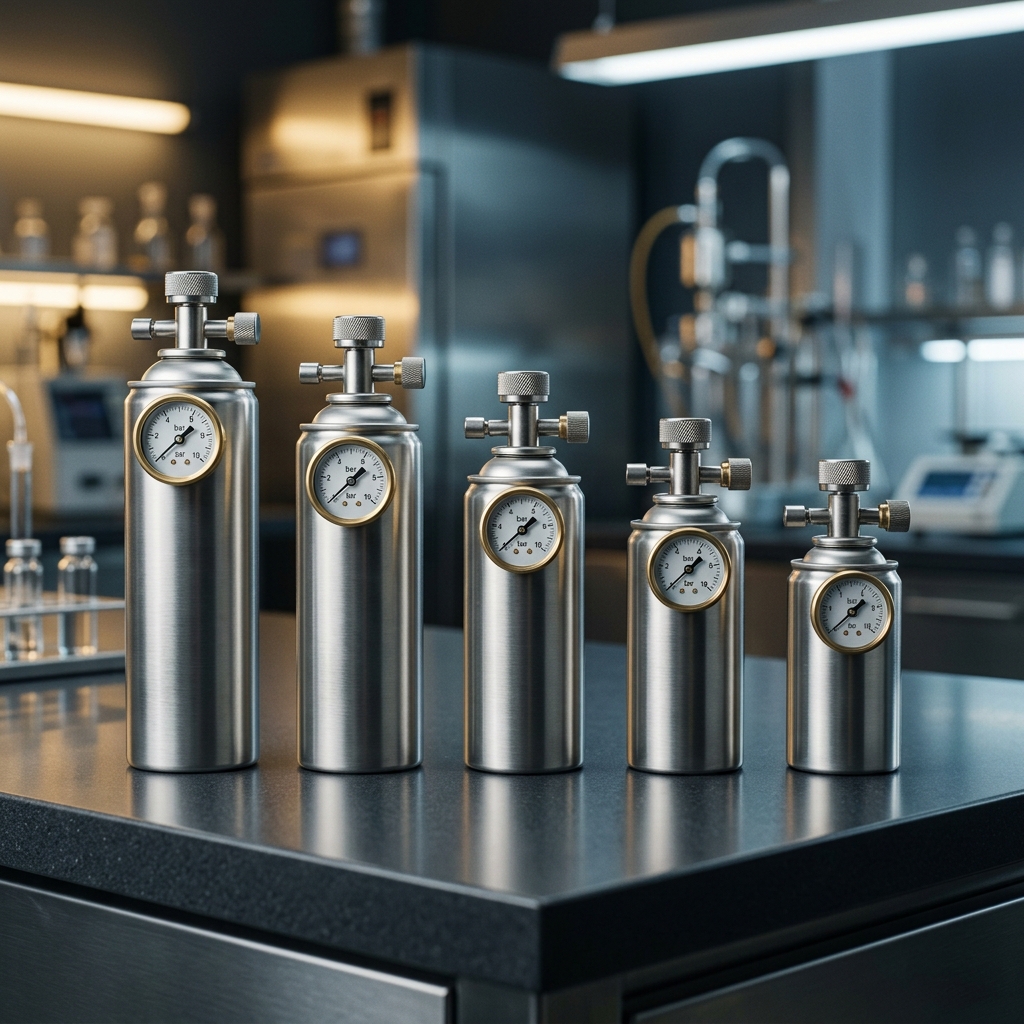
A spectrum of aerosol propellant systems — from compressed nitrogen and CO₂ to liquefied LPG blends — each with distinct pressure, solvency, and regulatory profiles that determine their appropriate application domain.
Spray Behaviour & Performance Characteristics
The propellant system choice directly shapes every aspect of spray performance — from initial spray velocity and droplet size distribution to the quality of atomisation at near-empty. In a liquefied gas system, the propellant flash-evaporates as it exits the valve, producing the energy that atomises the product concentrate into fine droplets. This rapid phase change is a significant contributor to spray quality in LPG and DME systems. As detailed in our guide to aerosol propellants explained, this flash evaporation mechanism is thermodynamically distinct from the mechanical expansion that occurs in compressed gas systems.
In a compressed gas system, the liquid product is pushed out by gas pressure alone, without any flash evaporation from the propellant. The atomisation energy must come entirely from the mechanical energy of gas expansion and the design of the actuator/nozzle system — making nozzle engineering particularly critical. This topic is explored in depth in our aerosol technology and formulations resource.
Droplet Size and Particle Distribution
Droplet size in aerosol products is a critical performance and regulatory parameter, particularly in pharmaceutical and pesticide aerosols. As documented in peer-reviewed literature available via PubMed, liquefied gas propellants typically generate finer droplets with a narrower size distribution than compressed gas systems at equivalent initial pressure, because flash evaporation provides a powerful atomisation mechanism. For applications where fine particle fraction is a regulatory specification — such as metered-dose inhalers — this difference is decisive and is one reason pharmaceutical aerosols almost universally use liquefied fluorinated propellants (HFAs).
Selection Criteria for Aerosol Formulators and Engineers
Choosing between a compressed gas and liquefied gas propellant system is a multi-dimensional engineering decision that must be made early in product development, as it affects formulation chemistry, filling line configuration, container and valve selection, regulatory compliance, and end-user experience simultaneously. There is no universally superior system — each has domains in which it provides clear technical advantages.
The choice begins with the formulation itself. If the active ingredient or carrier system is incompatible with the solvency of LPG or DME — for example, certain biologically active materials, aqueous-dominant formulations, or oxidation-sensitive compounds — a nitrogen-based compressed gas system may be the only viable option. Our how aerosol cans work guide provides a useful foundation for understanding how these propellant choices interact with the rest of the aerosol system.
Key Decision Factors
- Flammability requirement: If non-flammability is mandatory, compressed N₂ or CO₂ is required
- Spray consistency: Products where uniform spray output is a core requirement strongly favour liquefied gas
- Formulation compatibility: Aqueous systems without organic co-solvents are generally better served by nitrogen
- Regulatory market: Some markets impose flammability restrictions that dictate propellant choice
- Container pressure specification: Compressed gas systems require containers rated for higher initial charge pressures
- Environmental profile: Both system types can achieve low GWP; nitrogen is definitively zero-GWP
Regulatory & Safety Considerations
Both compressed gas and liquefied gas aerosol systems are subject to comprehensive regulatory oversight governing their design, testing, labelling, transport, and storage. The National Fire Protection Association's NFPA 30B standard — the primary US code for aerosol storage — classifies aerosol products into three levels based on flammability, with Level 1 (non-flammable, typically compressed gas systems) receiving the most permissive warehouse storage requirements. LPG-based aerosols typically fall into Level 2 or Level 3 classification, requiring sprinkler systems and dedicated storage zone configurations.
Transport classification is a significant practical consideration. Compressed gas aerosols using nitrogen or CO₂ carry less restrictive transport requirements than flammable aerosol classifications. LPG-based aerosols require compliance with IATA Dangerous Goods Regulations for air transport, IMDG Code for sea, and ADR for European road transport. Both system types require hot water bath testing per ISO standards to verify that cans can safely contain their charged pressure at elevated temperature — a standard quality release test for all filled aerosol products. For a comprehensive understanding, see our Aerosol Manufacturing 101 guide and our overview of aerosol can safety.
Frequently Asked Questions
What is the main difference between compressed gas and liquefied gas aerosols?
Why do compressed gas aerosols lose spray force toward the end of the can?
Which propellants are used in compressed gas aerosols?
What is the constant pressure advantage of liquefied gas propellants?
Are compressed gas aerosols safer than liquefied gas aerosols?
How does temperature affect compressed gas versus liquefied gas aerosol pressure?
When should a formulator choose a compressed gas aerosol over a liquefied gas system?
Need Expert Aerosol Consulting?
Our team provides end-to-end aerosol technical consultancy — from formulation development and propellant selection to filling line setup, regulatory compliance, and market launch strategy.
Get a Free ConsultationRelated Articles
- Aerosol Propellants Explained: LPG vs DME vs HFC vs N₂ vs CO₂
- Propellant Influence on Aerosol Spray Performance
- Aerosol Manufacturing 101: The Complete Technical Guide
- How Aerosol Cans Work: Propellant, Pressure, Valve & Spray Dynamics
- Aerosol Propellants Explained: LPG vs DME vs HFC vs N₂ vs CO₂
- Aerosol Chemistry 101: Solvents, Binders, Surfactants & Additives
- From Lab to Factory: Aerosol R&D to Commercial Manufacturing
- How to Choose the Right Aerosol Product Consultant
Absar Khan
Absar Khan is a senior aerosol industry consultant with deep expertise spanning aerosol formulation, propellant technology, valve engineering, filling line setup, and regulatory compliance across global markets. His work integrates aerosol chemistry, GMP manufacturing practices, safety and flammability assessment, quality systems, and regulatory strategy for markets including India, the EU, and the US. As Founder and Lead Consultant at Global Aerosols, Absar leads technical and engineering teams delivering end-to-end aerosol solutions — from initial formulation and lab trials through pilot-scale testing, commercial manufacturing setup, and full market launch.