Aerosol Valve Gasket Materials: Types & Compatibility
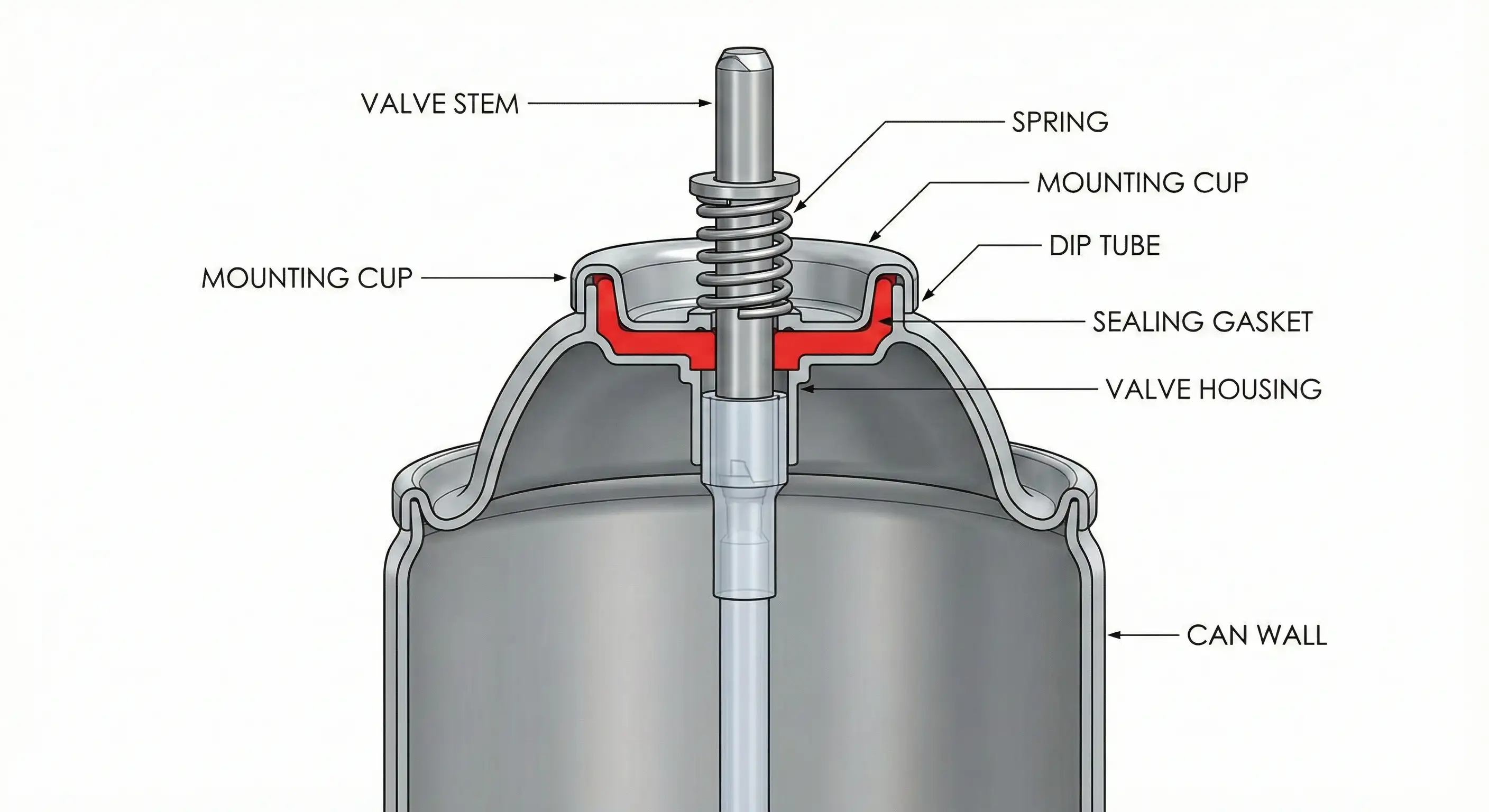
Guide Contents
Aerosol valves are precision-engineered systems where even the smallest component can determine product success or failure. Among these components, the valve gasket plays a decisive role in sealing, pressure retention, chemical resistance, and long-term reliability. Despite its importance, gasket selection is often treated as a commodity decision rather than a chemistry-driven engineering choice.
This article explains aerosol valve gasket materials from a scientific and engineering perspective, focusing strictly on established material science, elastomer chemistry, and real-world compatibility data. The objective is to help startups, students, and product developers prevent failures, reduce recalls, and design aerosols that perform consistently across markets and climates.
Because the gasket sits at the interface where the valve is crimped onto the can, its behaviour is inseparable from crimp quality and from the propellant it is exposed to. Readers troubleshooting a live problem may find our guides to why aerosol cans leak and the aerosol filling line useful alongside this material guide.
Why Valve Gaskets Matter in Aerosol Systems
In an aerosol container, the gasket forms the primary seal between the valve mounting cup, valve stem, and can rim. It must maintain integrity under internal pressure while remaining chemically inert to the formulation and propellant throughout the product’s shelf life. Any degradation directly compromises safety, spray performance, and storage stability.
Unlike many other components, the gasket is in continuous contact with both liquid product and vapor-phase propellant. This dual exposure creates complex chemical and mechanical stresses that cannot be addressed through generic rubber selection.
Key implications of gasket performance include:
- Long-term pressure retention and leak prevention
- Consistent spray rate and actuation force
- Shelf-life stability across temperature cycles
- Safety during storage, transport, and consumer use
How Aerosol Valve Gaskets Function
The gasket works by elastic compression rather than rigid sealing. When the valve is crimped onto the can, the gasket is compressed between metal surfaces to create a hermetic seal. During actuation, the gasket must flex repeatedly without losing resilience or dimensional stability.
This repetitive compression and relaxation exposes the gasket to mechanical fatigue. Simultaneously, chemical exposure can cause swelling, hardening, or extraction of plasticizers, which permanently alters gasket behavior.
Functional requirements of a valve gasket include:
- High elastic recovery after compression
- Controlled compression set under constant load
- Resistance to chemical swelling and shrinkage
- Stability across operating temperature ranges
Fundamentals of Valve Gasket Chemistry
Valve gaskets are manufactured from elastomers—polymers designed to exhibit rubber-like elasticity. Compatibility is not defined by whether a gasket dissolves, but by how its physical properties change over time when exposed to specific chemicals.
Chemical incompatibility typically manifests as swelling, embrittlement, softening, or loss of elastic memory. These changes are driven by molecular-level interactions between the elastomer polymer chains and solvents, propellants, oils, or additives in the formulation.
Critical chemical interaction mechanisms include:
- Solvent diffusion into the elastomer matrix
- Plasticizer extraction from rubber compounds
- Polymer chain scission or crosslink disruption
- Oxidative or thermal degradation
Common Aerosol Valve Gasket Materials
Different elastomers are used in aerosol valves based on formulation chemistry, propellant system, and target market requirements. Each material offers predictable strengths and limitations derived from its polymer backbone.
NBR (Nitrile Rubber / Buna-N)
NBR is widely used in aerosol valves due to its good resistance to aliphatic hydrocarbons and oils. It performs reliably in solvent-based systems where polar solvents are limited.
Typical characteristics of NBR gaskets:
- Good compatibility with LPG propellants
- Moderate resistance to oils and greases
- Poor resistance to water, alcohols, and ketones
- Limited high-temperature performance
EPDM (Ethylene Propylene Diene Monomer)
EPDM is selected for water-based and polar formulations. Its saturated polymer backbone offers excellent resistance to water, steam, and many detergents but poor resistance to hydrocarbons.
Key EPDM properties include:
- Excellent water and alcohol resistance
- Very good ozone and heat resistance
- Incompatible with mineral oils and LPG
- Common in cosmetic and household aerosols
Neoprene (Chloroprene Rubber)
Neoprene provides balanced performance across moderate chemical exposures. It is often used where neither extreme hydrocarbon nor extreme water resistance is required.
Performance characteristics of neoprene gaskets:
- Moderate resistance to oils and solvents
- Better weathering resistance than NBR
- Limited compatibility with aggressive solvents
- Stable mechanical properties under cycling
Butyl Rubber (IIR)
Butyl rubber is valued for its extremely low gas permeability. It is used when vapor loss and pressure retention are critical over long storage periods.
Butyl gasket attributes include:
- Excellent gas impermeability
- Good resistance to acids and alkalis
- Limited solvent compatibility
- Lower elastic recovery compared to NBR
Fluoroelastomers (FKM / Viton®)
FKM gaskets represent the highest chemical resistance class used in aerosols. Their fluorinated polymer structure resists aggressive solvents, oils, and high temperatures.
Characteristics of FKM gaskets:
- Exceptional chemical and solvent resistance
- High-temperature stability
- Low swelling across wide formulations
- Higher material and processing cost
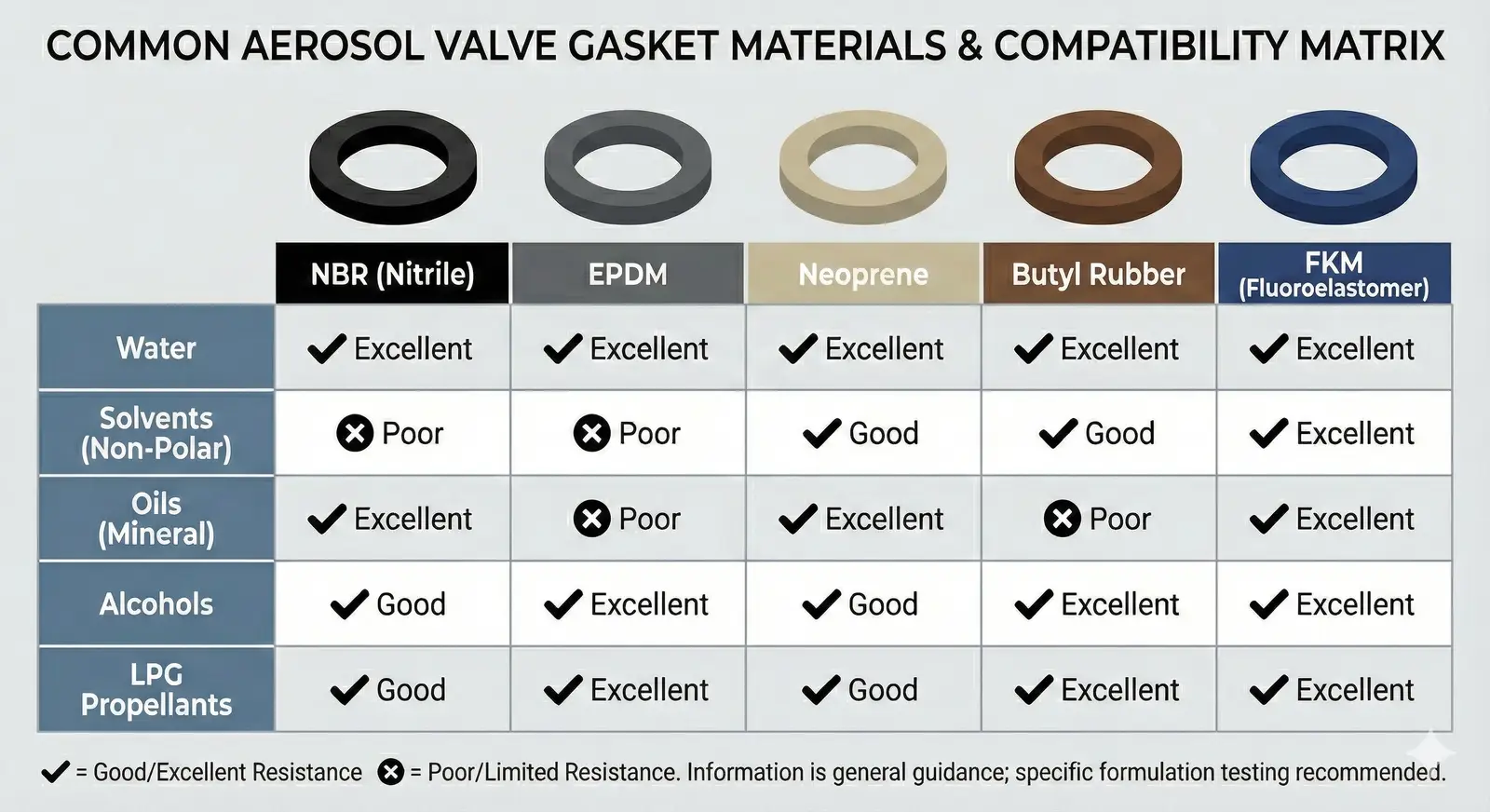
Chemical Compatibility by Product Type
Gasket selection must always be tied to the formulation class rather than product category or market positioning. Even small changes in solvent blends can radically alter compatibility outcomes.
Solvent-Based Paints and Coatings
These formulations often contain aromatic hydrocarbons, ketones, or esters that aggressively attack many elastomers. Incorrect gasket selection leads to swelling and leakage.
Water-Based and Emulsion Systems
Water-based aerosols require elastomers that resist hydrolysis and maintain elasticity in polar environments. Hydrocarbon-compatible rubbers fail rapidly here.
Hydrocarbon Propellant Systems
Liquefied petroleum gases diffuse easily into many elastomers. Resistance to swelling and plasticizer extraction is essential. The underlying reason is polarity: nitrile rubber owes its hydrocarbon resistance to the polar acrylonitrile content in the copolymer, and raising that content improves oil resistance while reducing low-temperature flexibility. Propellant choice therefore constrains gasket choice directly, as set out in our guide to aerosol propellants.
Typical compatibility trends:
- NBR — performs well with LPG but poorly with water
- EPDM — performs well with water but poorly with LPG
- FKM — performs well across most systems
Valve Gasket Compatibility Testing
Compatibility cannot be assumed from material datasheets alone. Testing under real formulation conditions is essential to avoid delayed field failures. Standardised classification and test methods for rubber materials are published by ASTM International, and equivalent international methods are maintained by ISO; working to a named method is what makes results comparable between two suppliers.
Standard validation approaches include:
- Immersion soak testing with dimensional measurement
- Compression set testing after chemical exposure
- Accelerated aging at elevated temperatures
- Pressure retention testing over time
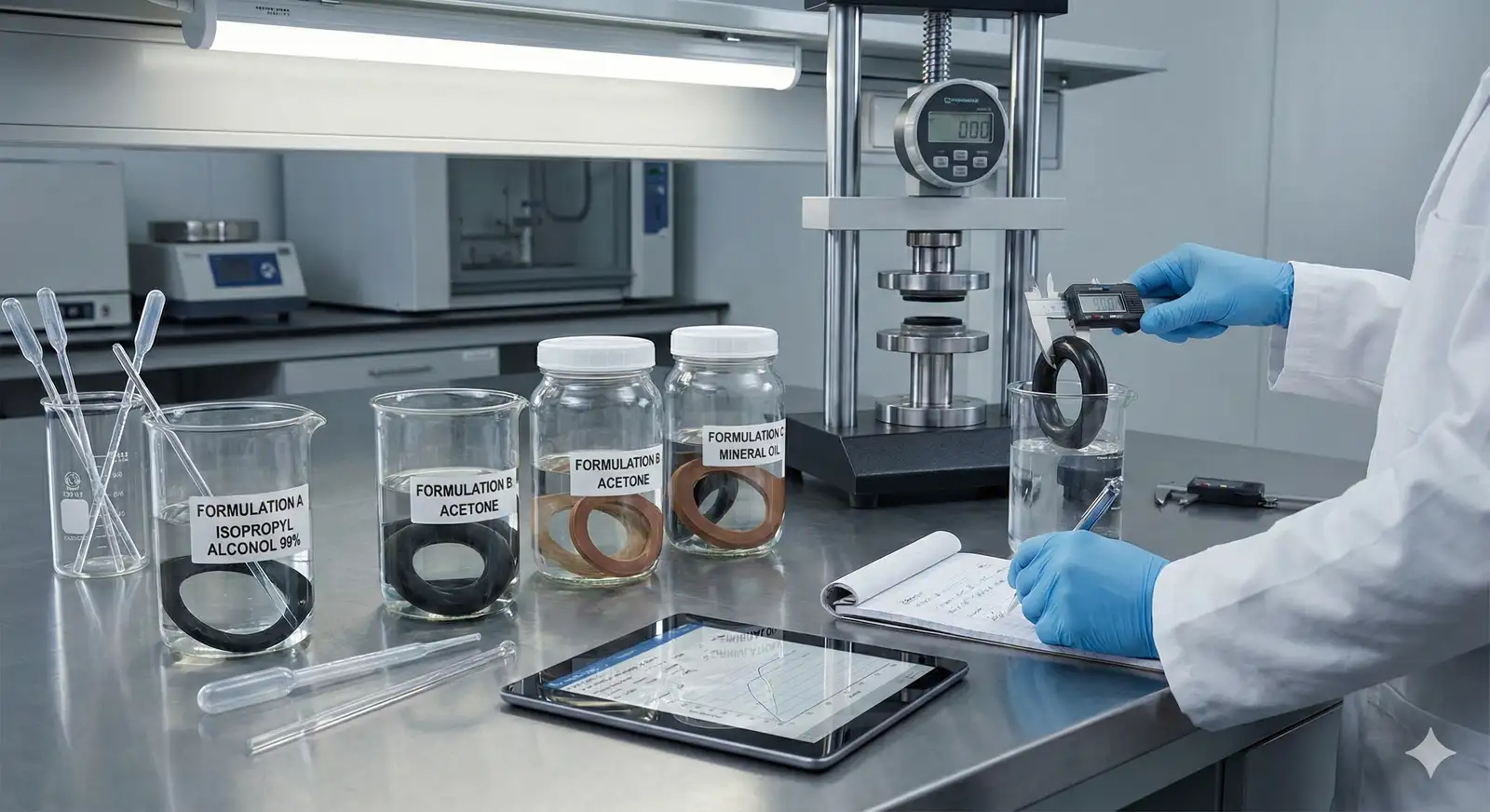
Common Gasket-Related Failure Modes
Most aerosol leaks and valve failures trace back to slow chemical degradation rather than immediate defects. These failures often appear weeks or months after filling.
Observed failure mechanisms include:
- Continuous micro-leaks due to gasket swelling
- Valve sticking from softened elastomers
- Pressure loss during storage
- Sudden leakage after temperature cycling
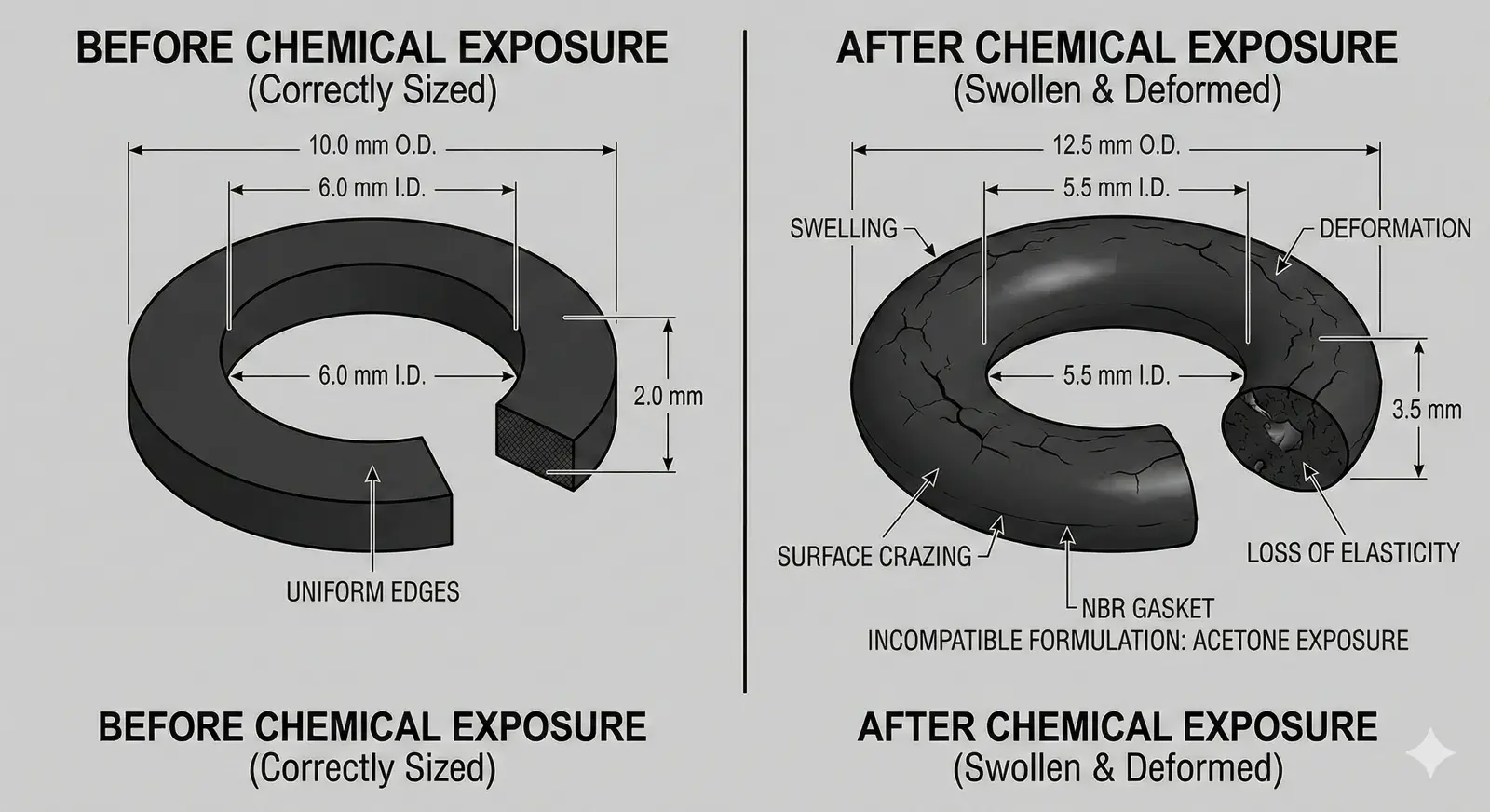
Special Considerations for Indian and Tropical Markets
High ambient temperatures accelerate chemical diffusion and elastomer aging. Gaskets that perform acceptably in temperate regions may fail prematurely in tropical climates.
Environmental factors to consider include:
- Elevated storage and transport temperatures
- Higher internal vapor pressure
- Longer distribution timelines
- Non-climate-controlled warehousing
Failure Prevention Through Correct Gasket Selection
Preventing gasket-related failures requires treating gasket selection as a formulation compatibility decision, not a procurement exercise. Early testing and conservative material choices reduce downstream risk.
Best-practice prevention steps include:
- Matching elastomer chemistry to formulation polarity
- Testing with actual product, not surrogate solvents
- Accounting for climate and storage conditions
- Avoiding cost-driven downgrades without validation
External Technical References
For further independent technical reading on elastomer compatibility and sealing systems:
- Parker O-Ring Handbook – Elastomer compatibility fundamentals
- FKM & EPDM Chemical Compatibility Charts - Utex Industries
- ISO 815 and ASTM D395 — the compression set test methods referenced throughout this guide
- Where an aerosol is food-contact, the elastomer must also satisfy the rubber-article requirements administered by the US Food and Drug Administration
Understanding the Broader Aerosol Ecosystem
Valve gaskets do not function in isolation. Their performance is directly linked to can materials, propellants, filling methods, corrosion behavior, and safety systems. A holistic understanding of the aerosol ecosystem is essential for designing reliable and compliant products.
For more information about the Aerosol ecosystem, please read our comprehensive articles that delve into the intricacies of aerosol product development: Explore how aerosol cans work, gain foundational knowledge with aerosol manufacturing 101, understand corrosion challenges in part 1 and part 2, master aerosol formulation techniques, ensure safety through aerosol can safety explained, compare propellants in aerosol propellants explained: LPG vs DME vs HFC vs N2 vs CO2, and learn about operations in how contract aerosol filling works. Together, these resources provide a complete engineering view of aerosol product development and commercialization from concept to shelf.
Frequently Asked Questions
What does an aerosol valve gasket actually do?
Which gasket materials are commonly used in aerosol valves?
How do I choose a gasket material for my formulation?
What is compression set and why does it matter?
What causes an aerosol valve gasket to swell?
How is gasket compatibility tested before production?
Design Your Aerosol Can in 3D
Please visit our Canwrap3D studio to visualize and test your artworks and designs on a realistic 3D aerosol can.
For tinplate cans:
https://www.globalaerosols.com/canwrap3d
For aluminium monoblock cans:
/services/canwrap-3d-aluminium/
Need Technical Support for Aerosol Formulations?
Partner with Global Aerosols to audit, scale up, and troubleshoot your aerosol chemistry, canister pressure calculations, filling lines, and safety systems.
Email: consulting@globalaerosols.com
Website: https://www.globalaerosols.com
Phone: +91 9819548320 +91 8169102990
About the Specialist
Absar Khan is the founder and lead aerosol consultant at Global Aerosols. He possesses cross-disciplinary engineering expertise spanning aerosol valve and gasket engineering, propellant compatibility, filling line design, and regulatory compliance. Absar leads scientific and engineering advisory teams supporting manufacturers globally in technology selection, GMP layouts, validation frameworks, and regulatory strategies.
LinkedIn Portfolio: Connect with Absar Khan on LinkedIn