Why Aerosol Cans Leak: Causes, Faults & Proven Fixes
Guide Contents
- 1. How Propellant Pressure Profiles Trigger Leaks
- 2. Can Body, Seam, and Structural Integrity Issues
- 3. Corrosion Mechanisms and Formulation Incompatibility
- 4. Manufacturing and Handling Factors That Increase Leak Risk
- 5. Proven Preventive Principles
- 6. Why Startups Face Higher Leakage Failure Rates
- 7. Frequently Asked Questions
Aerosol leakage is one of the most frequent and costly failures faced by aerosol manufacturers, brand owners, and contract fillers. While leaks often appear to be simple packaging defects, they are usually the result of complex interactions between propellant behavior, container integrity, valve mechanics, and manufacturing controls. Understanding these interactions is essential for preventing failures without compromising safety, compliance, or performance.
This article explains why aerosol cans leak, how propellants influence leakage risk, where manufacturing faults typically occur, and how the industry applies proven preventive strategies—all without disclosing formulations or proprietary solutions. If you are new to the underlying mechanics, our guide to how aerosol cans work covers the propellant, valve and pressure fundamentals this discussion builds on.
Understanding Aerosol Leakage in Technical Terms
Aerosol leakage refers to the unintended escape of propellant or product from a sealed aerosol system under normal storage, transport, or usage conditions. Even microscopic leaks can cause pressure loss, spray malfunction, regulatory non-compliance, and long-term safety risks. Leakage is not a single-point failure but a system-level problem involving pressure, materials, and process control.
From a performance standpoint, leakage directly impacts spray consistency, shelf life, and user safety. From a business perspective, it leads to returns, recalls, logistics damage, and brand erosion. Importantly, many leaks manifest weeks or months after filling, making root-cause diagnosis difficult without technical insight.
Key characteristics of aerosol leakage
- Gradual pressure decay — develops without any visible external damage to the can.
- Intermittent leakage — appears and disappears as ambient temperature cycles.
- Sudden seal failure — triggered by transport vibration or pallet stacking loads.
- Micro-leaks — detectable only under controlled test conditions, never by eye.
The Role of Propellants in Aerosol Can Leakage
Propellants are not passive pressurizing agents; they actively influence internal pressure, material compatibility, and mechanical stress within the aerosol system. Each propellant type exhibits distinct vapor pressure behavior, density, solvency, and thermal response, all of which affect leak risk. Misalignment between propellant characteristics and container design is a major contributor to failures.
Pressure inside an aerosol can is not constant—it changes with temperature, fill ratio, and propellant composition. If the pressure profile exceeds the tolerance of any system component, leakage becomes likely. This is why leakage analysis must always consider propellant physics, not just packaging quality. The comparative behaviour of each propellant class is covered in detail in our guide to LPG, DME, HFC, nitrogen and CO₂ propellants, and in propellant influence on aerosol performance.
Propellant-related leakage influences
- Vapour pressure variability — internal pressure tracks temperature across the distribution chain.
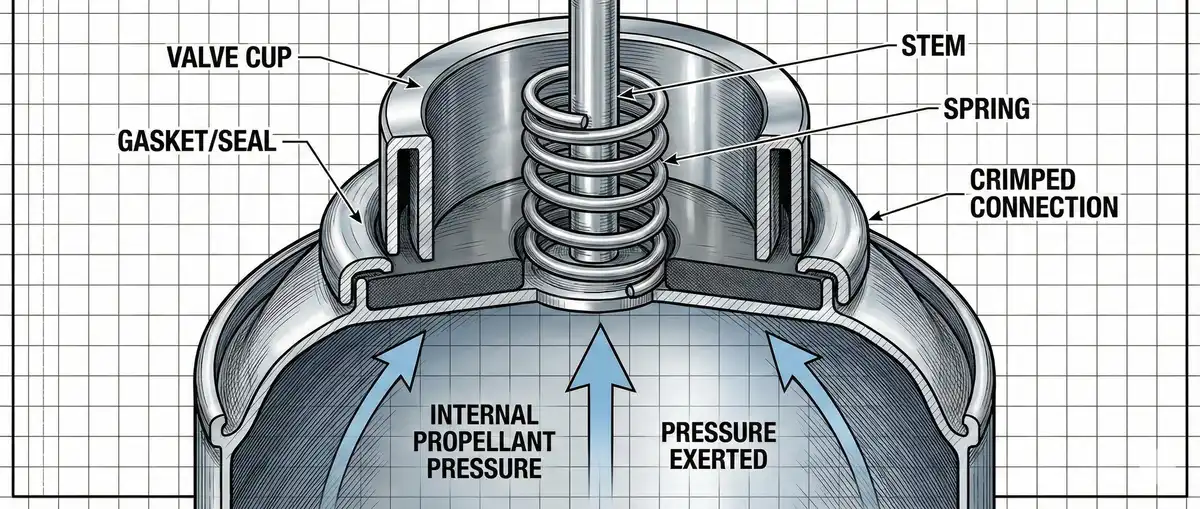
- Seal and crimp stress — higher pressure raises the load carried by the gasket interface.
- Elastomer and coating effects — hydrocarbon propellants exert solvency on sealing materials over time.
- Pressure cycling — repeated day/night swings during storage and transport fatigue the seal.
How Propellant Pressure Profiles Trigger Leaks
Every propellant has a defined vapor pressure curve that governs how internal pressure changes with temperature. If a can is exposed to elevated temperatures during transport or storage, internal pressure can rise significantly. When this pressure exceeds the sealing capacity of the valve crimp or gasket, leakage can occur even if the system passed initial quality checks.
This phenomenon explains why some aerosol cans remain stable in factories but fail in warehouses, shipping containers, or retail shelves. The failure is not sudden—it is the result of cumulative mechanical stress driven by pressure fluctuations.
Pressure-related leakage mechanisms
- Seal relaxation — elastomers lose recovery after repeated pressure cycling.
- Micro-deformation — crimped metal interfaces yield slightly under sustained load.
- Compression set — the gasket progressively loses the compression that forms the seal.
- Pressure spikes — short excursions above the design margin during heat exposure.
Valve System Failures and Propellant Interaction
The aerosol valve is the most common leakage point because it combines metal, elastomer, and mechanical interfaces under constant pressure. The crimp-on valve that has defined aerosol packaging since 1949 seals by clamping a gasket between the valve cup and the can bead, so the joint is only ever as good as that compressed elastomer. Propellants interact directly with valve components, influencing seal integrity over time. Even when valves meet dimensional specifications, incompatibility with pressure behaviour or chemical environment can result in leakage.
Valve failures are rarely due to a single defect. They are usually caused by interaction mismatches between propellant pressure, gasket resilience, and crimping force. These mismatches may only appear after extended storage or repeated temperature cycling. Because the gasket is the single most compatibility-sensitive component in the assembly, our breakdown of aerosol valve gasket materials and compatibility is the natural next step when diagnosing a recurring valve leak.
Common valve-related leakage contributors
- Compression retention loss — the gasket no longer holds sufficient sealing force.
- Elastomer fatigue — sustained pressure degrades the sealing material's resilience.
- Valve cup distortion — deformation at the mounting interface breaks seal continuity.
- Micro-channels — pressure-induced leak paths form across the sealing face.
Crimping Defects as a Structural Weak Point
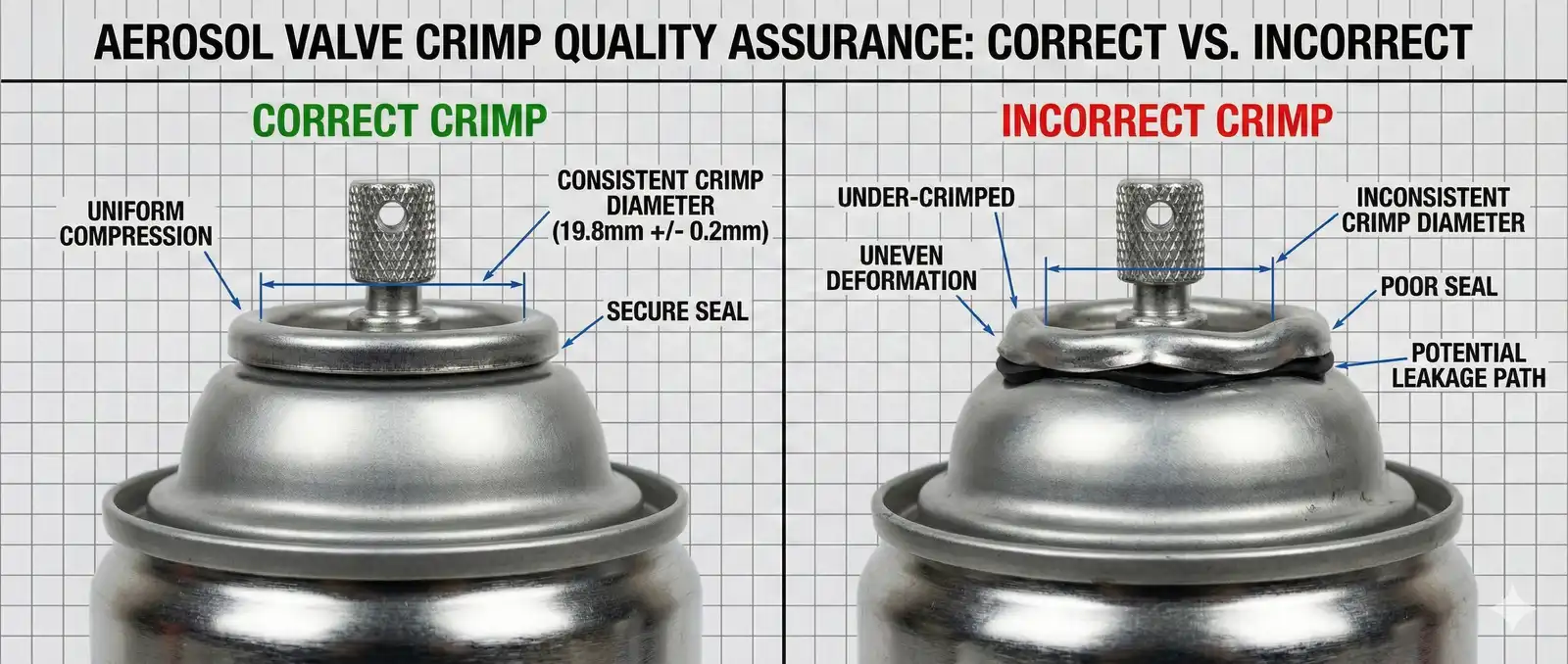
Crimping is a critical mechanical operation that seals the valve to the can. Even minor deviations in crimp diameter, height, or uniformity can compromise the seal. Since propellant pressure constantly loads the crimp area, any imperfection is magnified over time.
Crimping defects are especially dangerous because they may not be visible or immediately detectable. A can can pass post-fill testing and still develop leaks later due to gradual stress relaxation or pressure cycling. The crimping, gassing and leak-detection sequence itself is described step by step in our aerosol filling line guide.
Typical crimp-related leakage causes
- Under-crimping — leaves insufficient sealing force on the gasket.
- Over-crimping — work-hardens or distorts the metal, cracking the seal interface.
- Non-uniform profile — crimp depth varies around the circumference, leaving weak arcs.
- Tool wear — collet wear and calibration drift shift crimp dimensions over a production run.
Can Body, Seam, and Structural Integrity Issues
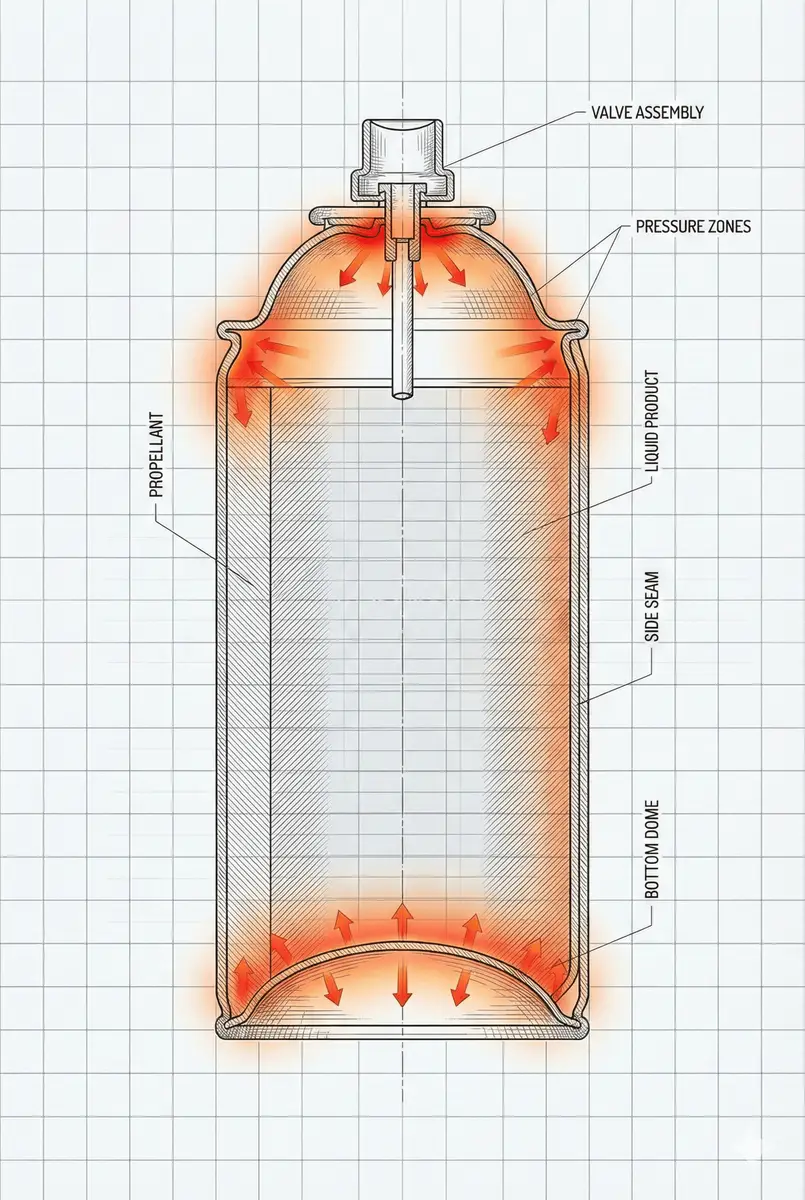
While less frequent than valve leaks, failures in the can body or seams can occur due to internal pressure stress combined with material weaknesses. Propellant pressure continuously loads the side seam, bottom dome, and internal coating. If any of these elements are compromised, leakage may develop gradually.
Internal corrosion, coating defects, or metal thinning can weaken structural zones without immediate visible signs. In such cases, leakage may appear as pressure loss rather than liquid escape, making detection more difficult.
Structural leakage contributors
- Side seam integrity — the welded or soldered seam of a tinplate can loses strength under load.
- Bottom dome deformation — the concave base inverts if internal pressure exceeds its rating.
- Coating degradation — the internal lacquer breaks down and exposes bare metal to the formulation.
- Stress concentration — formed and necked zones carry higher local stress than the can wall.
Corrosion Mechanisms and Formulation Incompatibility
Internal corrosion is a silent but devastating cause of leakage that stems from chemical reactions between the product formulation and the container material. Unlike mechanical seal failures, corrosion often manifests as microscopic pinholes that develop months after production. This is particularly common in water-based formulations where electrochemical reactions can degrade the internal coating or attack the metal substrate directly. If the pH balance is incorrect or if aggressive solvents penetrate the protective lacquer, the can wall may eventually perforate, leading to slow, undetectable product loss or sudden structural failure.
Because corrosion-driven leakage develops on a timescale of months, it is normally screened with accelerated storage trials rather than end-of-line testing. Standardised salt spray exposure — the B117 practice published by ASTM International — gives manufacturers a repeatable basis for comparing internal coating systems before commercial release. This failure mode is examined in depth across our two-part study of corrosion in water-based aerosol cans.
Manufacturing and Handling Factors That Increase Leak Risk
Even when design parameters are correct, manufacturing execution plays a decisive role. Filling speed, gassing pressure control, handling damage, and post-fill stabilization all influence long-term seal integrity. Propellants amplify the consequences of small process deviations because of their stored energy.
Leakage incidents often trace back to process inconsistency rather than material failure. This is why robust quality systems and process discipline are essential in aerosol manufacturing.
Manufacturing-related leakage risks
- Excessive gassing pressure — overshoots the fill target and overstresses the fresh crimp.
- Valve insertion damage — the gasket is nicked or displaced as the valve enters the can.
- Denting — handling damage before or after filling creates stress risers in the wall.
- Short stabilisation time — testing too soon after filling masks leaks that emerge later.
How the Industry Detects and Manages Aerosol Leaks
Leak detection is an established industrial practice governed by international standards. Because many leaks are microscopic, detection relies on indirect methods rather than visible inspection. These methods aim to identify pressure loss, gas escape, or mass reduction over time.
The hot water bath is the reference production test. Under the EU Aerosol Dispensers Directive 75/324/EEC, every filled dispenser must pass through a hot water bath in which the contents reach 50 °C without leaking or bursting. Equivalent duty applies in transport: aerosols shipped as UN 1950 must meet the pressure and leak-tightness requirements set out in the UN Model Regulations on the Transport of Dangerous Goods. Our guide to DOT and UN aerosol transport rules sets out how these obligations apply in practice.
Effective leak management focuses on early detection and trend analysis, not just pass/fail testing. This approach reduces downstream failures and improves system reliability.
Common industrial leak detection methods
- Hot water bath testing — filled cans are immersed at a controlled temperature and watched for escaping gas.
- Weight-loss monitoring — sample cans are weighed over time to quantify slow propellant loss.
- Pressure decay analysis — internal pressure is tracked to detect losses too small to see.
- Visual inspection — used only as a secondary control, never as the primary detection method.
Proven Preventive Principles
While specific corrective actions are proprietary, the industry relies on well-established engineering principles to prevent leakage. These principles focus on compatibility, control, and consistency rather than reactive fixes.
Preventing leaks requires a system-level approach that treats the aerosol as an integrated pressure vessel rather than a collection of parts.
Core preventive principles
- Pressure matching — select a propellant whose pressure envelope suits the container's rating.
- Tolerance control — hold crimp dimensions tightly and monitor them across the run.
- Thermal management — limit heat exposure throughout warehousing and distribution.
- Statistical quality systems — track leak-test trends rather than relying on pass/fail alone.
Why Startups Face Higher Leakage Failure Rates
Startups often encounter leakage issues not due to lack of effort, but due to incomplete understanding of aerosol system interactions. Cost-driven component selection, limited testing windows, and scale-up assumptions can expose products to risks that only appear in real-world distribution.
Understanding propellant influence early reduces failure rates, accelerates approvals, and protects brand credibility.
Common startup challenges
- Underestimating pressure variability — designing for ambient conditions rather than worst-case transit heat.
- Insufficient ageing trials — skipping accelerated storage and transport simulation before launch.
- Over-reliance on supplier data — accepting component specifications without validating them in the actual system.
- Limited system-level validation — qualifying parts individually instead of as an assembled pressure vessel.
Frequently Asked Questions
Why do aerosol cans leak after months of storage?
Are all aerosol leaks visible?
Is propellant choice a major leakage factor?
Can good crimping alone prevent leaks?
Why are leakage issues more common in hot climates?
How do manufacturers test aerosol cans for leaks?
Need Technical Support for Aerosol Formulations?
Partner with Global Aerosols to audit, scale up, and troubleshoot your aerosol chemistry, canister pressure calculations, filling lines, and safety systems.
Email: consulting@globalaerosols.com
Website: https://www.globalaerosols.com
Phone: +91 9819548320 +91 8169102990
About the Specialist
Absar Khan is the founder and lead aerosol consultant at Global Aerosols. He possesses cross-disciplinary engineering expertise spanning aerosol gassing systems, propellant selection, valve and crimp engineering, filling line setup, and regulatory compliance across global markets. Absar leads scientific and engineering advisory teams supporting manufacturers globally in technology selection, GMP layouts, validation frameworks, and regulatory strategies.
LinkedIn Portfolio: Connect with Absar Khan on LinkedIn