Aerosol Contact Cleaners: Dielectric Strength & Safety
Guide Contents
- 1. Understanding Electrical Contact Cleaners: Why Precision Matters
- 2. The Technical Core: Dielectric Strength and Its Critical Role
- 3. Evaporation Kinetics: Balancing Speed and Cleaning Power
- 4. Material Compatibility: Protecting Sensitive Components
- 5. Safety Protocols and Flammability Considerations
- 6. Selecting the Right Contact Cleaner for Your Project
- 7. Aerosol Contact Cleaner FAQs
A technical guide to aerosol contact cleaners for startups, students, and industrial engineers, covering dielectric strength, evaporation kinetics, and safe use on electronics.
Understanding Electrical Contact Cleaners: Why Precision Matters
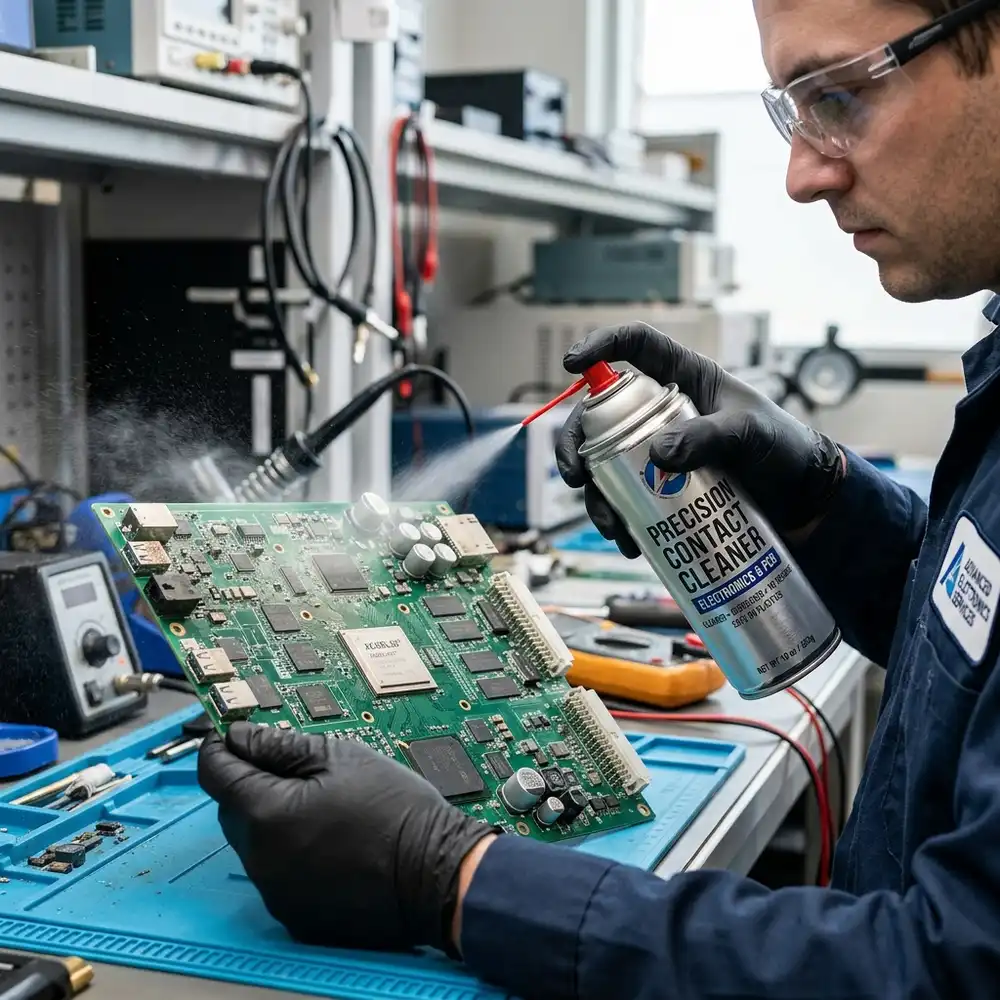
Electrical contact cleaners are highly specialized aerosol solvents designed to remove contaminants from sensitive electronic components. Removing oxidation, grease, and dust is critical to maintain circuit integrity and prevent signal degradation. Because these cleaners are applied to active or delicate systems, precision gassing (see our guide to crimping, gassing, and leak detection) and chemistry are non-negotiable. The sections below cover dielectric safety, evaporation, material compatibility, flammability, and product selection.
In the world of advanced electronics and industrial automation, the integrity of every electrical connection is the foundation of system reliability. Electrical contact cleaners are specialized aerosol solvents designed to remove contaminants from sensitive components without leaving residue or causing mechanical damage. For startups and engineering students, understanding how these chemicals interact with energized circuits is critical for both equipment longevity and personal safety. They sit within the broader range of industrial aerosol products.
Precision cleaning is not just about aesthetics; it is about maintaining low contact resistance and preventing signal attenuation. As devices become smaller and more complex, the margin for error narrows, making the choice of an aerosol cleaner a strategic engineering decision rather than a maintenance afterthought.
The Role of Aerosol Sprays in Electronic Maintenance
The aerosol delivery system provides a distinct advantage over manual cleaning methods like wipes or brushes. Pressurized spray allows the solvent to penetrate deep into recessed areas, connector pins, and micro-switches where mechanical cleaning is impossible. This "flush and dry" action ensures that dissolved contaminants are physically removed from the contact surface rather than just redistributed. The actuator determines whether the spray arrives as a directed stream or a wide fan, as covered in our guide to aerosol actuators.
- Non-Contact Application: Prevents physical stress on fragile solder joints and delicate traces.
- High-Pressure Flushing: Dislodges particulate matter from intricate internal geometries.
- Rapid Evaporation: Minimizes downtime by allowing equipment to be re-energized quickly.
The next question is which contaminants the solvent has to remove.
Common Contaminants: Oxidation, Dust, and Residue
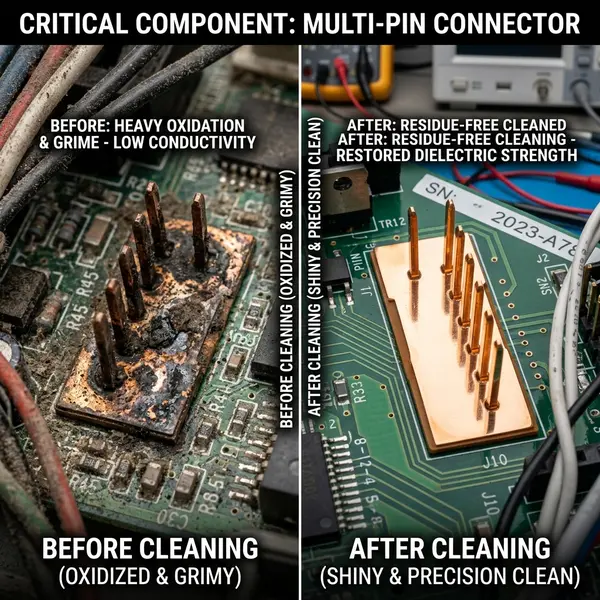
Over time, electrical contacts are subject to a variety of environmental stresses that degrade performance. Atmospheric oxygen leads to the formation of non-conductive oxide layers, while industrial environments introduce carbon deposits, oils, and particulate dust. If left untreated, these contaminants increase resistance, leading to heat buildup, arcing, and eventual component failure.
Understanding what you are cleaning is the first step in selecting the right solvent. Simple dust can be removed with compressed air, but oxidized contacts require chemical reduction and solvency to restore full conductivity.
The Technical Core: Dielectric Strength and Its Critical Role
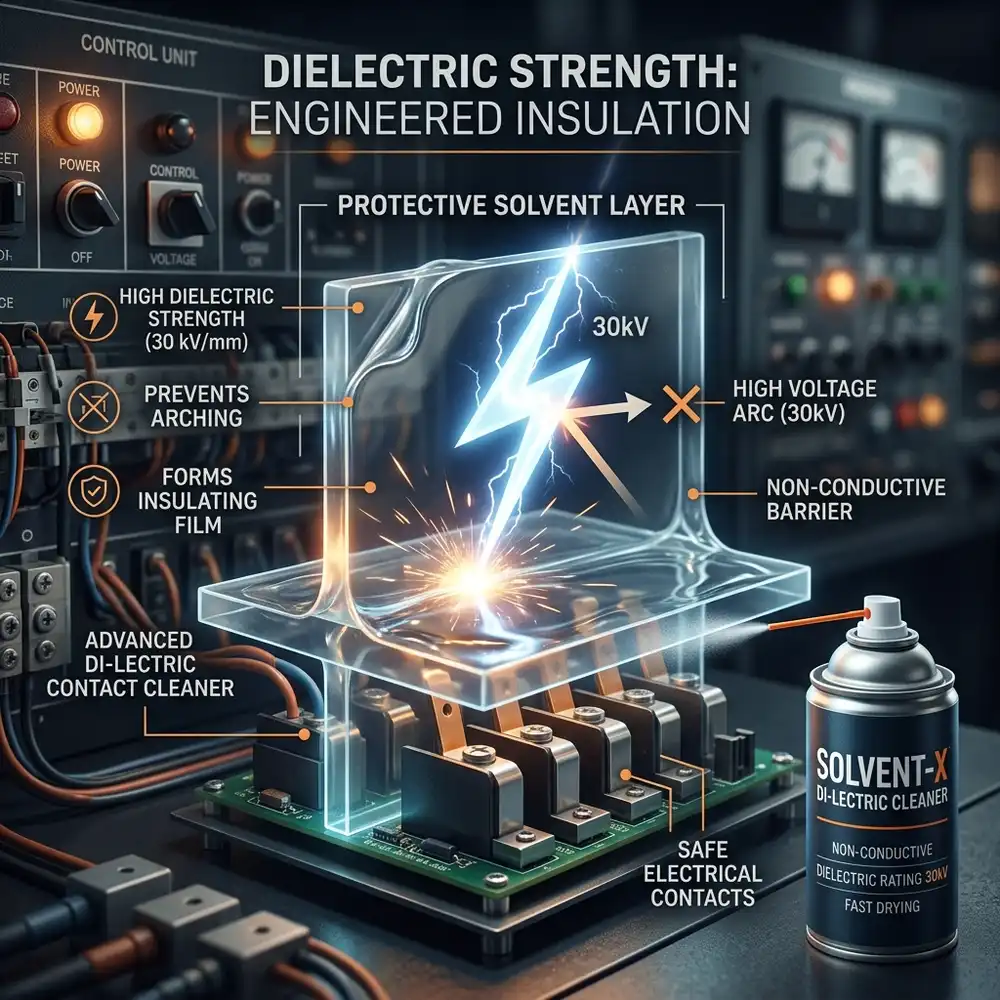
Dielectric strength is the measure of a solvent's electrical insulation properties, determining its safety when applied to active circuits. Utilizing a cleaner with insufficient dielectric strength can lead to short-circuits, equipment damage, or electrical shocks. High-quality industrial contact cleaners are formulated to maintain high insulation values even under pressure. The paragraphs below explain the factors that determine dielectric safety.
Dielectric strength is a vital technical specification for any contact cleaner used in professional environments. It refers to the maximum electric field that a pure material can withstand under ideal conditions without breaking down (i.e., without becoming conductive). For any technician or formulator, this value determines whether a cleaner is safe for use on live equipment or if it poses a risk of catastrophic short-circuiting.
What is Dielectric Strength in Solvents?
In liquid or vapor form, the solvent acts as an insulator. The dielectric strength is measured as the voltage required to cause an arc through a specific gap of the fluid. Test methods such as ASTM D877 for insulating liquids follow this principle. In aerosol form, the interaction is more complex as the spray contains both liquid droplets and propellant gases. A high dielectric rating ensures that even if the spray bridges two conductive points, it will not allow current to flow between them.
Why a High Dielectric Rating Prevents Costly Short Circuits
When cleaning complex control panels or server racks, it is impractical or impossible to fully de-energize every component. Using a cleaner with low dielectric strength on a live circuit creates a conductive path that can lead to arcing. This arc can destroy sensitive microprocessors, melt connectors, or even cause an electrical fire.
- Equipment Protection: Prevents "carbon tracking" and surface arcing.
- User Safety: Reduces the risk of electrical shock to the technician during application.
- Reliability: Ensures that cleaning doesn't introduce new failure modes into the system.
With the dielectric requirement defined, the next factor is how quickly the solvent leaves the surface.
Evaporation Kinetics: Balancing Speed and Cleaning Power
Evaporation kinetics govern how quickly the contact cleaner vaporizes after removing contaminants from the substrate. If the solvent evaporates too slowly, it can attract dust and lead to residue buildup. If it evaporates too quickly, it does not stay on the surface long enough to dissolve heavy grease deposits. Formulators balance this evaporation curve using specialized carrier blends. The paragraphs below cover the key variables in vaporization kinetics.
The evaporation rate of a contact cleaner determines how long the solvent remains on the surface to dissolve contaminants. While "fast-evaporating" is a popular marketing term, the actual kinetics must be carefully balanced. If the solvent evaporates too quickly, it lacks the "dwell time" needed to fully liquefy heavy oils or break down oxidation layers. Conversely, slow evaporation can lead to solvent entrapment in enclosed housings.
Fast-Evaporating vs. Slow-Evaporating Formulas
Precision electronics cleaners use fast-evaporating solvent systems, such as hydrofluorocarbons (HFCs), hydrofluoroolefins (HFOs), or high-purity alcohols, to allow immediate re-assembly and testing. Heavy-duty degreasers use slower-evaporating solvents to provide the solvency required for industrial-grade grime and carbon deposits.
| Cleaner Type | Relative Dielectric Rating | Relative Evaporation Rate | Best Use Case |
|---|---|---|---|
| Precision Electronic | High | Very Fast | Sensors, PCBs, CPUs |
| Industrial Grade | Moderate | Moderate | Heavy switches, Motors |
| Non-Flammable | Highest | Fast | High-voltage energized equipment |
The TDS of each product gives its exact tested dielectric strength and evaporation figures.
The Risks of Solvent Entrapment and Residue
"Residue-free" is a non-negotiable requirement for electrical contact cleaners. Any film left behind after evaporation can act as an insulator, ironically causing the very connectivity issues the cleaner was intended to solve. Furthermore, trapped solvent in a blind hole or connector housing can cause swelling of internal plastics or lead to unexpected conductivity if the dielectric strength is compromised by dissolved contaminants.
Material Compatibility: Protecting Sensitive Components
Contact cleaners must be highly compatible with the plastics, elastomers, and coatings used in electronic assemblies. Aggressive solvents can dissolve polycarbonates, swell silicone seals, or strip insulation varnish, leading to catastrophic component failures. Developers conduct extensive immersion tests to validate compatibility. The paragraphs below cover the primary materials that need safety screening.
Electronics are a mix of metals, plastics, and elastomers. A solvent that cleans copper contacts effectively can also attack the ABS plastic housing or swell the silicone seals. For entrepreneurs developing new hardware, verifying material compatibility (called "plastic safety") is a critical step in the prototyping phase to avoid long-term structural failures.
Plastic-Safe Formulations: Avoiding Stress Crazing
Aggressive solvents like acetone or chlorinated compounds are highly effective cleaners but are disastrous for most plastics. They cause "stress crazing" (a precursor of environmental stress cracking)—a network of fine cracks that compromises structural integrity. Plastic-safe cleaners are formulated to be inert toward common polymers like Polycarbonate, ABS, and Nylon.
- Polycarbonate Safety: Essential for clear housings and optical sensors.
- Elastomer Integrity: Ensures that O-rings and gaskets do not lose their seal.
- Coating Preservation: Protects conformal coatings on circuit boards from being stripped.
Material compatibility and dielectric strength then have to be weighed against flammability, which the next section covers.
Safety Protocols and Flammability Considerations
Managing flammability is one of the most critical safety aspects of contact cleaner design, as they are used near electrical contacts. Using non-flammable propellants like CO₂ (compared in our guide to compressed and liquefied gas aerosols) or specialized fluorinated solvents reduces the risk of ignition during application. Safety protocols also mandate proper ventilation and static grounding inside filling facilities. The sections below cover the key safety design parameters.
Working with aerosol solvents requires a deep understanding of flammability and chemical safety. Many high-performance cleaners use flammable hydrocarbons or alcohols. While these are cost-effective and have excellent solvency, they cannot be used near open flames, sparks, or on equipment that is actively generating heat. Flammable formulations also fall under storage rules such as NFPA 30B warehouse classification.
Flammable vs. Non-Flammable Contact Cleaners
Non-flammable contact cleaners are essential for "hot" environments or where de-energizing the equipment is impossible. Many of these use advanced chemistry such as HFOs, which have zero ozone depletion potential (ODP). HFOs are classed as non-flammable under standard ambient conditions, as detailed in our HFO-1234ze guide. Non-flammable cleaners cost more than their flammable counterparts.
| Attribute | Flammable Cleaners | Non-Flammable Cleaners |
|---|---|---|
| Chemistry | Hydrocarbons or alcohols | HFOs or other fluorinated solvents |
| Cost | Cost-effective, with excellent solvency | Higher |
| Ignition risk | Cannot be used near open flames, sparks, or heat-generating equipment | Suited to hot environments where de-energizing is impossible |
| Energized equipment | De-energize and lock out first | Acceptable when paired with high dielectric strength |
Cleaning Energized vs. De-energized Equipment
The gold standard for safety is to always de-energize and lock out equipment before cleaning, following OSHA's control of hazardous energy requirements. If you must clean an energized circuit, you must use a non-flammable cleaner with a high dielectric strength. Additionally, ensure proper ventilation to prevent the buildup of solvent vapors, which can be hazardous if inhaled in concentrated amounts.
For more detailed safety information, refer to the OSHA Solvent Safety Guidelines.
Selecting the Right Contact Cleaner for Your Project
Selecting the appropriate contact cleaner requires balancing dielectric properties, evaporation rates, and plastic compatibility for the target application. Heavy-duty industrial machinery requires different solvent strengths compared to delicate laboratory test equipment. Formulators customize these parameters through careful raw material selection. The sections below explain how to read the data sheets that drive the selection.
Choosing the right aerosol cleaner involves more than just picking a brand. It requires an analysis of the specific contamination, the sensitivity of the components, and the operational environment. For industrial startups, this selection can impact both the warranty of your products and the safety of your maintenance teams.
Reading the Technical Data Sheet (TDS) and SDS
The TDS is your primary source for dielectric strength, evaporation rate, and KB (Kauri-Butanol) value—a scaleless measure of solvent power defined for hydrocarbon solvents in ASTM D1133. A higher KB value indicates a stronger solvent, which is better for heavy grease but more damaging to plastics. Balancing these values is the art of aerosol formulation. Our guide to SDS, TDS and COA documents explains how to read all three documents that accompany an aerosol product.
For technical standards on electronics cleaning, visit the IPC - Association Connecting Electronics Industries.
Aerosol Contact Cleaner FAQs
What is dielectric strength and why does it matter for a contact cleaner?
Dielectric strength is the maximum electric field a material withstands without breaking down and becoming conductive. For a liquid it is tested as the voltage that causes breakdown across a fixed electrode gap, as in ASTM D877 for insulating liquids. A high value lowers the chance that the spray forms a conductive path between two contacts, which protects both the equipment and the technician.
Can I use an aerosol contact cleaner on energized equipment?
The safest practice is to de-energize and lock out equipment before cleaning, following OSHA's control of hazardous energy requirements. If the equipment cannot be de-energized, use a non-flammable cleaner with a high dielectric strength and ensure proper ventilation. Flammable hydrocarbon or alcohol cleaners cannot be used near sparks, open flames, or heat-generating equipment.
What is the difference between flammable and non-flammable contact cleaners?
Flammable cleaners use hydrocarbons or alcohols, which are cost-effective and have excellent solvency but cannot be used near open flames or sparks. Non-flammable cleaners use chemistry such as HFOs, which have zero ozone depletion potential and are classed as non-flammable under standard ambient conditions. They cost more, and the SDS states the flash point and GHS flammability rating of each product.
Why do some contact cleaners damage plastics?
Aggressive solvents such as acetone and chlorinated compounds cause stress crazing, a network of fine cracks that weakens the plastic. Plastic-safe cleaners are formulated to be inert toward common polymers such as polycarbonate, ABS, and nylon. A higher Kauri-Butanol (KB) value indicates a stronger solvent, so it also signals a greater risk to plastics.
What does the Kauri-Butanol (KB) value tell me about a cleaner?
The KB value is a scaleless index of solvent power, and ASTM D1133 defines it for hydrocarbon solvents. A higher KB value means a more aggressive solvent, which cleans heavy grease better but attacks plastics more readily. Read it together with the dielectric strength and evaporation rate on the TDS.
Why must a contact cleaner evaporate without leaving residue?
Any film left after evaporation acts as an insulator and causes the connectivity problems the cleaner was meant to solve. Solvent trapped in blind holes or connector housings can swell internal plastics. Evaporation rate must therefore be balanced: fast enough to leave no residue, but slow enough to give the solvent the dwell time to dissolve grease and oxidation.
Need Technical Support for Aerosol Formulations?
Partner with Global Aerosols to audit, scale up, and troubleshoot your aerosol chemistry, canister pressure calculations, filling lines, and safety systems.
Email: consulting@globalaerosols.com
Website: https://www.globalaerosols.com
Phone: +91 9819548320 +91 8169102990
About the Specialist
Absar Khan is the principal consultant and chemical formulation architect at Global Formulation. He possesses cross-disciplinary engineering expertise spanning aerosol gassing systems, pharmaceutical manufacturing, sterile injectables, cosmetics, and green chemical plant setups. Absar leads scientific and engineering advisory teams supporting manufacturers globally in technology selection, GMP layouts, validation frameworks, and regulatory strategies.
LinkedIn Portfolio: Connect with Absar Khan on LinkedIn