Personal Care Aerosols Explained: Deodorant & Body Spray Systems
Guide Contents
- 1. Introduction to Personal Care Aerosols
- 2. Deodorant vs Body Spray – System-Level Differences
- 3. Core Components of a Deodorant & Body Spray System
- 4. Manufacturing Process Overview (End-to-End)
- 5. Safety, Compliance, and Regulatory Landscape
- 6. Cost Structure and Commercial Viability
- 7. Common Technical and Commercial Challenges
- 8. Market Trends and Innovation
- 9. How Startups Can Enter the Market
- 10. Frequently Asked Questions
Personal care aerosols — particularly deodorants and body sprays — represent one of the most technically demanding yet commercially scalable product categories in the FMCG sector. While they appear simple to consumers, these products are complex engineered systems where chemistry, packaging, fluid dynamics, safety, and regulation intersect. For students, startups, and entrepreneurs, understanding the system-level architecture is essential before attempting product development or commercialisation. This article explains deodorant and body spray aerosols from a technical and manufacturing perspective, focusing on how these systems function, how they are produced, and what challenges govern their performance — without disclosing formulations or actionable recipes. The broader context of the personal care aerosol category guide provides useful industry and product overview context alongside this technical article.
Introduction to Personal Care Aerosols
Personal care aerosols are pressurised dispensing systems designed to deliver functional cosmetic products in a controlled spray form. Unlike creams or roll-ons, aerosols rely on a sealed package containing a liquid concentrate and a propellant, which together create atomisation upon actuation. This delivery method offers hygiene advantages — no direct skin contact with the container interior — ease of application, and consistent dosage coverage, which explains its global adoption across deodorant, body spray, antiperspirant, and fragrance categories.
From an industrial standpoint, deodorant and body spray aerosols are not just cosmetic products — they are regulated pressure vessels with chemical, mechanical, and safety constraints that require cross-disciplinary understanding. The mechanics of how aerosol cans work — from propellant phase equilibrium to valve actuation dynamics — are the physical foundation of all personal care aerosol performance. Developing these products therefore requires expertise that spans formulation chemistry, aerosol engineering, regulatory compliance, and manufacturing process validation simultaneously. Industry production and sustainability data for the personal care aerosol sector are compiled by the British Aerosol Manufacturers' Association (BAMA) and the FEA.
| Key Characteristic | Description |
|---|---|
| Pressurised dispensing | Liquefied or compressed propellants provide atomisation energy |
| Engineered spray patterns | Controlled by valve–actuator geometry and propellant pressure |
| Regulatory classification | Cosmetic product AND pressure vessel — dual regulatory compliance required |
Deodorant vs Body Spray – System-Level Differences
Although deodorants and body sprays often share similar aerosol packaging formats — the same aluminium or tinplate cans, similar valve and actuator hardware — they are engineered to meet fundamentally different functional objectives, and treating them as interchangeable is a common beginner mistake that leads to performance or compliance failures. Deodorants prioritise odour control mechanisms by targeting the odour-generation process at the source, while body sprays function as fragrance delivery vehicles designed for broad sensorial coverage. This distinction influences everything from spray rate to application zone to usage frequency, and consequently drives different formulation strategies, actuator selections, and regulatory classifications in some jurisdictions.
| System Dimension | Deodorant Aerosol | Body Spray Aerosol |
|---|---|---|
| Functional intent | Odour suppression or prevention | Fragrance projection and sensory experience |
| Application zone | Underarm (axilla) — targeted | Full body — broad coverage |
| Usage frequency | Daily, once or twice | Variable, multiple times daily |
| Dose per actuation | Lower (targeted dose) | Higher (broad coverage) |
Core Components of a Deodorant & Body Spray Aerosol System
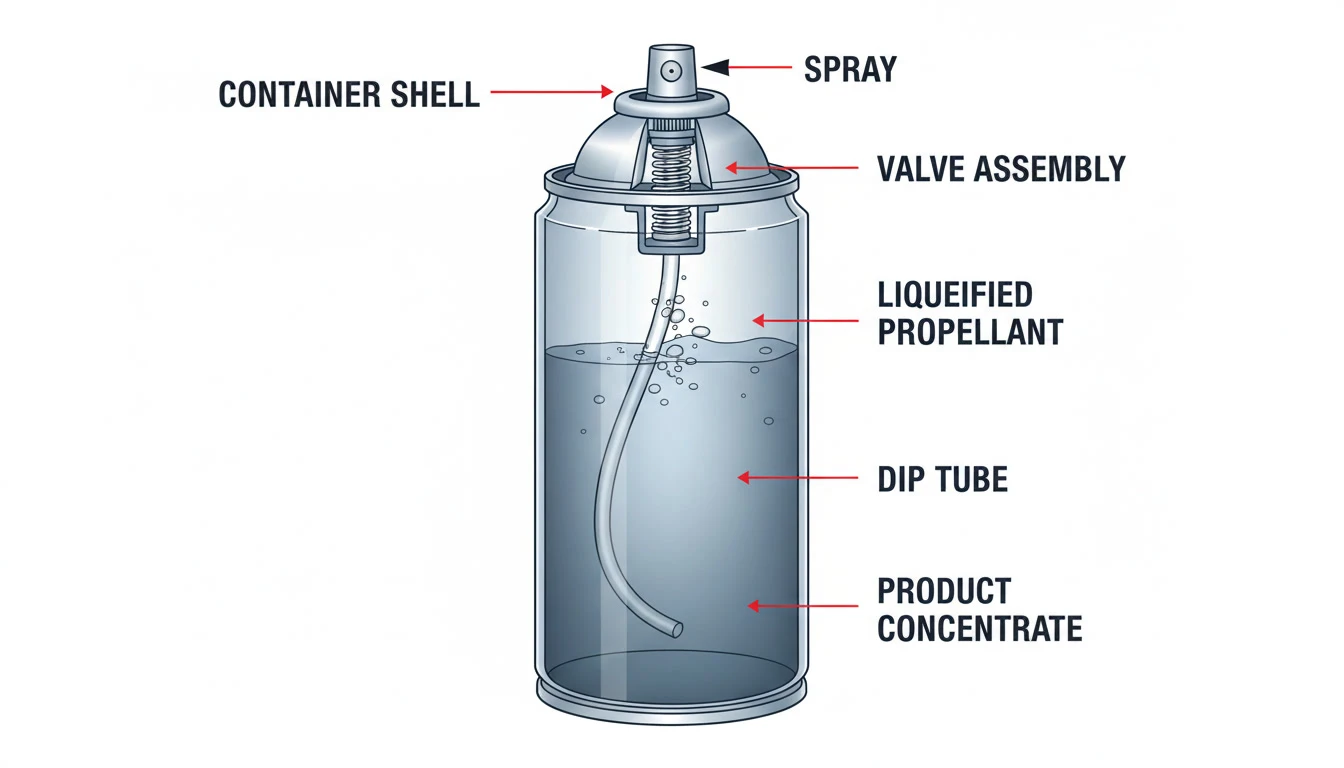
An aerosol product is best understood as an integrated system rather than simply a chemical formulation. Each component — liquid phase, propellant, container, valve, and actuator — must be compatible with all others across the product's full shelf life under real-world temperature and handling conditions. Failure in any single component compromises either safety or performance. This systems approach is why aerosol product development cannot be reduced to formulation chemistry alone; packaging and mechanical design carry equal technical weight in determining the final product's performance envelope and commercial viability.
Active System (Functional Concept)
The active system defines what the product is intended to do — controlling odour or delivering fragrance. This function determines the overall product architecture, including solubility requirements, delivery rate per actuation, and the skin exposure pathway. Actives must remain stable and evenly delivered throughout the product's life across the full range of storage temperatures (typically −5°C to +40°C in standard distribution). Understanding how fragrance materials interact with the aerosol system — including the propellant and solvent — is critical for preventing active degradation or phase separation during storage.
Solvent and Carrier Architecture
The carrier system enables actives and fragrances to be dissolved and delivered through the spray mechanism. Carrier choice directly affects evaporation rate, skin feel, spray visibility, and compatibility with packaging materials. Ethanol is the dominant carrier in deodorant and body spray aerosols due to its fast evaporation, antimicrobial contribution, and fragrance solubility, but its concentration level directly affects the flammability classification — a regulatory parameter that governs labelling, transport, and storage. Improper carrier architecture causes clogging, inconsistent spray patterns, and residue complaints in the field.
Propellant Selection and Spray Behaviour
Propellants provide the energy required for dispensing and atomisation. Their physical properties — vapour pressure, boiling point, solvency — influence spray pressure, droplet size, and discharge consistency. The key thermodynamic properties of common propellant systems are tabulated in the NIST Chemistry WebBook, which provides authoritative vapour pressure, boiling point, and density data for propellant gases. Propellant selection also determines flammability classification, which in turn governs transport hazmat requirements, warehouse storage rules, and consumer labelling obligations. Our guide on aerosol propellants explained covers propellant comparison in full technical detail.
Valve, Actuator, and Spray Pattern Engineering
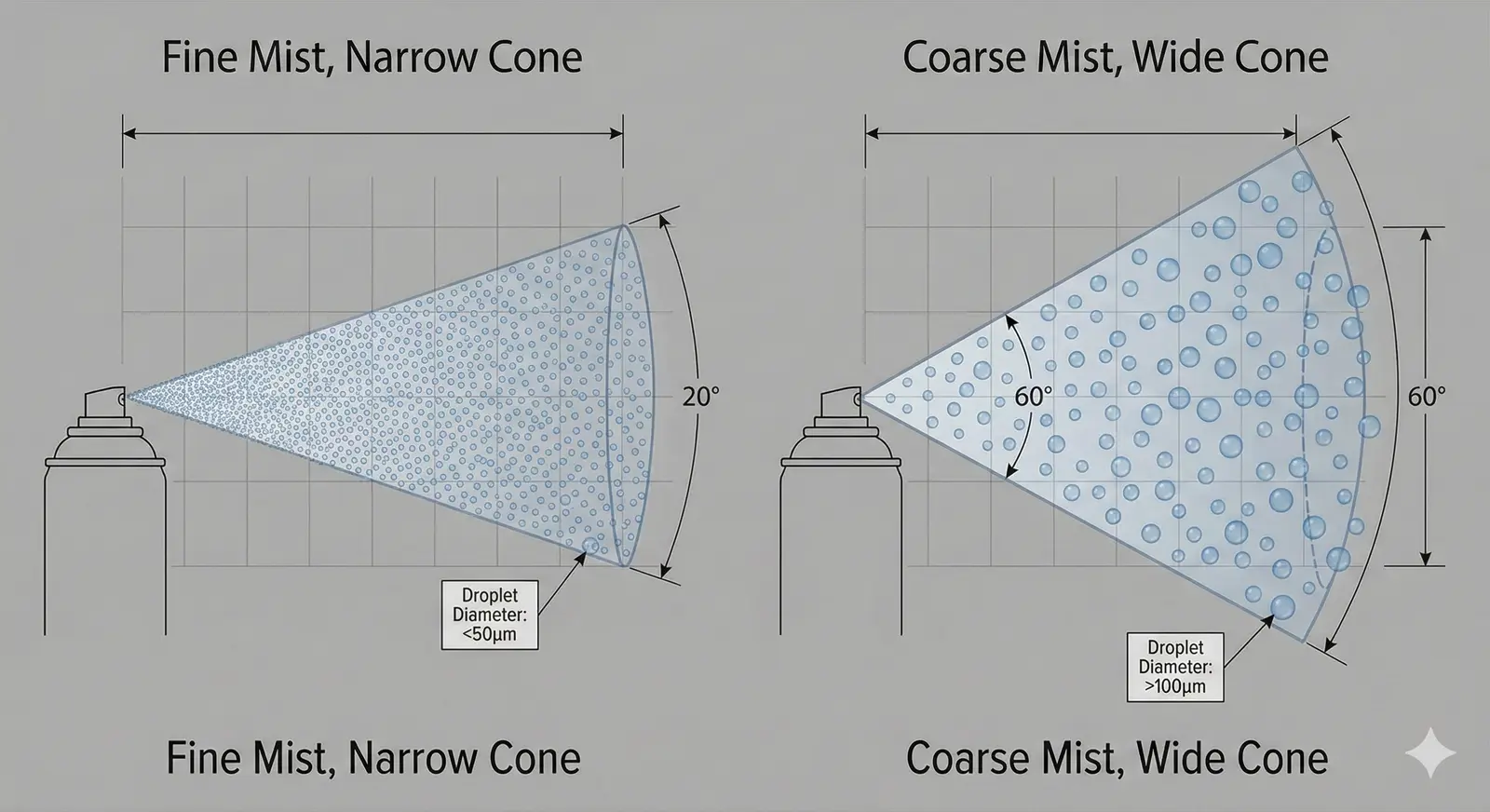
The valve–actuator assembly is the mechanical heart of the aerosol system. Spray angle, flow rate, and droplet distribution are entirely determined by this assembly design. Even minor mismatches between formulation rheology and valve design — such as a slightly higher-viscosity ethanol-water ratio than the valve was designed for — can result in inconsistent spray rates, elevated residue, or poor consumer experience. Actuator swirl chamber geometry is the primary determinant of cone angle and droplet size for deodorant and body spray applications. The principles of aerosol actuator design and spray physics are relevant to anyone specifying hardware for new personal care aerosol products.
| Component | Function |
|---|---|
| Liquid concentrate (functional phase) | Carries the active or fragrance to the spray mechanism |
| Propellant (energy source) | Provides pressurisation and atomisation energy |
| Valve assembly (flow control) | Controls spray rate and determines dose per actuation |
| Actuator (spray shaping) | Shapes droplet size distribution and spray cone angle |
| Aerosol can (pressure containment) | Contains system pressure safely throughout shelf life |
Manufacturing Process Overview (End-to-End)
Manufacturing personal care aerosols is a controlled industrial process governed by safety standards, quality management systems, and regulatory requirements that differ from those applicable to non-pressurised cosmetics. Aerosol manufacturing introduces specific risks related to pressure, flammability, and propellant gas handling, requiring purpose-built infrastructure including explosion-proof electrical systems, dedicated propellant storage and handling areas, and water bath pressure testing equipment. From bulk compounding to final packing, each step must be validated and documented to ensure consistency, compliance, and product safety at commercial volumes. The guide to how contract aerosol filling works explains the commercial filling process step by step, including equipment, safety infrastructure, and quality checks.
Bulk Compounding
Bulk liquid preparation for personal care aerosols focuses on achieving homogeneity, stability, and compatibility — not merely mixing ingredients. Temperature control, agitation method, order of addition, and contamination prevention are critical, particularly for fragrance-containing systems where heat or incompatible surfaces can degrade volatile top-note components or cause phase instability. The concentrate must be stable at the fill temperature and compatible with all contact surfaces of the filling equipment, particularly stainless steel and polymer seals.
Aerosol Filling Line Configuration
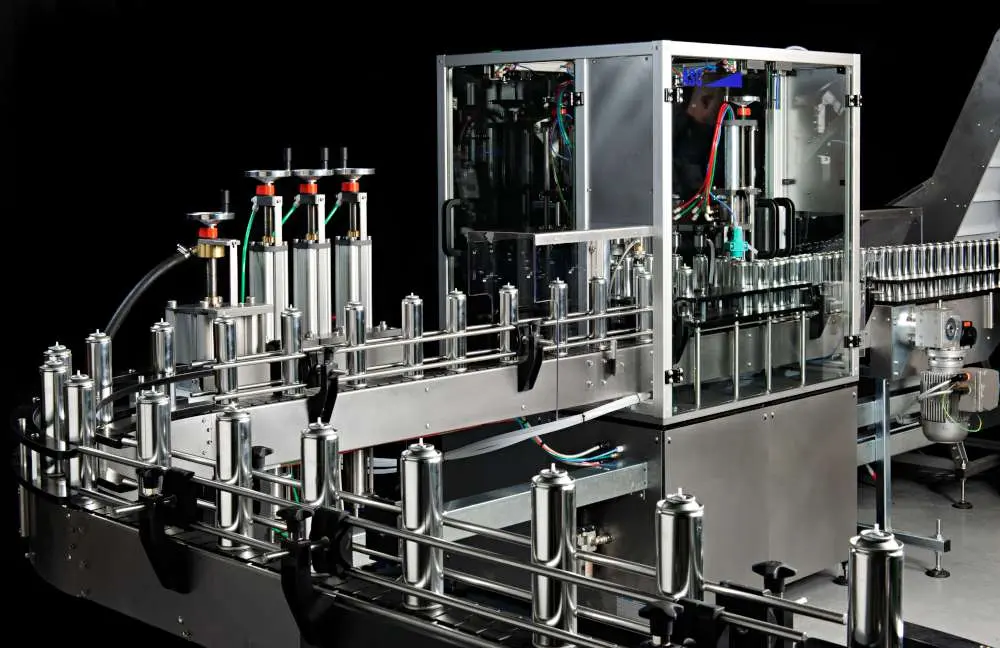
Aerosol filling lines are purpose-built to handle liquids and propellants safely under controlled conditions. Line configuration for deodorant and body spray products depends on can size, propellant type (LPG requiring different explosion protection to compressed nitrogen), and target production volume. Filling methods — under-the-cup (UTC) or through-the-valve (TTV) — affect propellant loss factor, fill accuracy, and line speed. Automation level directly impacts consistency of crimp dimensions, fill weight, and headspace.
Crimping, Gassing, and Leak Testing
Crimping secures the valve to the can by deforming the can curl around the valve cup flange, compressing the elastomer gasket to create a hermetic seal. Crimp quality is the single most critical manufacturing variable in aerosol production, directly affecting leak rate and product shelf life. Gassing introduces the propellant under controlled pressure, and 100% water bath leak testing at 55°C is mandatory for commercial aerosol production under UN transport regulations. Any can that shows bubbles or deformation during the water bath test is immediately quarantined and rejected from the batch.
Stability, Compatibility, and Shelf Life
Finished products undergo stability and compatibility testing at multiple temperature conditions — typically 5°C, 25°C, and 45°C — to verify that pressure, spray performance, and chemical integrity remain within specification throughout the commercial shelf life, typically 24 to 36 months. Corrosion-driven formulation failures — a known risk in aqueous and ethanol-containing aerosol systems — must be assessed during accelerated stability studies before commercial launch.
Safety, Compliance, and Regulatory Landscape
Personal care aerosols are regulated as both cosmetic products and pressurised containers, creating overlapping compliance obligations that vary by market. In India, aerosol deodorants and body sprays are governed by the Cosmetics Rules under the Drugs and Cosmetics Act, with additional obligations under the Legal Metrology Act for net content and the Motor Vehicles Act for transport of flammable goods. In the EU, the EU Cosmetics Regulation (EC) No 1223/2009 governs ingredient safety, ingredient listing, and labelling, while the Aerosol Dispensers Directive 75/324/EEC governs container pressure safety. In the US, the FDA provides regulatory guidance on cosmetic product regulations, with aerosol-specific safety requirements under DOT 49 CFR for transport classification.
IFRA, VOC, and Flammability Considerations
Fragrance use in body spray aerosols is governed by the International Fragrance Association (IFRA) standards, which set concentration limits for sensitising or restricted fragrance materials based on skin exposure pathway and category. IFRA compliance is required by major retailers globally and is an auditable component of quality systems. VOC regulations influence solvent and propellant selection: California's CARB (California Air Resources Board) sets product-category-specific VOC limits that restrict LPG and ethanol concentrations in certain cosmetic aerosol categories, while EU Directive 2004/42/EC and national regulations in various markets impose additional constraints. Flammability classification — determined by flash point, closed cup test data, and propellant type — affects mandatory labelling, storage rack limits, and sea/air transport documentation. The EU CLP Regulation (ECHA) defines flammability hazard categories for aerosol products sold in the EU.
Cost Structure and Commercial Viability
Cost competitiveness in deodorant and body spray aerosols is driven more by packaging economics and operational efficiency than by the liquid concentrate cost alone. Entrepreneurs consistently underestimate the capital and compliance costs involved in aerosol manufacturing relative to equivalent non-pressurised product formats. In aerosol personal care products, the concentrate typically represents 20–35% of the total material cost, while the aerosol can, valve, actuator, propellant, and secondary packaging account for the remainder — often 65–80% of total materials cost at small-to-medium production volumes.
| Cost Driver | Impact on Total Unit Cost |
|---|---|
| Aerosol can and valve | Typically the largest single cost component; benefits from volume scale |
| Propellant logistics and storage | Significant infrastructure cost; reduces proportionally at higher volumes |
| Filling line efficiency and propellant loss | Directly affects per-unit variable cost; validated through pilot trials |
Common Technical and Commercial Challenges
Many aerosol failures in deodorant and body spray production are not due to formulation errors but to system mismatches or process oversights that only become apparent after scale-up or in real-world consumer use. Understanding common failure modes allows teams to design proactively against them, saving significant development cost and time to market. The aerosol manufacturing fundamentals guide covers process control principles applicable to all personal care aerosol categories.
| Challenge | Root Cause Category |
|---|---|
| Inconsistent spray performance | Formulation-valve mismatch or fill weight variability |
| Valve clogging or leakage | Formulation incompatibility with gasket or crimp failure |
| Fragrance instability over time | Fragrance-propellant or fragrance-can interaction |
| Regulatory non-compliance during export | IFRA, VOC, or flammability classification gap |
Market Trends and Innovation in Personal Care Aerosols
Innovation in personal care aerosols is driven by regulatory pressure, sustainability goals, and changing consumer expectations around ingredient transparency and environmental impact. While the fundamental aerosol system — pressurised can, valve, propellant — remains unchanged, design priorities continue to evolve. Low-VOC formulations using compressed gas propellants, aluminium can recycling programmes, and concentrated refill systems are among the trends reshaping the category. European market trend data from the FEA (European Aerosol Federation) provides quantitative insight into sustainable aerosol packaging adoption rates.
| Trend Area | Technical Implication |
|---|---|
| Low-VOC and eco-focused positioning | Propellant reformulation; compressed N₂ or CO₂ alternatives |
| Sensitive-skin and minimalist claims | Simplified ingredient deck; validated skin compatibility testing |
| Improved spray feel and coverage control | Actuator innovation; propellant blend tuning for droplet size control |
How Startups Can Enter the Deodorant & Body Spray Market
Market entry in the deodorant and body spray aerosol category requires strategic alignment of product design, manufacturing strategy, and regulatory readiness from day one. The most common entry pathway for startups and new brands is through contract aerosol manufacturing, which avoids the capital investment in filling infrastructure while allowing the brand to focus on formulation, packaging differentiation, and commercial strategy. For an early-stage team considering this pathway, our guide on choosing the right aerosol technical consultant explains how experienced aerosol consultants add measurable value during the critical R&D and scale-up phases.
| Entry Pathway | Best Suited For |
|---|---|
| White-label sourcing | Fastest route to market for brand testing; lowest technical investment |
| Contract manufacturing | Custom formulation with external production; moderate investment |
| Custom system development | Full proprietary differentiation; highest investment, highest control |
Startups benefit most from phased entry approaches that systematically reduce technical and financial risk before committing to custom manufacturing infrastructure. Our guide to aerosol product scale-up from lab to commercial manufacturing explains each phase of the development and scale-up pathway in detail, from R&D formulation through pilot validation to commercial launch readiness.
Frequently Asked Questions
What is the fundamental engineering difference between deodorant and body spray aerosols?
Deodorant aerosols are designed to deliver odour-control actives that reduce odour-causing bacteria at the application site, whereas body spray aerosols are primarily fragrance delivery vehicles. This functional difference drives distinct spray rate specifications, application zone targeting, usage frequency, and regulatory classification. Deodorants require precise, lower-volume targeted dose delivery; body sprays require wider spray coverage and higher fragrance load delivery across the body surface.
What propellants are used in deodorant and body spray aerosols?
Deodorant and body spray aerosols most commonly use LPG (propane-butane blends) as the primary propellant, selected for consistent pressure profile and fine atomisation. DME is used where additional solvency is beneficial. Compressed nitrogen is used in sensitive formulations incompatible with hydrocarbon propellants. Propellant selection directly determines flammability classification, which governs labelling, transport, and storage requirements.
Why is crimping integrity so critical in deodorant aerosol manufacturing?
Crimp integrity is the single most critical manufacturing quality attribute in aerosol production. An under-crimped valve allows propellant to leak, causing pressure loss and reduced product life. An over-crimped valve deforms the gasket elastomer, creating immediate or delayed leakage. At commercial scale, even a 0.1 mm systematic deviation in crimp diameter or depth across a batch creates significant product loss and potential hazardous pressure failures during distribution.
What does IFRA compliance mean for fragrance in aerosol body sprays?
The International Fragrance Association (IFRA) publishes standards that restrict or prohibit certain fragrance ingredients based on skin exposure pathway and usage category. For body spray aerosols delivering fragrance directly to skin, IFRA standards specify concentration limits for sensitising, phototoxic, or restricted fragrance materials. Formulators must verify that the total fragrance compound in the aerosol concentrate complies with IFRA limits at the expected skin deposition concentration after atomisation.
How do aerosol body sprays achieve wide coverage spray patterns?
Wide coverage spray patterns are achieved through actuator design — a larger-diameter swirl chamber with a wider discharge orifice converts pressurised liquid into a broad cone. The propellant vapour pressure determines exit velocity while actuator geometry determines droplet size and spray angle. Body spray actuators typically produce droplets in the 50–150 micron range to achieve fast skin deposition and minimal overspray drift in indoor environments.
What are the key regulatory requirements for launching a deodorant aerosol in India?
In India, aerosol deodorants and body sprays are governed by the Cosmetics Rules under the Drugs and Cosmetics Act as cosmetic products. Key requirements include: INCI ingredient declaration, net content compliance under the Legal Metrology Act, hazard warning labels for flammable products, and manufacturing under a valid cosmetics manufacturing licence. Products making antiperspirant claims may be re-classified as drugs, triggering stricter clinical efficacy and GMP requirements.
Need Technical Support for Aerosol Formulations?
Partner with Global Aerosols to audit, scale up, and troubleshoot your aerosol chemistry, canister pressure calculations, filling lines, and safety systems.
Email: consulting@globalaerosols.com
Website: https://www.globalaerosols.com
Phone: +91 9819548320 +91 8169102990
About the Specialist
Absar Khan is the principal consultant and chemical formulation architect at Global Formulation. He possesses cross-disciplinary engineering expertise spanning aerosol gassing systems, pharmaceutical manufacturing, sterile injectables, cosmetics, and green chemical plant setups. Absar leads scientific and engineering advisory teams supporting manufacturers globally in technology selection, GMP layouts, validation frameworks, and regulatory strategies.
LinkedIn Portfolio: Connect with Absar Khan on LinkedIn