From Lab to Market: Aerosol R&D vs Pilot Scale vs Commercial Manufacturing
Guide Contents
- 1. Why Understanding Aerosol Manufacturing Stages Matters
- 2. R&D Stage – Compatibility & Feasibility
- 3. Pilot Scale – The Verification Stage
- 4. Commercial Manufacturing – High-Speed & Safety
- 5. Key Differences at a Glance
- 6. Why Aerosols That Work in the Lab Fail at Scale
- 7. How Startups Should Approach Scale-Up Strategically
- 8. Lab to Market: India vs Global Context
- 9. Final Thoughts – Scaling is a Safety Discipline
- 10. Frequently Asked Questions
Bringing an aerosol product from the laboratory to the market is far more complex than standard liquid filling. It involves pressurised systems, volatile propellants, precise valve mechanics, and strict safety regulations. A formula that sprays perfectly from a hand-crimped lab sample often fails when subjected to high-speed commercial gassing lines, because the physical conditions — gassing velocity, crimp force, bulk shear, and propellant blending dynamics — are fundamentally different at each scale.
This article explains, using established engineering and aerosol manufacturing principles, how R&D, pilot scale, and commercial manufacturing differ, why each stage exists, and what technically changes when moving from one to the next. The intent is to help startups and entrepreneurs design aerosol products that are safe, scalable, and compliant. For a foundational overview of the entire aerosol manufacturing process, our Manufacturing 101 guide provides essential context before diving into the scale-up pathway. For the technical checklist itself — propellant behaviour, valve compatibility, and filling-line validation — see our companion guide on aerosol scale-up from R&D to commercial launch.
Why Understanding Aerosol Manufacturing Stages Matters
Scaling up an aerosol product from a small laboratory bench to a high-speed commercial filling line is a complex engineering process that requires careful validation of both the chemical formulation and the packaging hardware at each step. Each phase of development introduces new process variables — gassing pressure, crimper force, dip tube insertion dynamics, bulk shear rates — that must be characterised and controlled to prevent product failure at commercial scale. Decisions made during early R&D, such as propellant ratio or valve orifice selection, directly influence the safety, cost structure, and regulatory feasibility of the final product.
A concentrate that is stable in a beaker may precipitate when mixed with propellant under pressure. A valve that functions well in a static lab test may leak under the dynamic stress of high-speed crimping. Treating aerosol scale-up as a simple linear progression — rather than as a structured validation process — is the most common cause of expensive commercial failures. The safety implications of these failures are significant: aerosol can pressure and burst safety standards exist precisely because pressurised containers carrying flammable propellants create serious fire and explosion hazards if the manufacturing process fails.
- Avoiding dangerous pressure failures or leakage in distribution and on the shelf
- Ensuring valve and gasket compatibility across the full pressure-temperature operating range
- Aligning technical design with VOC regulations, flammability classifications, and safety norms from day one
R&D Stage – Compatibility & Feasibility
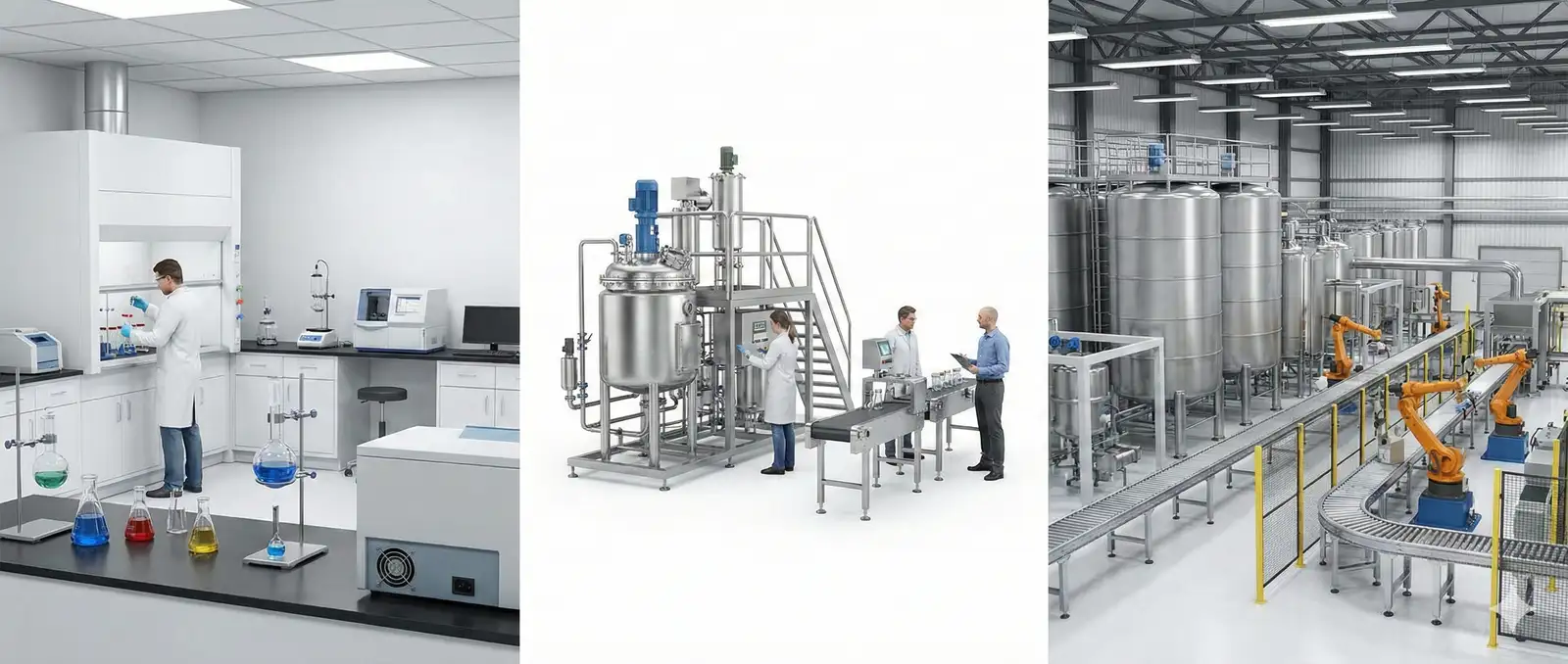
The R&D stage focuses on chemical compatibility and spray performance at the smallest practical scale. The objective is to establish that the concentrate, propellant, can, and valve system work together harmoniously — that the formulation dissolves or suspends correctly in the propellant-solvent mixture and produces the intended spray pattern without separation, clogging, or corrosion. Experiments at this stage use manual hand-crimpers and gassing burettes, with batch sizes typically of five to twenty cans, allowing rapid iteration of valve specifications and propellant ratios without the cost of semi-industrial fill runs.
R&D outcomes are proof-of-concept data, not production-ready specifications. The focus is on verifying the basic solubility of active ingredients, testing candidate propellant configurations, and identifying gross compatibility issues — not on locking dimensional specifications or producing statistically significant performance data. These results form the foundation for later pilot line trials but must not be assumed to represent final product behaviour. Understanding the underlying propellant selection trade-offs between LPG, DME, and compressed gases is essential for intelligent R&D propellant work.

| Parameter | Typical R&D Value |
|---|---|
| Batch sizes | 5 to 20 cans |
| Equipment | Hand crimpers, lab gassing burettes, glass pressure tubes |
| Tests performed | Spray pattern, discharge rate, pressure at 55°C, flammability |
| Primary focus | Valve/gasket compatibility, formula stability, solubility |
What R&D does not solve: High-speed crimp consistency, propellant handling logistics, line efficiencies, bulk batching homogeneity, or commercial cost-of-goods. These questions are only answerable at pilot scale.
Pilot Scale – The Verification Stage
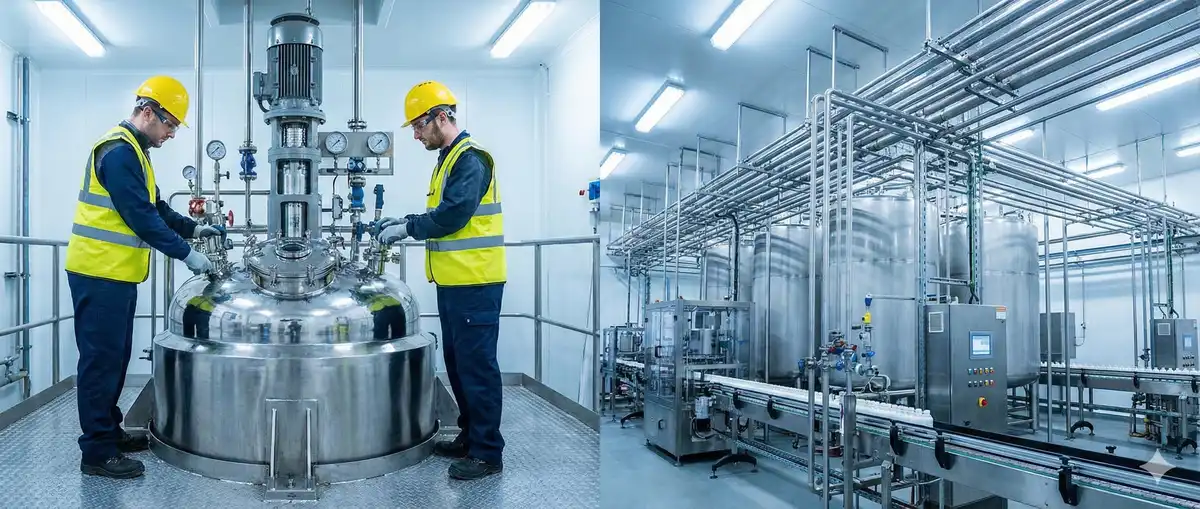
Pilot scale is the engineering bridge between the lab bench and the commercial filling line. At this stage, the product is produced for the first time using semi-automatic or rotary indexing equipment capable of 50–200 cans per hour, exposing crimp and gassing behaviours that are invisible at the laboratory scale. The goal is to verify that the valve specifications developed during R&D translate correctly to semi-industrial crimping conditions, that the gassing process — whether under-the-cup or through-the-valve — works efficiently, and that the formulation maintains its physical integrity under bulk fill conditions. The contract aerosol filling process guide describes the equipment and process steps common to both pilot and commercial lines.
Pilot trials generate the data required to set machine parameters for commercial lines. Because pilot filling operates at semi-industrial speeds, it exposes mechanical bottlenecks and formulation stability challenges — emulsion separation from nozzle shear, foam formation during concentrate filling, slow gassing rates from restrictive valve stems — that are not detectable in hand-filled R&D samples. This stage also produces enough units for stability testing and consumer trials. The deliverables from pilot scale are crimp dimension data, propellant loss factor calculations, and validated fill-weight specifications ready for commercial line setup.
| Parameter | Typical Pilot Scale Value |
|---|---|
| Batch sizes | 500 to 5,000 cans |
| Equipment | Single-head semi-automatic fillers and crimpers |
| Validation | Crimp depth/diameter analysis, leak detection, weight checks |
| Critical output | Propellant loss calculation, headspace verification |
Commercial Manufacturing – High-Speed & Safety
Commercial aerosol manufacturing operates on high-speed rotary lines capable of filling 60 to 300 cans per minute in explosion-proof (Class 1, Division 1 or ATEX Zone 1) environments, due to the large volumes of flammable propellant handled simultaneously. Every single can passes through a water bath at 55°C to test for leakage and pressure resistance — a mandatory safety step that is required under UN transport regulations and is not practical to replicate in laboratory settings. At this scale, quality is ensured not by individual inspection but by statistical process control, validated set-up procedures, and continuous monitoring of key parameters such as fill weight and crimp dimensions. The flammability and explosion protection requirements for aerosol filling environments are governed by standards such as NFPA 30B, the Code for the Manufacture and Storage of Aerosol Products.
Changes at the commercial stage are extremely costly and disruptive. A wrong valve specification creates thousands of leaking cans or a complete line stoppage; a shift in propellant blend ratio due to supplier change can alter the spray rate across the entire batch. Commercial production therefore operates under rigid change-control systems with batch-release protocols and documented container testing. This is why all technical decisions — valve spec, propellant blend, fill weight — must be locked and validated at pilot scale before commercial commitment.
- Batch sizes: 10,000 to 100,000+ cans per production run
- Equipment: High-speed rotary indexers, automated valve placers, in-line water baths
- Safety: 100% water bath leak testing, gas detection systems, explosion-proof infrastructure
- Logistics: Bulk propellant tank farms for LPG, DME, or nitrogen with certified handling systems
Key Differences at a Glance
The three manufacturing stages differ not just in scale, but in the nature of the technical risks managed, the equipment used, and the hazard level of the environment. Understanding these transitions is essential for anyone planning an aerosol product launch, because investment decisions and technical milestones depend on clearly defined stage boundaries. Confusing these roles leads to unrealistic production cost estimates, unsafe facility designs, or commercially non-viable valve specifications locked in from R&D data alone.
| Stage | Primary Focus | Primary Risk Managed |
|---|---|---|
| R&D | Formulation stability & valve selection | Formula separation and incompatibility |
| Pilot Scale | Crimp validation & fill-speed assessment | Crimp leakage and propellant loss |
| Commercial | High-speed throughput, 100% leak testing | Explosion, fire safety, regulatory compliance |
Why Aerosols That Work in the Lab Fail at Scale
Aerosol formulations that show excellent stability and spray characteristics in hand-filled glass tubes frequently exhibit failures when transferred to automated production equipment. These failures are usually physical and mechanical in origin rather than chemical. High-speed gassing pressure, friction inside automated valve stems, and bulk shear rates from filling nozzles can cause emulsions to separate or solid suspensions to agglomerate into valve-blocking clogs — issues that are physically impossible to detect at the 5–20 can scale of a hand-filled R&D batch.
Aerosol scale-up failures share a predictable set of root causes that experienced formulators know to anticipate and test for during pilot stage. Understanding these failure modes early allows developers to design more robust formulations and hardware specifications. The aerosol can corrosion series covers related compatibility failures that emerge at scale, particularly for aqueous and solvent-heavy formulations in contact with metallic packaging components.
- Gassing speed issues: Valve stems that are correctly sized for slow hand-gassing may be too restrictive for high-speed gassing lines, extending fill time and increasing propellant loss.
- Crimp variation: Lab hand-crimpers apply manual force that differs in speed and consistency from pneumatic or servo-driven production crimping heads, requiring re-qualification of crimp dimensions at pilot stage.
- Dip tube curvature: Automated dip tube insertion equipment curves the tube differently than hand insertion, potentially changing draw-down characteristics, particularly for viscous or bottom-heavy formulations.
- Propellant blending: In-line propellant blending from tank farms delivers different blend ratios to the gassing head than pre-mixed laboratory cylinders, requiring vapour pressure re-verification against the R&D specification.
How Startups Should Approach Scale-Up Strategically
Startups entering the aerosol market must approach scale-up with a disciplined, stage-gated methodology to avoid wasting capital on rejected batches, defective packaging runs, or inadequate safety infrastructure. The most common mistake is attempting to compress the R&D and pilot stages into a single step by going directly to a contract manufacturer with an untested formulation, expecting the filler to resolve all process issues on the commercial line. This approach is both expensive and dangerous. Choosing the right aerosol technical consultant early in the process is the most cost-effective first step for any startup team that lacks in-house aerosol manufacturing experience.
Successful aerosol scale-up begins by designing for the manufacturing line from day one — consulting with the intended contract filler about their equipment constraints before finalising valve and actuator specifications. This dialogue prevents situations where a beautifully performing R&D formulation uses a valve the commercial filler doesn't handle, or requires a gassing method their line doesn't support. Strategic start-up actions that minimise scale-up risk include the following:
- Verify valve and actuator specifications with the contract manufacturer at R&D inception, not at pilot stage.
- Run pilot batches specifically to determine propellant loss factors and fill-weight control tolerances before commercial cost modelling.
- Ensure the can lining (epoxy-phenolic, epoxy-amine, or PAM) is specified and validated for the formulation's specific chemistry.
- Validate raw material supply chains for propellants, solvents, and cans before committing to commercial volumes — supply shortages directly affect production cost and schedule.
Lab to Market: India vs Global Context
Manufacturing and scaling aerosol products in India involves navigating a distinct logistics landscape, specific temperature climate conditions (which affect propellant pressure specifications), and evolving regulatory frameworks under BIS (Bureau of Indian Standards) and CDSCO. Indian aerosol manufacturing infrastructure typically operates at smaller commercial scales — 10,000–100,000 units per run — compared to EU or US facilities optimised for multi-million unit campaigns. This creates both advantages (flexibility, lower minimum order quantity) and disadvantages (higher per-unit cost, less consistent automation levels). Industry production statistics and technical standards for the European aerosol market are published by the FEA (European Aerosol Federation), which provides useful benchmarks for comparing Indian and global operational scale.
VOC regulatory constraints differ significantly between markets. India does not yet have product-specific aerosol VOC limits comparable to California's CARB consumer products regulations, which significantly restrict propellant types in specific cosmetic and cleaning aerosol categories in the US. Brands designing for global export must comply with the strictest applicable market requirements from the start, since reformulation after launch is prohibitively expensive. Transport of aerosols across international borders additionally requires IMDG (International Maritime Dangerous Goods) certification, adding logistics compliance costs to the export pathway.
- Propellant quality: Purity specifications for LPG (propane/butane ratio, odour level, moisture) vary between domestic Indian supply and international commercial-grade specifications required for sensitive cosmetic formulations.
- Regulations: VOC limits differ vastly between California (CARB), the EU, and India — designing to the strictest applicable standard from R&D inception avoids expensive reformulation later.
- Transport: Shipping aerosols internationally requires dangerous goods IMDG Class 2.1 (flammable gas) or Class 2.2 (non-flammable gas) classification, packing group documentation, and declared quantities compliance.
Final Thoughts – Scaling is a Safety Discipline
Moving from lab to market in the aerosol industry is fundamentally a safety and engineering discipline, not merely a production volume exercise. It is a transition from chemical curiosity — the proof-of-concept R&D batch — to pressurised precision at commercial scale, where every process parameter must be controlled to within validated tolerances. Products that succeed commercially are those engineered for the high-speed line from day one, with each development stage used deliberately to reduce risk before the next level of capital commitment. Aerosol scale-up done well is methodical, data-driven, and safety-first. Done poorly, it is one of the most dangerous product development pathways in the consumer goods industry.
Frequently Asked Questions
Why do aerosol formulations that work in the lab often fail at pilot scale?
Laboratory aerosol prototypes are hand-filled using manual crimpers and gassing burettes at slow speeds with precise manual control. When transferred to semi-automated pilot lines, the higher gassing speed, different crimping force from pneumatic heads, and automated dip tube insertion create different physical conditions that expose formulation weaknesses invisible in the lab. Common failure modes include valve stem clogging from formulations too viscous for high-speed flow, emulsion separation under bulk shear, and propellant flash-off from filling bowls that changes final can pressure.
What is the purpose of the hot water bath (55°C) test in commercial aerosol manufacturing?
The 100% hot water bath test at 55°C serves two purposes: leak detection and pressure resistance verification. Every filled can is immersed in water at 55°C, and any can that leaks or deforms is immediately identified and rejected. The 55°C temperature corresponds to the maximum permitted internal pressure for UN-compliant aerosol containers under normal transport conditions, making this a realistic stress test for distribution safety. This test cannot be economically replicated in laboratory settings, which is one reason commercial manufacturing cannot be bypassed.
What crimp measurements must be validated during aerosol pilot scale trials?
The two critical crimp measurements are crimp diameter and crimp depth. Crimp diameter must fall within the valve manufacturer's specified tolerance, typically ±0.1 mm, to ensure correct gasket compression. Crimp depth affects the sealing integrity of the gasket against the can curl. Both dimensions must be validated across the full pilot batch using statistical sampling to confirm the line produces consistently safe, leak-free crimps before commercial commitment.
What are 'loss factors' for propellant in aerosol manufacturing?
Propellant loss factor is the percentage of propellant that evaporates, bleeds off, or is lost to the atmosphere between the storage tank and the final sealed can during the gassing process. Loss factors vary depending on filling method (under-the-cup vs through-the-valve), line speed, ambient temperature, and propellant volatility. Accurately quantifying loss factors during pilot scale trials is essential for commercial cost planning, since propellant often represents 15–30% of total product cost.
How do VOC regulations differ between India, the EU, and the US for aerosol manufacturing?
In the US, California's CARB sets the strictest VOC limits, restricting LPG propellant in certain cosmetic aerosol categories. EU regulations set VOC limits for decorative and automotive aerosols, with HFC phase-down affecting propellant selection. India currently lacks product-specific aerosol VOC regulations at the same detail, though manufacturers targeting export markets must comply with destination-country VOC rules from the design stage to avoid costly reformulation after launch.
When should an aerosol startup use contract filling rather than building in-house manufacturing?
Contract aerosol filling is typically the correct initial strategy for startups because it eliminates capital investment in explosion-proof filling infrastructure — explosion-proof electrical systems, propellant storage, water bath testing lines — which can cost several crore rupees or millions of dollars. Contract filling allows a brand to validate market demand and resolve formulation issues at relatively low cost before a capital decision is warranted. In-house manufacturing becomes viable when annual volumes justify infrastructure investment and when tight process control over proprietary formulations is a competitive requirement.
Visualising the 3D Product
Check how your aerosol product branding looks on a physical cylinder using our 3D design studio:
Need Technical Support for Aerosol Formulations?
Partner with Global Aerosols to audit, scale up, and troubleshoot your aerosol chemistry, canister pressure calculations, filling lines, and safety systems.
Email: consulting@globalaerosols.com
Website: https://www.globalaerosols.com
Phone: +91 9819548320 +91 8169102990
About the Specialist
Absar Khan is the principal consultant and chemical formulation architect at Global Formulation. He possesses cross-disciplinary engineering expertise spanning aerosol gassing systems, pharmaceutical manufacturing, sterile injectables, cosmetics, and green chemical plant setups. Absar leads scientific and engineering advisory teams supporting manufacturers globally in technology selection, GMP layouts, validation frameworks, and regulatory strategies.
LinkedIn Portfolio: Connect with Absar Khan on LinkedIn