Aerosol vs Pump vs Trigger Spray: Technical Comparison
Guide Contents
In the competitive landscape of liquid product development, the choice of delivery system is a pivot point between commercial success and technical failure. Whether you are launching a cosmetic mist, an industrial cleaner, or a pharmaceutical spray, understanding the fluid dynamics and mechanical engineering behind aerosol, pump, and trigger systems is critical. This guide dissects these technologies to help founders make data-driven decisions that balance performance, cost, and user experience. Our aerosol technology and formulations hub covers the engineering behind the aerosol option in more depth.
1. Understanding the Core Technologies
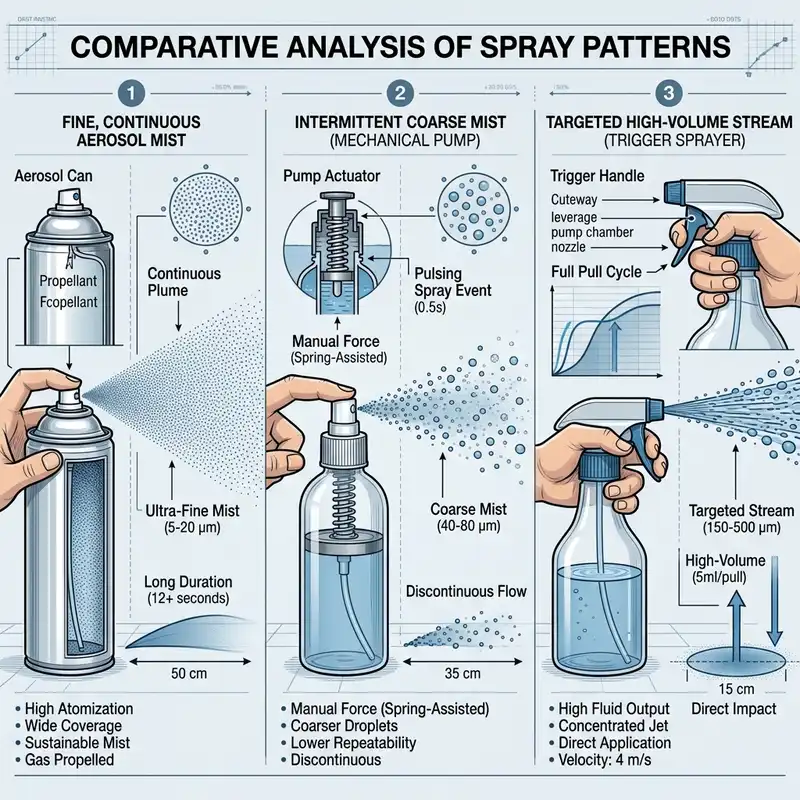
At their core, all three systems serve the same purpose: to convert a bulk liquid into a dispersed phase (droplets) for application. However, the energy source used to achieve this atomization varies significantly between them. Aerosols rely on stored chemical energy in the form of propellants, while pump and trigger sprays utilize manual mechanical energy converted through a piston-and-spring assembly. Understanding these fundamental mechanics is the first step in selecting the right "engine" for your product's delivery.
Aerosol Systems: The Power of Pressurization
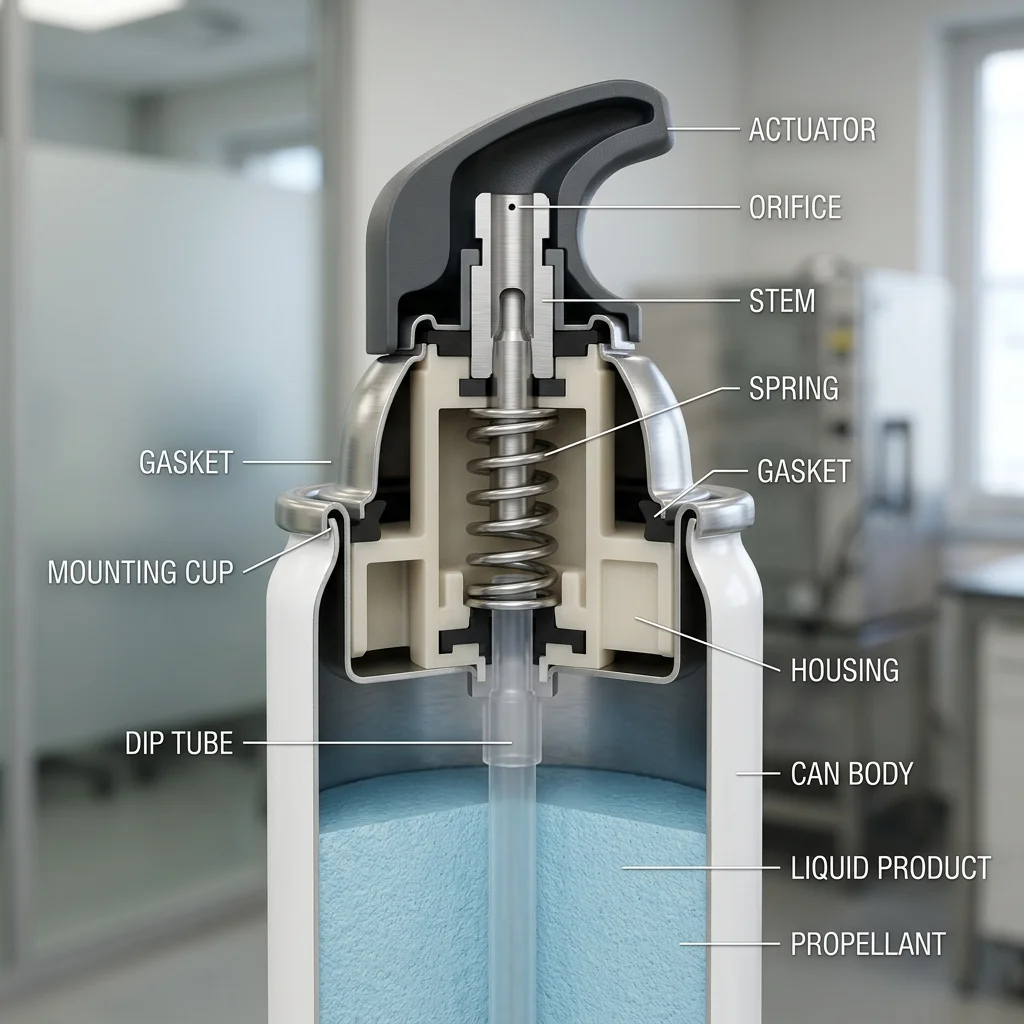
Aerosol technology is a sophisticated closed-loop system where the product is stored under pressure alongside a liquefied or compressed gas propellant. When the actuator is depressed, the pressure differential forces the product through a dip tube and a precision-engineered valve. The propellant then rapidly expands as it hits atmospheric pressure, shattering the liquid into an ultra-fine, consistent mist. This process allows for continuous application without the user needing to exert repetitive manual force.
Pump Sprays: Mechanical Precision in Small Form Factors
Pump sprays, used in personal care and fragrances, operate via a miniature positive displacement pump. When the user presses the actuator, a piston moves within a cylinder, creating a vacuum that draws liquid up the dip tube. Upon release or further compression, the liquid is forced through a swirl chamber in the nozzle, which induces turbulence and breaks the liquid into droplets. Unlike aerosols, pump sprays are intermittent and depend entirely on the speed and force of the user's finger stroke.
Trigger Sprays: High-Volume Manual Delivery
Trigger sprayers are the heavy-duty cousins of pump sprays, designed for ergonomic comfort during high-volume applications. They utilize a larger piston assembly actuated by a trigger lever, which provides greater mechanical advantage. This allows for the delivery of higher volumes of liquid per stroke and the ability to handle higher-viscosity formulations that would clog a standard finger pump. They are the industry standard for household cleaning, garden care, and automotive detailing products.
2. Technical Performance Comparison
When evaluating performance, engineers focus on two primary metrics: Particle Size Distribution (PSD) and spray pattern consistency. These factors determine how effectively the product interacts with the target surface, whether it's a human hair strand, a solar panel, or a brake rotor. A mismatch between the delivery system and the formulation's physical properties can lead to "spitting," "drooling," or uneven coverage, all of which diminish the perceived quality of the brand.
Atomization and Particle Size Distribution
Aerosols offer the finest atomization of the three systems, which suits "dry" sprays and airborne applications. Pump sprays produce medium-sized droplets suited to surface-wetting applications like skin toners. Trigger sprays produce the largest droplets, delivering a significant volume of liquid quickly to a surface with minimal drift. Achieving a specific PSD requires fine-tuning the nozzle geometry and, in the case of aerosols, the propellant-to-product ratio.
In an aerosol, the liquefied propellant dissolved in the concentrate flash-boils as the pressure drops at the orifice, and the released energy breaks the liquid into droplets. Our guide to aerosol particle size distribution measurement explains how droplet sizes are measured, and aerosol actuators 101 covers the nozzle geometry that shapes them.
Coverage and Continuous vs. Intermittent Spray
One of the greatest technical advantages of aerosols is the ability to provide a continuous, even spray for as long as the actuator is held. This ensures uniform film thickness on complex surfaces. Manual sprays (pump and trigger) are inherently intermittent. The spray begins and ends with each stroke, which can lead to "heavy spots" at the start of a stroke and "fines" at the end. For products requiring precision coatings or professional-grade finishes, the continuous nature of aerosols is non-negotiable.
Viscosity Compatibility and Clogging Risks
Formulation viscosity is the "deal-breaker" in delivery system selection. High-viscosity liquids (like heavy oils or waxes) require significant energy to atomize. Trigger sprayers, with their large pistons, are most capable of handling these fluids. Aerosols can handle higher viscosities if the propellant is soluble in the product, essentially thinning it out internally before atomization. Finger pumps are the most sensitive and are limited to water-thin or very light oil-based formulations to prevent mechanical failure and clogging.
Bag-on-valve designs keep the product separate from the propellant inside a multi-layered bag. This suits medium to high-viscosity formulations such as gels and thick creams, as covered in our bag-on-valve guide.
| Feature | Aerosol | Pump Spray | Trigger Spray |
|---|---|---|---|
| Mechanism | Pressurized Propellant | Manual Piston | Trigger Lever Piston |
| Spray Type | Continuous & Ultra-Fine | Intermittent & Fine Mist | High-Volume & Targeted |
| Viscosity Limit | Low to Medium | Very Low (Water-thin) | Medium to High |
| Typical Applications | Paints, Deodorants, Lubes | Perfumes, Facial Mists | Glass Cleaners, Degreasers |
The table summarizes how the three systems differ on performance. The next section adds cost and logistics to the picture.
3. Manufacturing and Cost Analysis for Startups
For a startup, the technical ideal must be weighed against the financial reality of manufacturing and logistics. The "Total Cost of Goods" (COGS) for a spray product includes more than the liquid and the spray head. It also covers the container, the filling process, and the regulatory compliance costs associated with the chosen technology. Founders must also consider Minimum Order Quantities (MOQs), which can vary drastically between simple bottle filling and complex aerosol production lines.

Packaging Material Costs
Aerosol systems are the most expensive to package. They require high-pressure metal cans (aluminum or tinplate), specialized valves, and custom actuators. In contrast, pump and trigger sprays use standard plastic or glass bottles with threaded necks. While high-end "fine mist" pump heads can be pricey, a manual spray system's component cost is meaningfully lower than an equivalent aerosol system's, providing better margins for early-stage ventures.
Filling Line Complexity and MOQs
Filling aerosols is a specialized process that requires explosion-proof facilities and high-precision equipment to handle propellants safely. Contract manufacturers (CMOs) for aerosols set correspondingly higher minimum order quantities (MOQs) to cover that overhead. Pump and trigger sprays are filled on much simpler liquid filling lines, which accept far smaller production runs. This lower barrier to entry makes manual sprays attractive for "Minimum Viable Product" (MVP) launches.
Supply Chain and Hazmat Logistics
Logistics carry "hidden costs" that are easy to overlook. Aerosols are classified as "Dangerous Goods" (UN1950) because they are pressurized, and flammable formulations add a further hazard. This leads to higher shipping rates, specialized warehousing requirements, and strict limitations on air freight. Manual sprays (non-pressurized) are significantly easier and cheaper to ship, especially for Direct-to-Consumer (DTC) brands relying on standard courier services like FedEx or DHL.
Transport rules for aerosols are summarized in our guide to DOT and UN aerosol transport regulations. In the US they sit in 49 CFR, and air shipments follow the IATA Dangerous Goods Regulations. Our guide to how contract aerosol filling works explains what to expect from an aerosol contract filler.
The table below sets the packaging, filling, and shipping differences side by side.
| Factor | Aerosol | Pump / Trigger Spray |
|---|---|---|
| Container | High-pressure metal can (aluminum or tinplate) | Standard plastic or glass bottle with a threaded neck |
| Dispensing hardware | Specialized valve and custom actuator | Pump head or trigger sprayer |
| Filling | Explosion-proof facility and high-precision equipment | Simpler liquid filling lines |
| Shipping | Dangerous Goods (UN1950) with strict limits on air freight | Standard courier services |
Once cost and logistics are clear, the last filters are sustainability and regulation.
4. Sustainability and Regulatory Landscape
In the modern market, technical excellence is insufficient if it doesn't align with sustainability goals and regulatory mandates. Global regulators, including the EPA in the US and the CPCB in India, are increasingly tightening restrictions on Volatile Organic Compounds (VOCs) and single-use plastics. Founders must navigate these rules while meeting the growing consumer demand for "eco-friendly" and "refillable" product formats, which can significantly influence the choice of delivery system.
VOC Emissions and Propellant Safety
The primary environmental concern with aerosols is the use of propellants. Modern aerosols no longer use ozone-depleting CFCs. Many still rely on LPG (Liquefied Petroleum Gas), a hydrocarbon that counts toward VOC levels, or on HFCs, which carry a high global warming potential. However, the industry is shifting toward "Green Propellants" like Nitrogen (N2) or Carbon Dioxide (CO2). Manual pump and trigger sprays are inherently VOC-free (from a propellant standpoint), making them the "greener" choice by default for many eco-conscious brands. For more technical details on this, you can read our guide on aerosol propellants explained. Category-level VOC limits are covered in our guide to CARB aerosol VOC regulations.
Refillability and Circular Economy Trends
A major trend in startup innovation is the "concentrate and refill" model. Trigger and pump spray systems are perfectly suited for this. The high-quality spray head can be reused dozens of times while the consumer simply buys a refill bottle or a concentrated pod. Aerosol cans, being pressurized and sealed, are harder to integrate into a circular economy model. For founders focusing on sustainability as a core brand pillar, the reuse potential of trigger sprayers is a powerful marketing and environmental advantage.
5. Strategic Selection: Which System Fits Your Product?
Ultimately, the selection process should be a weighted matrix of performance needs, target margins, and brand identity. If your product's value proposition is "professional-grade coverage" or "effortless application," an aerosol can justify the added investment. If your focus is "clean beauty," "eco-friendly cleaning," or "cost-effective scaling," a high-quality pump or trigger system will serve you better. Consult with technical experts early in the formulation phase to ensure your liquid is compatible with your chosen "engine."
For more information about the aerosol ecosystem and how these systems compare in real-world manufacturing, please read our related technical articles. We cover everything from the fundamental physics of how aerosol cans work to the complexities of aerosol manufacturing 101. Understanding the nuances of aerosol formulation and common issues like aerosol can corrosion is essential for long-term product stability.
If you are in the design phase, we highly recommend visiting our 3D Can Artwork Design studio. You can visualize your branding on different formats using our tools for Tinplate Can Wrapping and specialized Aluminium Can Designs. This allows you to check how your design translates to a cylindrical format before committing to a delivery system.
Spray System FAQs
What is the main difference between aerosol, pump, and trigger sprays?
The difference is the energy source. Aerosols store chemical energy in a propellant, while pump and trigger sprays use manual mechanical energy transmitted through a piston-and-spring assembly. That difference shapes droplet size, spray continuity, viscosity range, cost, and shipping rules.
Which spray system produces the finest droplets?
Aerosols produce the finest droplets, which suits dry sprays and airborne applications. Pump sprays produce medium droplets suited to surface wetting, and trigger sprays produce the largest droplets for high-volume delivery with minimal drift. Nozzle geometry and, for aerosols, the propellant-to-product ratio tune the final droplet size distribution.
Which system handles high-viscosity formulations best?
Trigger sprayers handle higher-viscosity fluids best because their large pistons supply more energy per stroke. Aerosols can handle higher viscosities when the propellant dissolves in the product and thins it before atomization. Finger pumps are the most sensitive and suit water-thin or very light oil-based formulations.
Why are aerosols more expensive to package and ship?
Aerosols need high-pressure metal cans, specialized valves, and custom actuators, whereas pump and trigger sprays use standard plastic or glass bottles with threaded necks. Aerosol filling requires explosion-proof facilities and high-precision equipment. Shipping costs more because aerosols are classified as dangerous goods under UN1950, which also limits air freight.
Are pump and trigger sprays more sustainable than aerosols?
Pump and trigger sprays contain no propellant, so they are free of propellant VOCs, and their spray heads can be reused in concentrate-and-refill models. Aerosol cans are pressurized and sealed, which makes them harder to integrate into a refill model. Aerosols can lower their impact by using nitrogen or CO2 in place of LPG or HFCs.
How should a founder choose between the three systems?
Weigh performance needs, target margins, and brand identity. An aerosol suits professional-grade coverage and effortless application, while a pump or trigger system suits clean beauty, eco-friendly cleaning, and cost-effective scaling. Confirm that the formulation is compatible with the chosen system early in development.
Need Technical Support for Aerosol Formulations?
Partner with Global Aerosols to audit, scale up, and troubleshoot your aerosol chemistry, canister pressure calculations, filling lines, and safety systems.
Email: consulting@globalaerosols.com
Website: https://www.globalaerosols.com
Phone: +91 9819548320 +91 8169102990
About the Specialist
Absar Khan is the principal consultant and chemical formulation architect at Global Formulation. He possesses cross-disciplinary engineering expertise spanning aerosol gassing systems, pharmaceutical manufacturing, sterile injectables, cosmetics, and green chemical plant setups. Absar leads scientific and engineering advisory teams supporting manufacturers globally in technology selection, GMP layouts, validation frameworks, and regulatory strategies.
LinkedIn Portfolio: Connect with Absar Khan on LinkedIn