Chain Lubricant Aerosols: Science of Chemistry, Adhesion & Wear Protection
Guide Contents
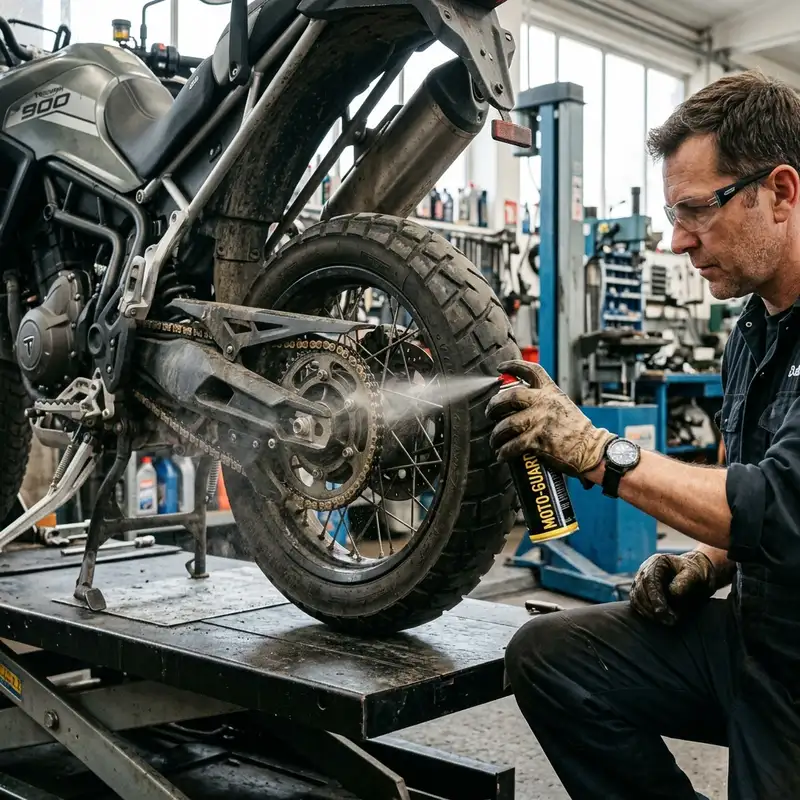
Drive chains are the lifeblood of countless mechanical systems, ranging from industrial conveyors and agricultural harvesters to high-performance motorcycles and bicycle drivetrains. In these environments, chains endure extreme mechanical stresses, varying temperatures, and exposure to abrasive contaminants like dust and moisture. Maintaining these systems requires more than simple lubrication; it necessitates a sophisticated chemical approach to ensure the lubricant stays exactly where it is needed — deep within the pins and rollers — while resisting the centrifugal forces that attempt to fling it off during high-speed operation. Aerosol delivery is uniquely suited to this task, combining precision atomisation with penetrating solvent carriers that reach inaccessible internal interfaces. For more on how industrial aerosol systems are engineered for demanding applications, see our industrial overview.
Introduction to Aerosol Chain Lubricants
Aerosol delivery systems offer a precise and technically superior application method for chain maintenance compared to traditional liquid or paste lubricants. By atomising the lubricant into a fine mist or targeted stream, aerosol systems force the fluid into microscopic clearances — typically around 0.05 mm — between pins, bushings, and rollers that are otherwise inaccessible. This penetrative capability is achieved through a carefully balanced combination of low-surface-tension solvent carriers and high-velocity propellant energy, ensuring internal chain components are coated in a protective film before the thickening and adhesion agents take effect. Understanding the underlying formulation science is essential to selecting the correct product for a given chain type and operating environment.
- Precision delivery: Reduces lubricant waste by targeting the specific contact points of the chain rather than flooding surrounding surfaces.
- Penetration depth: Low-viscosity initial carrier phase allows the lubricant to reach the internal pin-roller interface before the solvent flashes off.
- Contamination displacement: The pressurised jet creates a localised fluid dynamic that can help displace light debris during application.
- Controlled overspray: Minimises lubricant deposition on wheels, frames, or surrounding machinery compared to drip or brush application.
The aerosol format also enables consistent dosing regardless of operator technique — a critical factor in maintenance-intensive industrial environments where human variability directly affects chain service life. Chain lubrication intervals and film thickness requirements are governed by engineering standards including those published by the American Society for Testing and Materials (ASTM), which provides standardised wear and lubrication test methods applicable to industrial drive systems.
The Chemistry of Adhesion in Chain Lubricants
The most significant tribological challenge for any chain lubricant is adhesion — the ability of the chemical film to bond to metal surfaces and resist mechanical displacement. High-speed chains generate significant centrifugal force, which easily flings low-adhesion oils off the surface, leaving metal-to-metal contact points exposed. To prevent this, formulators incorporate tackifiers — specialised high-molecular-weight polymers that increase the cohesive strength of the lubricant film, creating a stringy texture that grips the metallic surface with exceptional tenacity. The selection of the correct tackifier molecular weight and chemistry is a key differentiator between entry-level and professional-grade chain lubricants.

Beyond tackiness, effective adhesion chemistry involves polar molecules that have a natural affinity for steel and alloy surfaces. These polar compounds — typically specialised esters or fatty acid derivatives — form a semi-permanent molecular orientation layer on the metal lattice, acting as a foundation for the bulk lubricant film above. This dual-layer approach — a polar base layer for surface affinity and a polymer-fortified bulk layer for mechanical resilience — ensures the lubricant does not migrate or drip even in vertically oriented industrial applications. The chemistry of chain lubricant adhesion is well-characterised in the tribology literature, with research accessible through databases such as PubMed (NIH) covering thin-film lubrication and boundary adsorption mechanisms.
- Tackifier selection: High-molecular-weight polymers that provide film cling without attracting excessive abrasive debris from the environment.
- Polar compounds: Specialised esters or fatty acids that orient ionically toward the metallic lattice, establishing a substrate-bound anchor layer.
- Surface tension optimisation: Balancing the ability to wet the metal surface during application with the need for high cohesion after solvent evaporation.
- Thermal stability: Ensuring the adhesion layer does not degrade or lose viscosity as the chain heats up during sustained operation.
For formulators developing aerosol dry lubricant systems based on solid particle suspensions rather than liquid films, the adhesion challenge differs — particles must be distributed uniformly and held in suspension within the aerosol before application, then adhere mechanically to the surface asperities after deposition.
Wear Protection and Boundary Lubrication
Wear protection in chain systems is primarily a function of boundary lubrication — the ability of the lubricant to prevent direct metal-on-metal contact when operating pressures are too high for a full hydrodynamic film to form. During the heavy-load phases of a chain's rotation, particularly at the sprocket engagement points, the lubricant film is squeezed to extreme thinness, requiring chemical additives to intervene. Anti-Wear (AW) and Extreme Pressure (EP) agents respond to these high-energy environments by reacting with the metal surface to form sacrificial protective layers — typically phosphate, sulfide, or organometallic compounds — that shear more easily than the base metal, significantly extending the service life of sprockets and links.
| Additive Type | Primary Function | Common Examples |
|---|---|---|
| Anti-Wear (AW) | Prevents steady wear under moderate loads by forming a sacrificial phosphate film | ZDDP (Zinc Dialkyldithiophosphate) |
| Extreme Pressure (EP) | Prevents welding and galling under high-impact loads by forming sulfide or chloride reaction films | Sulfurised fats, phosphated esters |
| Solid Lubricants | Provides dry-film fallback protection if the liquid lubricant film fails during startup or extreme load | MoS₂, PTFE, graphite |
| Corrosion Inhibitors | Prevents oxidation and rust in humid or marine environments by forming a passivation layer | Calcium sulfonates, synthetic esters |

Modern high-performance aerosol chain lubricants often incorporate solid lubricant suspensions such as Molybdenum Disulfide (MoS₂) or PTFE. These microscopic particles fill in the surface asperities — the microscopic peaks and valleys inherent in all machined metals — creating a smooth plane that reduces friction coefficients even under dry startup conditions. This dry-film protection is particularly critical for industrial chains that may remain idle for extended periods, preventing the initial scuffing that occurs before the liquid lubricant film mobilises. The performance of MoS₂ and PTFE solid lubricants under boundary conditions is documented in the tribology literature and can be verified through resources such as PubChem (NIH) for compound property data. For related context, our guide on PTFE and MoS₂ aerosol dry lubricants covers suspension formulation in depth.
Formulation Components for Aerosol Delivery
Transitioning a bulk lubricant into an aerosol-dispensed product requires careful management of solvent dynamics and propellant interaction. The lubricant concentrate must be diluted with a volatile carrier solvent to achieve the low viscosity required for atomisation; however, this solvent must evaporate rapidly after application to leave behind the high-viscosity, high-adhesion film. If the solvent evaporates too slowly, the lubricant may drain away before bonding; if it evaporates too quickly, insufficient penetration depth is achieved at pin-roller interfaces. This solvent-balance challenge is one of the most technically demanding aspects of chain lubricant aerosol formulation.
- Solvent carriers: Selected to regulate the open time — the window between application and solvent flash-off — to maximise internal penetration depth at the target operating temperature range.
- Propellant systems: LPG blends provide consistent pressure delivery throughout the can's life; Dimethyl Ether (DME) additionally contributes solvency that can assist initial lubricant penetration into tight chain clearances.
- Suspension stability agents: Ensure solid lubricants such as MoS₂ remain uniformly dispersed and do not agglomerate or settle in a way that clogs the aerosol valve during storage or use.
- Safety-compliant solvents: Non-chlorinated aliphatic or isoparaffinic hydrocarbons are selected to comply with environmental and occupational health regulations, including VOC limits set by regulatory agencies such as the US Environmental Protection Agency (EPA).
Propellant selection also affects the spray pattern and velocity, which in turn influences how deeply the lubricant penetrates the chain. Higher propellant pressures generate finer atomisation and greater penetrating velocity, but must be balanced against container pressure safety requirements. The mechanics of aerosol propellant selection — covering LPG, DME, and compressed gas options — are covered in detail in our propellants guide. Valve and actuator design is equally critical: the orifice diameter governs spray pattern width and droplet size, directly influencing whether the aerosol wets internal chain interfaces or disperses broadly across external surfaces. The fundamentals of aerosol actuator engineering provide useful context for understanding these design trade-offs.
Industrial Applications and Performance Standards
Performance testing is essential to validate that an aerosol chain lubricant meets the rigorous demands of industrial environments. Standardised test methods quantify lubricant performance in repeatable, comparative terms, allowing engineers to select products appropriate for their specific chain type, load profile, speed range, and environmental conditions. Without standardised testing, lubricant performance claims cannot be objectively verified. The two most widely referenced test methods in industrial chain lubricant qualification are ASTM D4172 and ASTM B117, both published by the ASTM International standards body.
| Test Standard | What It Measures | Relevance to Chain Lubrication |
|---|---|---|
| ASTM D4172 (Four-Ball Wear) | Wear scar diameter on steel balls under defined load, speed, and temperature | Quantifies AW additive effectiveness under boundary lubrication conditions |
| ASTM B117 (Salt Spray) | Hours to first corrosion under 5% NaCl fog exposure | Critical for marine, outdoor, and winter-road chain applications |
| Spin-Off Testing | Percentage of lubricant lost at specified RPM values | Directly measures tackifier effectiveness against centrifugal fling-off |
| Penetration Rating | Fluid ability to move through 0.05 mm clearances | Validates aerosol carrier system design for internal pin-roller access |
Industrial chain lubricant aerosols are used across a broad spectrum of applications — from food-grade conveyor chains in processing plants (which require NSF H1-certified lubricants) to high-speed motorcycle and bicycle drivetrains demanding thin, fling-resistant films. Agricultural harvest equipment chains face combined exposure to abrasive soil particles, moisture, and heavy loads, placing simultaneous demands on EP protection and corrosion resistance. Workplace safety requirements for aerosol lubricants used in confined industrial spaces are governed by regulations published by the Occupational Safety and Health Administration (OSHA), including hazard communication standards for flammable aerosol products. For context on how aerosol cans are designed to contain these formulations safely, our guide on aerosol can safety and pressure standards covers burst testing and DOT compliance in detail. Selecting the right chain lubricant aerosol for a given application is also part of a broader aerosol manufacturing and formulation decision framework that considers propellant type, can pressure, valve specification, and regulatory compliance simultaneously.
Frequently Asked Questions
How does an aerosol chain lubricant penetrate into pin-roller interfaces?
Aerosol chain lubricants are formulated with low-surface-tension volatile carrier solvents that reduce initial viscosity, allowing the product to flow into clearances of approximately 0.05 mm between pins, bushings, and rollers. High-velocity propellant atomisation drives penetration into these confined spaces before the solvent evaporates, leaving behind the high-adhesion lubricant film. This is the fundamental advantage of aerosol delivery over manual paste or drip-oil application.
What are tackifiers and why are they used in chain lubricants?
Tackifiers are high-molecular-weight polymers added to chain lubricants to increase the cohesive strength and adhesion of the lubricant film. They create a characteristic stringy, tenacious texture that resists the centrifugal forces generated by high-speed rotating chains, preventing fling-off. Without tackifiers, conventional mineral oils would be displaced from pin and roller surfaces within minutes of operation at elevated speeds.
What is boundary lubrication and when does it occur in chain systems?
Boundary lubrication occurs when the hydrodynamic film between two metal surfaces is squeezed too thin to prevent asperity-to-asperity contact — typically during start-up, high-load, or low-speed operation. In this regime, chemical additives rather than film thickness govern wear protection. Anti-wear (AW) agents such as ZDDP react with metal surfaces at moderate temperatures to form sacrificial phosphate or sulfide layers, while extreme pressure (EP) agents activate at higher localised flash temperatures to prevent welding and galling.
What do ASTM D4172 and ASTM B117 measure for chain lubricants?
ASTM D4172, the Four-Ball Wear Test, measures the wear scar diameter produced on steel balls under a controlled load (typically 40 kg), speed (1200 rpm), and temperature (75 °C) over a defined period. A smaller scar indicates superior anti-wear performance. ASTM B117, the Salt Spray Test, exposes coated or treated metal specimens to a 5% sodium chloride fog to quantify corrosion resistance over time — critical for chains used in marine, outdoor, or winter road environments.
Why are MoS₂ and PTFE used in aerosol chain lubricants?
Molybdenum disulfide (MoS₂) and polytetrafluoroethylene (PTFE) are solid lubricants with layered crystal structures that provide exceptionally low coefficients of friction. When suspended in aerosol chain lubricants, these microscopic particles fill surface asperities on metal contact zones, creating a smooth dry-film layer that maintains protection even during dry start-up conditions before the liquid lubricant reaches operating temperature. MoS₂ is particularly effective under high contact pressure where conventional oils thin out.
How does solvent carrier selection affect chain lubricant performance?
The volatile carrier solvent in an aerosol chain lubricant must balance two competing requirements: low enough viscosity and surface tension to penetrate pin-roller clearances during application, and a fast enough evaporation rate to leave behind the concentrated lubricant film before it drips off. Slow-evaporating solvents improve penetration depth but increase runoff. Formulators typically use aliphatic or isoparaffinic hydrocarbons whose flash points and evaporation rates are selected to meet both performance and flammability regulatory requirements.
Need Technical Support for Aerosol Formulations?
Partner with Global Aerosols to audit, scale up, and troubleshoot your aerosol chemistry, canister pressure calculations, filling lines, and safety systems.
Email: consulting@globalaerosols.com
Website: https://www.globalaerosols.com
Phone: +91 9819548320 +91 8169102990
About the Specialist
Absar Khan is the principal consultant and chemical formulation architect at Global Formulation. He possesses cross-disciplinary engineering expertise spanning aerosol gassing systems, pharmaceutical manufacturing, sterile injectables, cosmetics, and green chemical plant setups. Absar leads scientific and engineering advisory teams supporting manufacturers globally in technology selection, GMP layouts, validation frameworks, and regulatory strategies.
LinkedIn Portfolio: Connect with Absar Khan on LinkedIn