Food-Grade Aerosols: Nitrous Oxide and CO₂ in Whipping Cream & Beverages

Guide Contents
A food-grade aerosol propellant is a specialized, highly purified gas utilized to expel food products from pressurized containers while maintaining structural, microbial, and sensory integrity. In the modern food processing industry, nitrous oxide (N₂O) and carbon dioxide (CO₂) represent the primary compressed gases selected for dispensing whipped emulsions and carbonating beverages. This comprehensive guide details the thermodynamic properties, chemical mechanisms, valve engineering, and global regulatory frameworks that govern food-grade aerosol systems.
Understanding Compressed Gas Propellants
Industrial aerosol systems historically relied on liquefied gas propellants, such as hydrocarbons, to maintain a constant internal pressure throughout a product's life. In food applications, however, chemical safety and flavor preservation dictate the exclusive use of compressed gases or highly specific soluble gases. Understanding the distinction between liquefied and compressed gas behavior is fundamental to designing a reliable packaging system.
Unlike liquefied propellants, which exist in a liquid-gas equilibrium inside the container, compressed gas propellants remain entirely in the gaseous phase (or dissolved within the liquid product matrix) under typical operating pressures. This means that as the food product is discharged, the headspace volume increases, causing a corresponding drop in pressure according to the ideal gas law. To mitigate this pressure drop, engineers must select gases with high solubility in the formulation, allowing a reservoir of dissolved gas to desorb and sustain dispensing pressure. Nitrous oxide and carbon dioxide are the premier choices due to their unique solubility characteristics in lipid and aqueous phases, respectively, avoiding the flat discharge profile of insoluble gases like nitrogen.
Furthermore, the physical behavior of these gases is highly temperature-dependent. At room temperature, the gas molecules undergo constant kinetic interaction with the food emulsion, and their solubility decreases as temperature rises. This temperature sensitivity requires careful formulation adjustment to ensure the aerosol can retains sufficient propellant pressure under refrigerated storage (typically 4°C) as well as ambient conditions. A thorough analysis of thermodynamic properties is necessary when designing these systems, and researchers frequently reference databases like the NIST Chemistry WebBook to retrieve precise vapor pressure and density coefficients across operational temperature ranges.
Nitrous Oxide Whipping Cream Chemistry
The widespread success of aerosolized whipped cream is directly attributed to the solubility profile of nitrous oxide within the lipid structures of milk fat. When nitrous oxide is introduced to an emulsion under pressure, it dissolves preferentially into the fat globules rather than the surrounding water phase. This lipophilic affinity is key to generating the high overrun and structural stability characteristic of professional whipped cream.
When the valve actuator is depressed, the pressure drops instantly from the internal storage pressure to atmospheric pressure. This sudden thermodynamic change forces the dissolved nitrous oxide to rapidly desorb, expanding out of the fat phase. As the gas expands, it forms micro-bubbles that are immediately encapsulated by the surrounding lipid-protein matrix, creating a stable whipped structure. This phenomenon is known as "overrun" and represents the percentage increase in cream volume; the process depends heavily on the fat globules aligning to form a cohesive wall around the gaseous bubbles, preventing coalescence and subsequent drainage.
For chemical and structural properties of N₂O, including its partition coefficient and safety parameters, formulation engineers rely on databases such as the National Institutes of Health's PubChem Database. The inert nature of nitrous oxide ensures it does not oxidize the lipid compounds in the cream, preventing rancidity and off-flavors over the shelf life of the product, which is a common failure mode when using oxygen-containing compressed gases.
CO2 Beverage Aerosol Mechanics
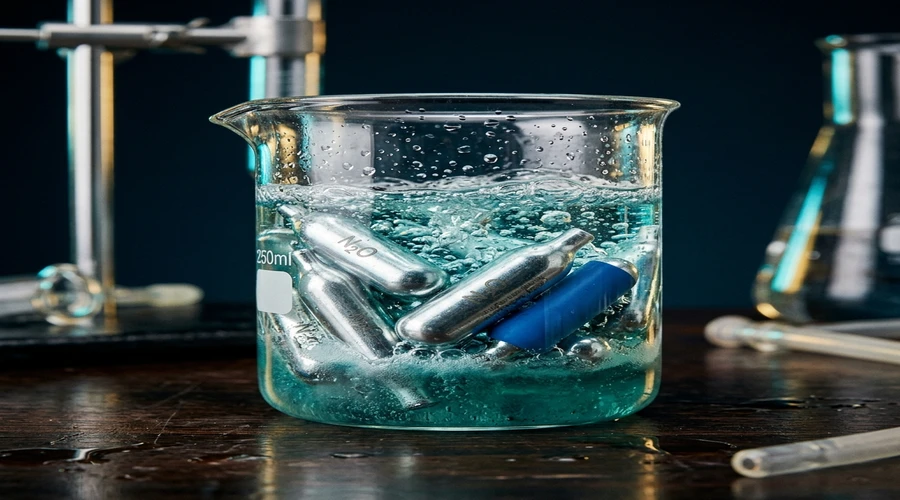
Carbon dioxide behaves quite differently than nitrous oxide when dissolved in food systems, owing to its high solubility in water and its chemical reactivity with aqueous matrices. In beverage aerosols, carbon dioxide functions both as an expelling agent and as a carbonating medium, introducing fizz and acidity to the product. The physics of this system is governed by Henry's Law, which determines the concentration of gas dissolved in the liquid based on the partial pressure of the gas headspace.
When carbon dioxide dissolves in water, a portion of the gas undergoes hydration to form carbonic acid (H₂CO₃), which subsequently dissociates into bicarbonate and hydrogen ions, lowering the pH of the liquid. This chemical transition gives carbonated beverages their characteristic tartness. In an aerosol container, the high pressure forces a large volume of carbon dioxide into solution; once dispensed, the pressure relief drives the gas out of solution, forming bubbles of effervescence. Because carbon dioxide does not dissolve in lipids to the same extent as nitrous oxide, it is unsuitable for creating stable whipped creams, as the bubble expansion in water occurs too rapidly to be stabilized by fat matrices, leading to immediate foam collapse.
The selection of the propellant—or a mixture of propellants—directly impacts the final sensory attributes and physical performance of the dispensed product. The physical differences between nitrous oxide and carbon dioxide must be carefully analyzed when engineering food aerosol systems, as shown in the comparison table below.
| Physical Property / Parameter | Nitrous Oxide (N₂O) | Carbon Dioxide (CO₂) |
|---|---|---|
| Primary Application | Emulsified whipping creams, oil sprays | Carbonated beverages, effervescent liquids |
| Solubility Profile | High lipid solubility, low aqueous solubility | High aqueous solubility, low lipid solubility |
| Sensory/Flavor Impact | Slightly sweet, completely neutral taste profile | Tart, acidic taste due to carbonic acid formation |
| Foam Stability | High; forms stable, long-lasting micro-bubbles | Low; bubbles collapse rapidly, causing fizz |
| Boiling Point (1 atm) | -88.5°C | -78.5°C (Sublimation point) |
Food-Grade Aerosol Propellant Valve Design and Packaging Materials
Aerosol packaging for food products requires specialized materials and engineering designs to ensure sanitary operation and prevent contamination. All components that come into direct contact with the food formulation must be constructed from inert, non-toxic, and corrosion-resistant materials. The standard container for food aerosols is either a coated aluminum can or a three-piece tinplate steel container designed to withstand high pressure.
The interior of the metal container must be protected with a high-performance, food-grade lacquer (such as epoxy-phenolic or organosol coatings) to prevent the food acids from corroding the metal and introducing metallic off-flavors. More critically, the valve assembly must be engineered for sanitary dispensing. The valve cup, spring, stem, and gaskets are subject to continuous exposure to organic compounds, which can spoil if trapped within the valve architecture. Gaskets are molded from food-compliant elastomers like EPDM or silicone, ensuring they do not leach plasticizers into the product.
The actuator nozzle must be engineered to shape the spray or foam pattern. For whipped cream, the nozzle features a series of expansion channels that slow down the velocity of the cream while allowing the nitrous oxide to expand, yielding a creamy, uniform foam. For liquid oils or pan sprays, the nozzle relies on mechanical breakup inserts to shear the liquid into a fine mist, using a high-pressure discharge. For detailed technical guidelines on aerosol valve standards and performance testing, the British Aerosol Manufacturers' Association (BAMA) provides comprehensive publications detailing industry best practices.
Global Food Aerosol Regulation
Compliance with international regulatory frameworks is a prerequisite for commercializing any food-grade aerosol product. Since the propellant is classified as a food additive or processing aid, it must meet strict chemical purity standards to ensure toxicological safety. The regulatory pathway varies by region, but all frameworks share a focus on chemical purity and pressure safety.
In the United States, food contact substances and propellants are regulated under the Federal Food, Drug, and Cosmetic Act and codified in the Code of Federal Regulations (CFR Title 21). In Europe, nitrous oxide and carbon dioxide are approved food additives designated by E-numbers (E942 and E290, respectively). The manufacturing process must comply with the European Union's Aerosol Dispensers Directive (75/324/EEC), which dictates structural pressure testing, volume limits, and labeling requirements for pressurized packaging sold within the European market.
In addition to gas purity, transport safety is heavily regulated. Pressurized food aerosol cans are classified as hazardous materials (Class 2.2, Non-Flammable Gases) for shipping. Packaging lines must adhere to strict quality control, including water-bath testing of filled cans at elevated temperatures (typically 50°C) to verify that the container can withstand pressure expansion without leaking or bursting. This testing conforms to safety protocols mandated by global transportation authorities.
Filling Technology & Line Setup
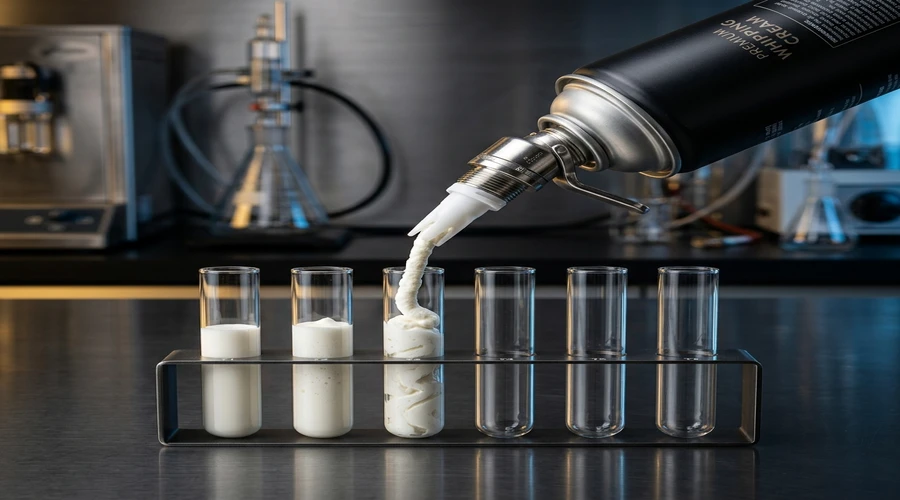
The filling process for food-grade aerosols requires a specialized manufacturing line that integrates sanitary liquid filling with high-pressure gas injection. Because N₂O and CO₂ are compressed gases, they cannot be filled as liquids at ambient temperatures. Instead, they must be injected under high pressure through the valve stem or under the valve cap before crimping, followed by mechanical agitation to dissolve the propellant.
The manufacturing facility must operate under strict hygienic zones, typically incorporating ISO-classified cleanrooms to prevent microbial introduction during the open-can liquid filling phase. The cream or beverage mix is pasteurized or sterilized using Ultra-High Temperature (UHT) processing, cooled, and filled into the sterile containers. Immediately following liquid filling, the valve cup is placed on the can and crimped. The propellant is then injected at pressures ranging from 8 to 12 bar. Because the gas must dissolve into the product matrix to build a reservoir of propellant, the cans are passed through a rotary gassing shaker, which vigorously agitates the cans for several seconds, forcing the gas into solution.
Aseptic filling lines represent the pinnacle of food aerosol technology, utilizing hydrogen peroxide sterilization for the containers and valves, and operating entirely within a sterile enclosure. This setup allows whipped cream to be stored at room temperature prior to opening, extending shelf life without chemical preservatives. To explore general aerosol packaging concepts, manufacturing guidelines, and standard structures, the European Aerosol Federation (FEA) offers technical resources that outline manufacturing line design and compliance protocols.
For a detailed overview of general aerosol engineering concepts, please consult our foundational guide on aerosol propellants and valves. Further reading on propellant formulations can be found in our technical articles on aerosol propellants explained, our comparative review of types of aerosol systems, and our safety guidelines on aerosol can safety.
Frequently Asked Questions
Why is nitrous oxide preferred over carbon dioxide for whipping cream?
Nitrous oxide is highly lipophilic, meaning it dissolves readily in the fat phase of cream under pressure without altering the taste. Upon dispensing, the sudden drop in pressure causes the dissolved gas to expand rapidly, whipping the fat matrix into a light, stable foam. Carbon dioxide, in contrast, is highly hydrophilic, dissolves in the water phase to form carbonic acid, and creates a sour taste and effervescence rather than a stable foam structure.
What safety hazards are associated with food-grade N2O aerosol cans?
Food-grade nitrous oxide aerosol cans operate under high pressure and present risk of bursting if exposed to heat exceeding standard limits, as compressed gases do not maintain a constant vapor pressure like liquefied gases. Safety hazards are mitigated by compliance with transport regulations, pressure testing of empty cans, and implementing temperature protection thresholds. Proper ventilation and handling equipment are mandatory on filling lines to prevent accidental gas inhalation.
How does Henry's Law govern the behavior of carbon dioxide in beverage aerosols?
Henry's Law states that at a constant temperature, the amount of a given gas dissolved in a given type and volume of liquid is directly proportional to the partial pressure of that gas in equilibrium with that liquid. In beverage aerosols, carbon dioxide is dissolved under high pressure in the aqueous matrix; once the actuator is pressed, the local partial pressure drops, causing the dissolved carbon dioxide to desorb from the liquid phase and form effervescent bubbles.
What sanitary requirements apply to food-grade aerosol valves?
Food-grade aerosol valves must utilize materials certified for food contact, such as FDA-compliant elastomers (silicone, Buna-N, or EPDM gaskets) and stainless steel springs. The valve architecture must prevent product entrapment to avoid microbial contamination. Sanitary designs dictate that the actuator nozzle is easily cleanable, self-draining, and free of dead zones where residue can spoil.
How is overrun controlled in commercial aerosol whipped cream?
Overrun, which represents the volume expansion percentage of whipped cream, is controlled by balancing the pressure of nitrous oxide, the lipid structure of the cream emulsion, and the design of the expansion chamber in the valve. A high-lipid content provides the necessary matrix to trap expanding gas bubbles. The nozzle geometry and actuator expansion chamber regulate the shearing force, ensuring consistent foam texture and stability without structural collapse.
What are the regulatory purity standards for food contact aerosol propellants?
Food contact aerosol propellants must comply with strict purity standards defined by global bodies, such as FDA Title 21 CFR and EFSA specifications (E942 for nitrous oxide, E290 for carbon dioxide). The gas must have a minimum purity of 99.0% or 99.9%, with strict limitations on contaminants such as carbon monoxide, nitrogen dioxide, moisture, and volatile organic compounds to ensure safety and prevent off-flavors.
Need Expert Aerosol Consulting?
Our team provides end-to-end aerosol technical consultancy — from formulation development and propellant selection to filling line setup, regulatory compliance, and market launch strategy.
Related Articles
- Aerosol Propellants Explained LPG vs DME vs HFC vs N₂ vs CO₂ propellants compared.
- Types of Aerosol Systems Complete technical overview of aerosol systems.
- Aerosol Manufacturing 101 The ultimate guide to commercial aerosol manufacturing.
- How Aerosol Cans Work Explore valve, pressure, and actuator physics.
- Aerosol Chemistry 101 Solvents, active ingredients, and surfactants.
- From Lab to Commercial Launch R&D scale-up to commercial aerosol production.
- Choosing a Product Consultant How to select the right technical expert.
- Aerosol Can Safety Guidelines NFPA storage and handling specifications.
Absar Khan
Founder & Lead Aerosol Consultant, Global Aerosols
Absar Khan is a senior aerosol industry consultant with deep expertise spanning aerosol formulation, propellant technology, valve engineering, filling line setup, and regulatory compliance across global markets. His work integrates aerosol chemistry, GMP manufacturing practices, safety and flammability assessment, quality systems, and regulatory strategy for markets including India, the EU, and the US. As Founder and Lead Consultant at Global Aerosols, Absar leads technical and engineering teams delivering end-to-end aerosol solutions — from initial formulation and lab trials through pilot-scale testing, commercial manufacturing setup, and full market launch.
Connect on LinkedIn →