Tilt Valve vs Vertical Valve Aerosols: Selection Criteria & Use Cases

Tilt valve vs vertical valve aerosol selection determines how a can's spray is actuated and, in many cases, the spray angle it can deliver. A vertical valve opens only when pressed straight down along the can's central axis, while a tilt valve opens when its actuator stem is tilted off-axis, allowing directional or angled spray without repositioning the can. This distinction matters for product developers because valve type is decided early in development — it constrains actuator design, gasket geometry, and manufacturing tooling — and choosing incorrectly can mean redesigning the actuator system late in the product development cycle.
Tilt Valve vs Vertical Valve: The Core Mechanism
Both valve types share the same basic purpose — sealing the can under pressure until actuated, then opening a controlled path for product and propellant to exit through the actuator — but they differ in the direction of mechanical force required to break that seal. A vertical valve's stem moves straight down into the valve body, compressing a spring and unseating a gasket to open a fixed orifice path. A tilt valve's stem is instead designed to pivot at an angle, so pressing the actuator sideways or at a designed angle unseats the internal seal, a mechanically more complex arrangement that gives actuator designers more flexibility in spray direction.
- Vertical valve: Actuates via straight downward stem movement along the can's central axis
- Tilt valve: Actuates via angled or pivoting stem movement, enabling off-axis spray direction
- Shared function: Both seal against propellant pressure until deliberately actuated
- Design impact: Valve type constrains compatible actuator geometry and manufacturing tooling
Understanding this mechanical distinction is foundational before diving into how each valve performs in practice — for a broader primer on valve and gasket fundamentals across aerosol systems, see our aerosol valve and gasket guide.
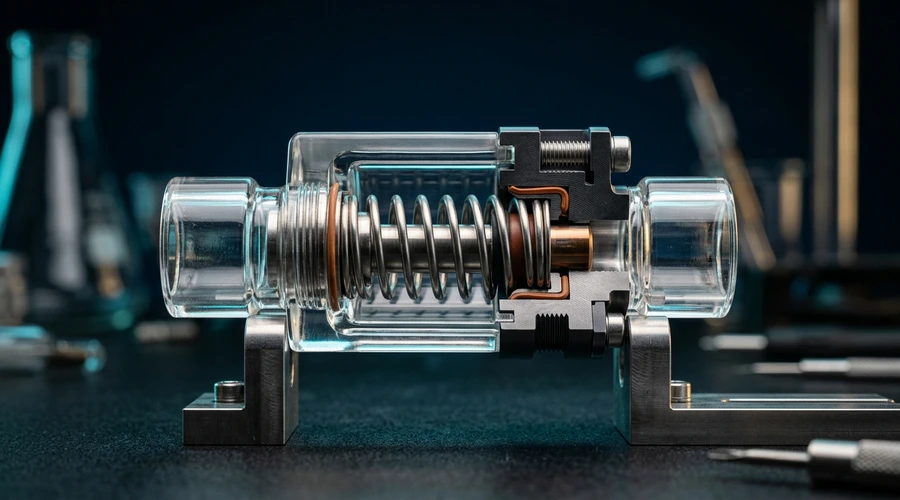
Cross-section view of a tilt valve mechanism, showing the internal spring and gasket geometry that permits off-axis actuation.
How Tilt Valves Work
A tilt valve's stem sits in a valve housing engineered to allow controlled pivoting rather than purely axial travel, so that pressing the actuator at an angle displaces the stem enough to unseat the internal gasket seal and open the flow path. This mechanism is what allows an actuator to be shaped and oriented for angled or directional spray without requiring the user to tip the entire can. Because the sealing geometry must accommodate off-axis movement while still maintaining a reliable pressure seal when at rest, tilt valves are inherently more complex to engineer and manufacture consistently than vertical valves.
How Vertical Valves Work
A vertical valve is the more mechanically straightforward of the two designs: the actuator stem travels straight down into the valve body when pressed, compressing the internal spring and unseating a simple gasket seal to open the orifice path directly beneath the point of pressure. Because the motion is purely axial, the sealing geometry is simpler to manufacture consistently, gasket wear patterns are more predictable, and vertical valves remain the default choice across the majority of aerosol product categories — household, industrial, and much of personal care.
Why Vertical Remains the Default
Vertical valves benefit from decades of established tooling, supplier familiarity, and manufacturing process control across the industry, which generally makes them lower-cost and lower-risk to qualify for a new product compared to a tilt valve system. Unless a product specifically requires the directional actuation benefit a tilt valve provides, the simpler vertical valve is usually the more defensible default engineering choice, a principle consistent with the broader actuator and valve selection logic covered in our Aerosol Actuators 101 guide.
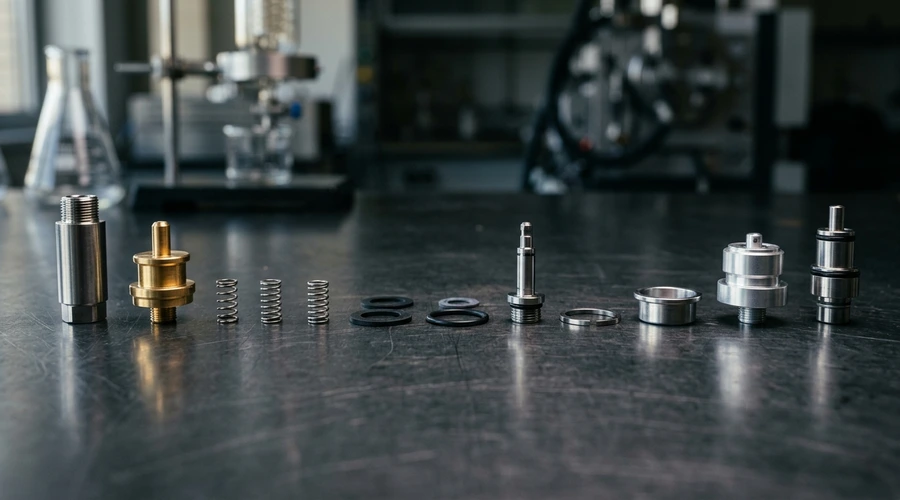
Spray test comparison illustrating how tilt valve actuation differs from standard vertical valve triggering during use.
Selection Criteria by Use Case
Choosing between a tilt valve and a vertical valve should be driven by the product's required spray direction, ergonomic use pattern, and category convention, decided early since it determines can, valve cup, and actuator tooling that are expensive to change later. Personal care products such as certain antiperspirant and body spray formats sometimes use tilt valves specifically to support angled underarm or directional application without requiring the user to tilt the can itself, while most industrial, household, and general personal care aerosols default to vertical valves for their manufacturing simplicity and reliability.
| Factor | Vertical Valve | Tilt Valve |
|---|---|---|
| Actuation direction | Straight down, axial | Angled or pivoting, off-axis |
| Mechanical complexity | Lower | Higher |
| Typical use case | General industrial, household, most personal care | Directional spray products, select personal care formats |
| Manufacturing tooling familiarity | Widely established across suppliers | More specialized, fewer qualified suppliers |
| Sealing tolerance sensitivity | Lower | Higher — requires tighter QC |
Beyond ergonomics, valve type selection should also be validated against the propellant and formulation viscosity in use, since valve orifice and spring characteristics interact with product flow behavior — a consideration explored more broadly in our overview of aerosol propellant and valve systems.
Gasket & Sealing Considerations
Gasket material selection for both valve types is governed primarily by chemical compatibility with the propellant and formulation — EPDM, Buna-N, and other elastomer families are selected based on resistance to swelling or degradation from hydrocarbon propellants, DME, or aqueous formulations, regardless of whether the valve is tilt or vertical. Propellant vapor pressure and chemical property data from sources such as the PubChem chemical database informs which elastomer families are suitable for a given propellant system. What differs between the two valve types is the gasket's physical geometry and the sealing surface design required to accommodate each valve's actuation mechanics, since a tilt valve gasket must maintain a reliable seal despite off-axis stem movement.
Manufacturing & Compatibility Factors
Because valve type affects can, valve cup, and actuator tooling, manufacturers must confirm supplier capability and component compatibility early in development rather than treating valve selection as a late-stage decision. Tilt valves in particular require verifying that the chosen actuator, valve cup crimp specification, and gasket geometry are all qualified together as a matched system, since mismatched tolerances between suppliers are a more common source of field failure in tilt valve products than in the simpler vertical valve configuration. Finished valve assemblies of either type are typically validated against recognized aerosol testing methodology such as ASTM aerosol product standards, which cover sampling and performance testing relevant to valve function and spray delivery.
Products intended for inverted spraying — such as certain foam or coating products designed to dispense upside down — require a dedicated inverted-use valve and dip tube design rather than a standard vertical or tilt valve used upside down, since dip tube positioning assumes a specific can orientation during use. How valve and dip tube design interact more broadly is covered in our guide on how aerosol cans work, which explains the full propellant, valve, and spray dynamics chain from can to actuator.
Teams switching an existing product from vertical to tilt valve format, or vice versa, should treat the change as a full requalification rather than a drop-in component swap, since spray performance, dose consistency, and leak rate can all shift even when the can and propellant system remain otherwise unchanged. Building valve type decisions into the formal development gate process — alongside propellant selection and actuator design — helps avoid late-stage rework, a workflow discipline covered more broadly in our Aerosol Manufacturing 101 guide.
Frequently Asked Questions
What is the difference between a tilt valve and a vertical valve aerosol?
Why would a product use a tilt valve instead of a vertical valve?
Can a vertical valve be used in an inverted aerosol can?
Does valve type affect spray pattern or only actuation direction?
Are tilt valves more prone to leakage than vertical valves?
How is valve type selected during aerosol product development?
Do tilt valves and vertical valves use different gasket materials?
Which industries most commonly use tilt valve aerosols?
Need Expert Aerosol Consulting?
Our team provides end-to-end aerosol technical consultancy — from formulation development and propellant selection to filling line setup, regulatory compliance, and market launch strategy.
Get a Free Consultation