Propellant Blend Formulation: Vapor Pressure Control Using Binary LPG Mixtures
Guide Contents
- 1. Thermodynamic Principles of Vapor Pressure in LPG Blends
- 2. Chemical Composition and Physical Properties of Binary LPG Propellants
- 3. Mathematical Formulation: Raoult's Law and Dalton's Law Calculations
- 4. Vapor Pressure Control and Phase Behavior in Aerosol Cans
- 5. Industrial Propellant Blending and Safety Engineering Standards
- 6. Quality Control, Vapor Pressure Measurement and Leak Testing Protocols
- 7. Frequently Asked Questions
Propellant blend formulation is the technical practice of mixing liquefied hydrocarbon gases—predominantly propane, n-butane, and isobutane—to engineer a precise vapor pressure inside an aerosol container. This formulation regulates spray atomization, container pressure consistency, and discharge characteristics throughout the product's lifetime, ensuring that the active ingredients are delivered in a uniform pattern. Understanding how these gases blend and exert pressure is critical for engineers because it directly affects package safety, formulation stability, and spray quality. By adjusting the ratios of high-pressure and low-pressure components, formulators can design customized delivery profiles for personal care, household, paint, and industrial specialty products. For a detailed review of alternative propellant choices like DME and fluorocarbons, refer to our guide on aerosol propellants explained.
Thermodynamic Principles of Vapor Pressure in LPG Blends
The thermodynamic behavior of a liquefied petroleum gas (LPG) propellant inside an aerosol can is governed by liquid-vapor phase equilibrium. Within the closed system of a metal container, the liquefied gas exists in a state of dynamic equilibrium where the rate of evaporation of molecules from the liquid surface equals the rate of condensation of vapor molecules back into the liquid phase. The pressure exerted by the gas phase under these equilibrium conditions is defined as the vapor pressure, which is solely a function of temperature and chemical composition. As long as some liquid propellant remains in the container, this pressure will remain constant at a given temperature, regardless of the volume of liquid present. This unique property of liquefied gas propellants differentiates them from compressed gases (such as nitrogen or carbon dioxide), where pressure drops linearly as the product is discharged. For a detailed comparison of compressed and liquefied systems, check out our guide on propellant influence on aerosol performance.
- Dynamic Equilibrium: Evaporation and condensation occur at equal rates, maintaining constant headspace pressure.
- Temperature Dependence: Vapor pressure increases exponentially with temperature, following the Clausius-Clapeyron relation.
- Independent of Volume: Liquid phase depletion does not drop pressure, ensuring consistent delivery until exhaustion.
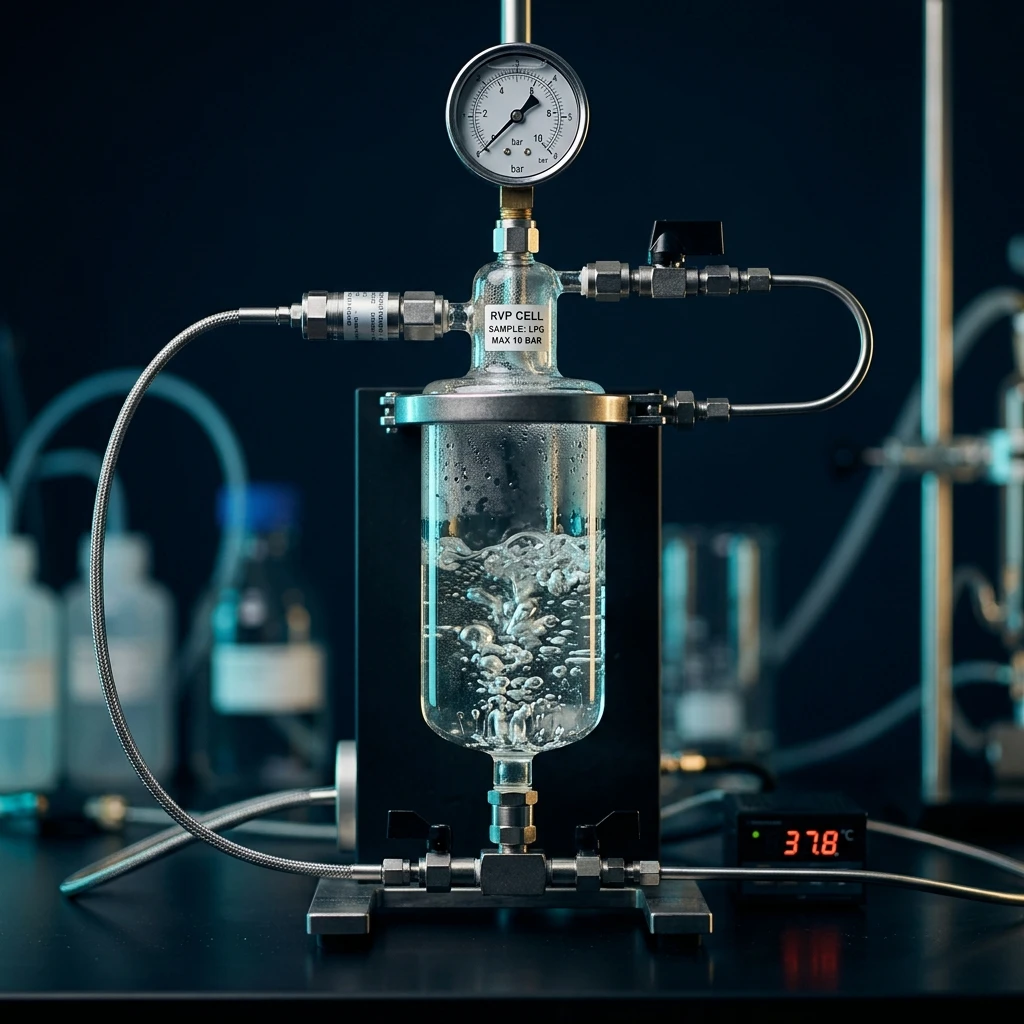
Figure 1: Laboratory vapor pressure measurement apparatus demonstrating phase equilibrium and pressure control of binary LPG propellant mixtures.
Chemical Composition and Physical Properties of Binary LPG Propellants
The primary hydrocarbon propellants used in aerosol packaging are propane, n-butane, and isobutane. Each of these components possesses distinct physical properties, such as molecular weight, boiling point, density, and pure vapor pressure, which are documented in technical databases like PubChem (NIH). Propane, with a boiling point of -42.1°C, is a high-pressure agent that provides the primary force in formulations requiring high atomization energy. Conversely, n-butane has a boiling point of -0.5°C and exerts a very low vapor pressure, making it useful as a diluent and pressure reducer. Isobutane, an isomer of n-butane, has a boiling point of -11.7°C and provides an intermediate pressure, serving as the workhorse propellant in many cosmetic and personal care aerosols. The selection of these materials is based on their physical compatibility, cost, environmental profile, and chemical stability in aqueous or solvent-based concentrates.
| Propellant Component | Chemical Formula | Boiling Point (°C) | Vapor Pressure at 21°C (psig) | Liquid Density at 21°C (g/mL) |
|---|---|---|---|---|
| Propane | C3H8 | -42.1 | 108.0 | 0.500 |
| Isobutane | C4H10 (branched) | -11.7 | 31.0 | 0.557 |
| n-Butane | C4H10 (linear) | -0.5 | 17.0 | 0.579 |
Mathematical Formulation: Raoult's Law and Dalton's Law Calculations
Predicting the final vapor pressure of a propellant blend formulation requires applying fundamental thermodynamic laws to the mixture. In an ideal solution, the partial vapor pressure of each component (Pi) is calculated using Raoult's Law, which states that Pi = Xi · Pi°, where Xi is the mole fraction of the component in the liquid phase and Pi° is the vapor pressure of the pure component at that temperature. According to Dalton's Law of partial pressures, the total vapor pressure of the mixture (Ptotal) is the sum of the partial pressures of all individual components: Ptotal = P1 + P2 + ... + Pn. Formulators use molecular weights and liquid densities to convert weight percentages into mole fractions, allowing them to calculate the exact pressure curve of binary and ternary mixtures. Thermodynamic data for these calculations can be cross-referenced with the NIST WebBook database.
- Mole Fraction (Xi): Calculated by dividing the moles of a component by the total moles of all components in the liquid phase.
- Raoult's Law (Pi = Xi · Pi°): Assumes ideal chemical behavior, which is a highly accurate approximation for non-polar liquefied hydrocarbons.
- Dalton's Law (Ptotal = Σ Pi): Adds the calculated partial pressures to predict the overall container headspace pressure.
Vapor Pressure Control and Phase Behavior in Aerosol Cans
In a packaged aerosol product, the propellant blend is not isolated; it is contact-blended with the liquid concentrate, which often contains solvents, surfactants, active ingredients, and water. When the propellant dissolves in the concentrate, it forms a homogeneous single-phase solution or a heterogeneous emulsion, modifying the overall vapor pressure of the system. For instance, polar solvents like ethanol exhibit high affinity for hydrocarbon propellants, forming a solution that lowers the propellant's effective vapor pressure below the calculated ideal value. In contrast, in water-based systems where hydrocarbons are insoluble, the propellant forms a separate liquid layer floating on top of the aqueous phase, and the headspace pressure remains close to the pure propellant pressure. Understanding these phase interactions is essential for maintaining spray quality and avoiding valve clogging. For details on container materials and preventing leaks in such systems, read our article on aerosol can safety explained.
Key Insight
Solvent choice directly dictates the active vapor pressure in homogeneous aerosol systems. High-affinity organic solvents lower vapor pressure through molecular solvation, whereas immiscible aqueous concentrates allow the propellant to exert its full vapor pressure independently.
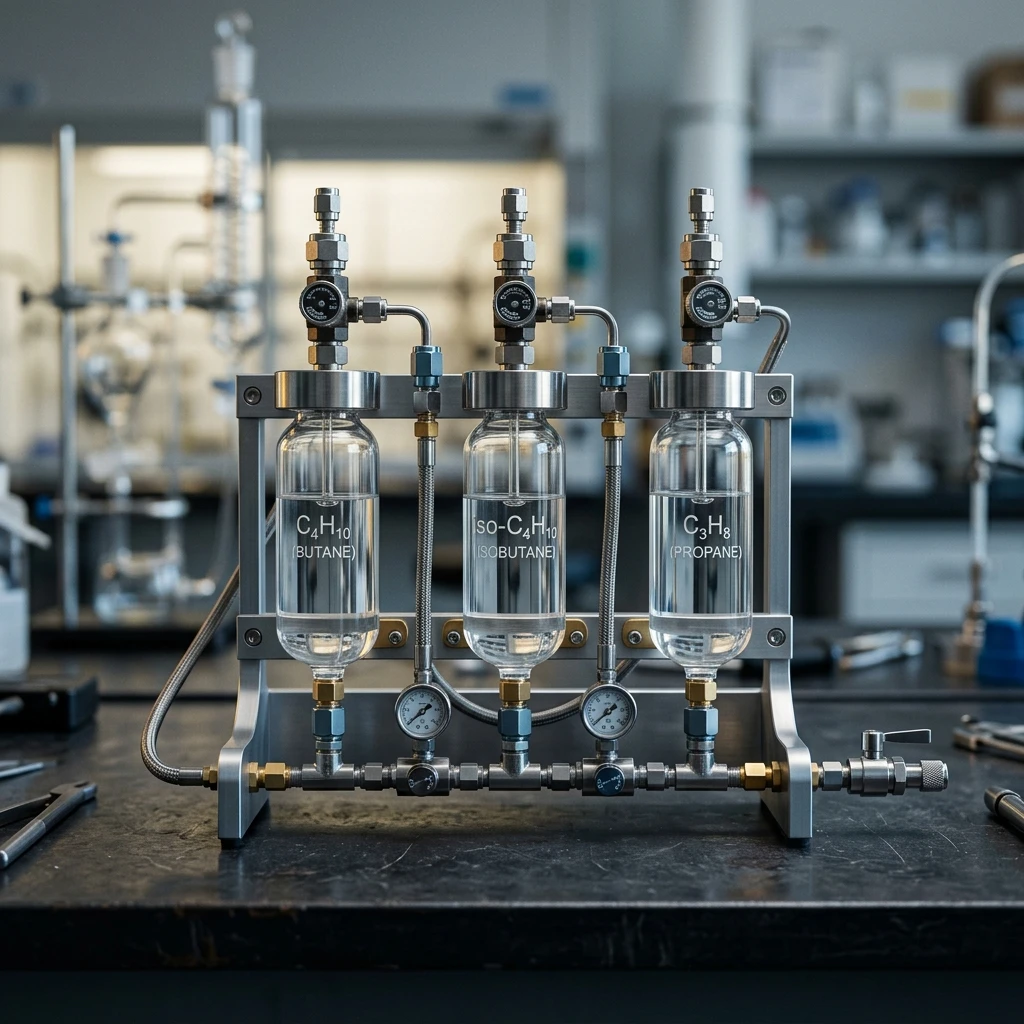
Figure 2: Three standard industrial propellant gas cylinders (butane, isobutane, propane) configured with a blending manifold for precise ratio control.
Propellant Blend Formulation and Industrial Safety Standards
Because liquefied hydrocarbon propellants are highly flammable gases, industrial blending, storage, and filling processes are subject to rigorous safety engineering standards. Facilities handling these propellants must comply with safety codes such as the NFPA 58 (Liquefied Petroleum Gas Code) and NFPA 30B (Code for the Manufacture and Storage of Aerosol Products). Equipment must be designed to withstand high operational pressures and prevent gas leaks that could form explosive mixtures in the air. Blending is typically carried out inline using mass flow meters or in pressurized vessels gunder nitrogen blankets to prevent oxygen contamination. All electrical hardware in the blending and gassing zones must be rated Class I, Division 1, Group D, utilizing explosion-proof enclosures or intrinsic safety barriers. In addition, high-capacity ventilation systems and continuous gas monitoring arrays are mandatory to automatically shut down gassing operations if gas concentration exceeds 20% of the Lower Explosive Limit (LEL).
Rule of Thumb
Always maintain continuous static grounding loops across all piping, blending vessels, and aerosol gassing heads. Hydrocarbon liquid flow generates static charges that can trigger ignition if discharge paths are not continuously grounded.
Quality Control, Vapor Pressure Measurement and Leak Testing Protocols
Quality control in propellant blending ensures that the delivered raw materials meet the precise chemical composition and vapor pressure specifications. Aerosol manufacturers perform gas chromatography (GC) on incoming propellant shipments to verify the hydrocarbons' relative ratios and detect impurities, such as heavy oil residues or excessive moisture, which can damage valve gaskets. Once the aerosol can is filled, closed, and gassed, it undergoes continuous inline quality checks, including weight checks to confirm the correct propellant charge and water bath testing. According to dangerous goods transport regulations published by the UNECE (United Nations Economic Commission for Europe), every filled aerosol container must be tested in a hot water bath at 50°C (or an approved alternative method) to verify structural integrity and ensure it does not leak or burst under thermal stress.
- Gas Chromatography: Quantifies butane, propane, and isobutane mole percentages to ensure raw material consistency.
- Hot Water Bath Testing: Heats cans to 50°C to increase internal pressure, verifying crimp integrity and detecting leaks.
- Vapor Pressure Gauging: Measures headspace pressure at standard reference temperatures to catch blending ratio errors.
Frequently Asked Questions
What is a propellant blend formulation?
How does Raoult's Law apply to binary LPG propellant mixtures?
What is the difference between propane, n-butane, and isobutane as propellants?
Why is headspace volume optimization critical in aerosol packaging?
What are the primary safety standards for industrial LPG propellant blending?
How does liquid phase depletion affect aerosol spray pressure over time?
Need Expert Aerosol Consulting?
Our team provides end-to-end aerosol technical consultancy — from formulation development and propellant selection to filling line setup, regulatory compliance, and market launch strategy.
Get a Free Consultation